Business
Meeting Minutes Template: Free AI-Driven 2026 Productivity Tool
Free Meeting Minutes Template (2026): download and customize with AI to improve compliance, document decisions, and support legal standards with real-world examples.
Meetings are where major decisions happen but without a proper record, those decisions may never hold up. A missing signature, forgotten task, or undocumented vote can lead to disputes, delays, or legal exposure. For organizations serious about accountability, a professionally formatted Meeting Minutes Template is not just helpful it’s essential. It provides an official, organized way to capture discussions, approvals, and responsibilities that stand up to scrutiny.
You Might Also Like:
What Is a Meeting Minutes Template?
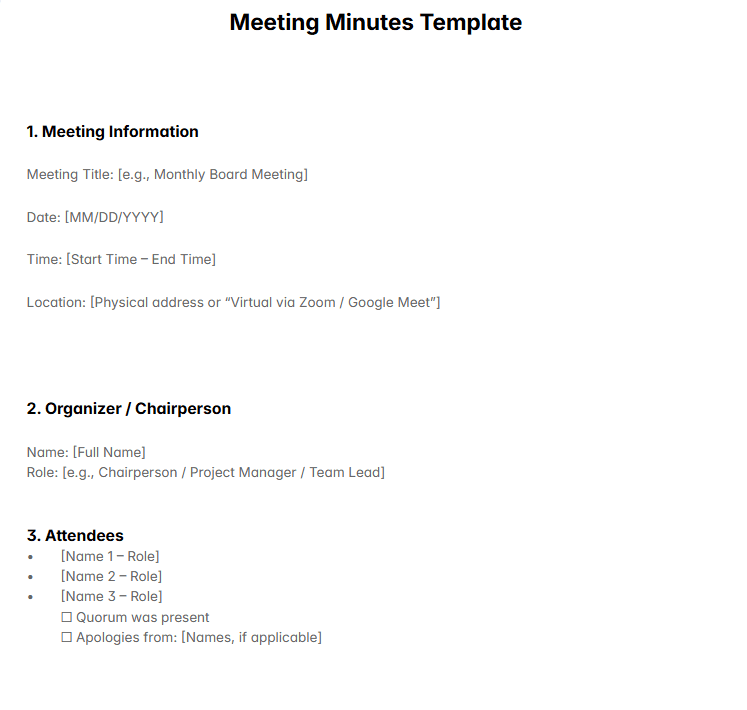
A meeting minutes template is a structured format used to record key meeting details, including the date, time, attendees, agenda items, decisions made, assigned tasks with deadlines, and final approval. It ensures clear, consistent, and accountable documentation.
Meeting Minutes Template represents one of the many templates available within the Business Document category featured on our website.
For a more comprehensive understanding of Business Document — including their legal nuances, variations across jurisdictions, and practical applications — we invite you to explore our in-depth overview article dedicated to this document category.
Who Benefits Most from a Meeting Minutes Template?
Executive teams and corporate boards rely on detailed minutes to demonstrate fiduciary compliance, document legal votes, and defend governance decisions during audits or disputes. Accurate records reinforce their accountability and provide transparency to stakeholders.
Project managers and cross‑functional leaders benefit from structured minutes that track decisions, follow up on assigned tasks, and keep initiatives on schedule. This avoids miscommunication, ensures execution, and speeds up project completion.
HR professionals and compliance officers use official minutes to document policy changes, staff disputes, and formal warnings. Properly signed minutes can protect organizations during investigations, regulatory reviews, or litigation.
Freelancers and consultants operating in client-facing or advisory roles gain credibility when they deliver professional minutes. These documents record client decisions and tasks, eliminating ambiguity and preventing scope drift.
Nonprofit directors and charity committees depend on well-documented meetings for transparency with funders, regulators, and the public. Minutes validate how funds are managed and how decisions impact program delivery.
Remote and hybrid teams face coordination challenges across geographies. A shared template ensures clear documentation of roles, outcomes, and timelines — helping distributed teams stay synchronized and accountable post-meeting.
Event organizers and creative teams use a template to capture venue approvals, budget allocations, and production deadlines. Minutes serve as a reliable record when booking vendors, confirming schedules, or resolving issues during fast-paced planning cycles.
Why there is growing Importance of Meeting Minutes in 2026
In 2026, rising legal scrutiny and remote collaboration demand clear, documented accountability. Meeting minutes ensure decisions are recorded, responsibilities are tracked, and compliance is maintained.
Key Statistics & Importance
Unproductive meetings are a massive drain: Ineffective meetings cost U.S. companies approximately $375 billion per year and can waste up to $25,000 per employee annually, with large orgs losing over $100 million a year.
Meetings Eat Time, But Minutes Protect It Templates make meetings shorter, more focused, and action oriented. Over 22% of professionals spend half their week in meetings, yet only 65% document them properly leading to lost time and accountability.
Structured formats drive results: Structured meeting minutes templates lead to 67% more action-item completion, 23% shorter meetings, 34% faster decision implementation, and 45% higher team satisfaction.
Faster decisions, greater accountability.
Structured minutes boost follow through on action items and improve team coordination.
Legal Importance and Context
Meeting minutes serve as legally recognized documents that can protect or implicate an organization and its leadership. Their importance includes:
Legal Evidence: Minutes are admissible in court and serve as official records during audits, regulatory reviews, or legal disputes.
Fiduciary Duty Compliance: Board members and executives are legally obligated to act in the organization’s best interest; clear minutes demonstrate this duty has been fulfilled.
Regulatory Compliance: Many jurisdictions and agencies (e.g., IRS, ASIC, APRA, ATO, Charity Commissions) require meeting minutes to be retained, signed, and accessible for inspection.
UK law (Companies Act 2006) requires companies to keep detailed meeting records including decisions and votes for at least 10 years, making them accessible to regulators, auditors, and shareholders.
Governance Transparency: Well-kept minutes protect against allegations of misconduct, mismanagement, or lack of oversight.
Director Liability Protection: Accurate records can defend directors against claims of negligence or breach of duty.
Real World Example
Asana’s 15‑minute meeting trial: Employees eliminated non-essential recurring meetings and cut 30‑minute meetings to 15 minutes. Results in 11 hours saved per person each month nearly 3.5 weeks annually.
When Should You Use a Meeting Minutes Template
Meeting minutes templates are useful in various scenarios:
Project kick-off meetings, where deliverables and deadlines are defined
Client approval sessions, to track feedback and next steps
Board or committee meetings, ensuring legal compliance and formal sign-off
By using a template in these, you standardize your process keeping everyone accountable, aligned, and protected.
Key Sections of a Meeting Minutes Template and How to Fill Them Out
Use these sections to ensure clarity and compliance:
Meeting Info Include date, time, place, type of meeting (e.g., board, client briefing).
Attendees & Apologies Note participants present and those absent.
Agenda Items List topics, brief summaries, and decision outcomes.
Actions & Ownership Specify tasks, who’s responsible, and deadlines.
Votes/Motions Record motions, voting outcome (e.g., “Motion passed unanimously”).
Authorization & Signature Final signer (e.g., chairperson or secretary) and date. This block confirms the meeting's legally compliant closure.
Practical Tips for Using a Meeting Minutes Template Effectively
Keep digital archives in cloud or folder for easy retrieval
Double‑check all information before distribution to avoid errors
Clearly explain the minutes process and deadlines to your team or clients
These simple habits ensure your minutes become reliable, searchable, and legally sound.
⚖️ Legal Tip: The Critical Elements That Protect Organizations in Meeting Minutes
According to the American Bar Association's Corporate Governance Committee, three essential protective elements are frequently omitted from meeting minutes that later lead to organizational liability:
Conflict of Interest Documentation: Most minutes fail to properly document when directors or officers disclose conflicts. The ABA recommends specific language like: "Prior to discussion, Director Smith disclosed a potential conflict of interest regarding the vendor selection due to her spouse's employment at Vendor X. Director Smith abstained from the discussion and vote on this matter. The remaining directors determined the conflict was not material to the decision and proceeded with deliberation." This documentation creates a clear record of proper governance procedures.
Basis for Decision Language: Industry data shows that 72% of board liability cases involve questioning the rationale behind decisions. Your minutes should clearly state: "After thorough discussion of the alternatives presented in the board packet (attached as Exhibit A), including consideration of financial projections, market analysis, and potential risks, the Board determined that Option 2 represented the most prudent course of action based on the following factors: [list 2-3 key factors]. The Board noted the potential downside risks but concluded they were outweighed by the strategic benefits." This language demonstrates the board's fulfillment of its duty of care.
Executive Session Notation: The National Association of Corporate Directors reports that 58% of minutes fail to properly document executive sessions. Include specific language about: "The Board met in executive session from 2:15pm to 2:45pm. During this session, no formal actions were taken, but the Board discussed matters related to CEO performance evaluation. The CEO was not present during this portion of the meeting." This documentation helps establish proper oversight and governance practices.
The Corporate Secretaries and Governance Professionals Association reports that disputes involving these missing elements account for approximately 67% of all governance-related litigation.
📌 Real‑World Case: $115K Excess Compensation Penalty Triggered by Missing Meeting Records
In 2014, a charitable organization paid its president and secretary (a husband-and-wife leadership team) over $115,000 in unrecorded compensation. Despite issuing W‑2 forms and payments totaling $115,000, board meeting minutes made no mention of approving these payments, nor did they document any compensation intent or discussion. The minutes lacked disclosure of conflict-of-interest or comparative data justifying the pay level. When the IRS audited, it determined the payments constituted an excess benefit transaction under Section 4958 of the Internal Revenue Code.
The IRS imposed a first‑tier excise tax of $28,750 (25% of the excess amount) on the disqualified individual and a second‑tier tax of $230,000 (200%) when the compensation was not timely corrected. Additionally, the organization had its tax‑exempt status retroactively revoked, exposing both individuals and the charity to further financial and reputational consequences.
Source: Church & Clergy Tax Guide – Charity Founder’s Wife Heavily Penalized for Excess Benefit
Key Takeaway: Missing or inadequate meeting minutes can turn pay policies into tax penalties. Without documenting the board’s approval process, comparability research, and conflict‑of‑interest disclosures, nonprofit leadership lost the rebuttable presumption of reasonable compensation. Well‑structured, signed minutes would have satisfied safe‑harbor standards and prevented excise tax liability or loss of tax‑exempt status.
🔑 Additional Insight: Industry-Specific Meeting Minutes Considerations
Modern meeting minutes should include industry-specific sections that address unique regulatory and liability concerns:
Industry | Key Minutes Elements | Special Considerations | Risk Factors |
|---|---|---|---|
Healthcare | Patient privacy compliance | Clinical decision rationale | Credentialing documentation |
Financial Services | Regulatory reporting approvals | Risk assessment documentation | Customer impact analysis |
Technology | Data security reviews | Intellectual property protection | Competitive analysis confidentiality |
Nonprofit | Donor restriction compliance | Public benefit documentation | Conflict of interest management |
Education | Student privacy considerations | Academic freedom discussions | Accommodation decision process |
According to the Society of Corporate Governance's 2024 Minutes Best Practices Report, 83% of well-governed organizations now use industry-specific minutes formats rather than generic templates. Your meeting minutes should reflect your specific industry with tailored sections addressing sector-standard compliance and risk management elements.
Expert Insights
“Board meeting minutes establish the record of matters considered and actions taken by the board. They are evidence of compliance with legal and regulatory requirements and of directors’ discharging their fiduciary duties.”
— Kathy Jaffari, Business Law Today
“Clear, well-prepared minutes offer numerous benefits to a company and its directors and can help shield organizations from a host of pitfalls. Writing good minutes is like flossing; nobody likes to do it, but it is essential.”
— The Private Company Director
How AI Lawyer Creates Your Document (Step-by-Step)
At AI Lawyer, we believe that drafting legal documents shouldn’t feel like decoding a foreign language. Whether you’re a business owner, landlord, freelancer, or someone navigating a personal matter — you should be able to create a legally sound document without needing a law degree.
That’s why we built a document experience that works like a conversation, not a form. Here’s exactly how it works:
1. You Tell AI Lawyer What You Need
It starts with a simple question:
“What type of document do you want to create?”
You choose from our list of professional templates — whether it’s a rental agreement, contractor form, invoice, publishing contract, or anything else — and AI Lawyer immediately pulls up the structure designed specifically for that use case.
Behind the scenes, the system references U.S. legal standards and best practices to make sure you’re starting from the right foundation.
2. We Highlight the Key Sections
Instead of throwing the whole document at you, AI Lawyer breaks it down.
Each key component — like payment terms, deadlines, responsibilities, clauses — is briefly explained in human language so you know what it means before you fill it out.
It’s like having a lawyer on your shoulder saying,
“Here’s what this section covers, and why it matters.”
3. You Answer Simple, Targeted Questions
AI Lawyer asks you step-by-step questions — like:
Who’s involved?
What are the key dates or timelines?
What are the terms (payments, conditions, obligations)?
Do you need special clauses like confidentiality, termination, or jurisdiction?
Each question is directly linked to a block in the final document — so your answers go exactly where they belong.
4. The Document Builds Itself As You Go
On the right side of your screen, the full document builds in real time.
Every time you answer a question, a corresponding section is added — with legally sound wording, smart defaults, and editable fields.
You’re not just answering a form — you’re watching your document take shape.
This phased process helps:
Reduce overwhelm
Catch errors early
Ensure nothing is forgotten
5. You Edit and Customize Freely
Once all the inputs are in, the full document is unlocked for editing.
You can:
Rewrite any clause
Change formatting
Add or remove sections
Rephrase terms in plain English (or more formal legal tone)
The editor works like a Google Doc — intuitive, responsive, and flexible.
6. Your Final Document Is Yours to Keep
Download in PDF, DOCX, or copy to clipboard.
You can print it, email it, or send it for signature — and revisit your answers anytime to generate updated versions.
Why This Workflow Matters
Most template tools give you a blank form.
We give you a process — one that mirrors how a real attorney would walk you through the creation of a document:
Context → Input → Assembly → Review → Delivery
It’s not magic. It’s just a smarter way to get legal work done — without getting lost in the jargon.
FAQs
Q: Do I need signatures on meeting minutes?
A: Yes. Legal and governance best practices require that minutes be reviewed and signed — typically by the meeting chair or appointed secretary — to finalize the record. Unapproved minutes may be challenged or deemed invalid in audits or disputes.
Q: How soon should minutes be shared?
A: Ideally within 5–7 business days. Distributing minutes promptly ensures participants can review, correct, or clarify details while memory is fresh and before the next meeting.
Q: Should I transcribe full discussions?
A: No. Minutes should focus on key decisions, votes, and action items. Avoid verbatim transcripts unless required by regulation — summary style is more effective and legally appropriate.
Q: Can meeting minutes be used in court?
A: Yes. Meeting minutes are admissible as legal evidence and often referenced in shareholder disputes, compliance audits, and contract enforcement cases. They demonstrate what was decided and who approved it.
Q: Are digital minutes legally valid?
A: Yes, provided they’re securely stored, properly signed (physical or digital), and consistent with your organization's bylaws or board resolutions regarding electronic documentation.
Q: Who should take meeting minutes?
A: Typically, the board secretary or designated recorder. However, in small teams or informal settings, a rotating or assigned member can take minutes as long as they follow a formal template and get sign-off.
Final thoughts
Harnessing a structured, legally vetted meeting minutes template saves time, minimizes mistakes, and streamlines accountability. For business organizer, freelancer or board secretary, our free and AI-customizable template ensures your meetings are clear, compliant, and actionable every time. Download it now and make every meeting count.
Sources and References
Legal and governance information in this guide references the U.S. Internal Revenue Service (IRS), American Bar Association Corporate Governance Committee, and the National Association of Corporate Directors (NACD).
Corporate-recordkeeping standards derive from the Companies Act 2006 (UK), U.S. Securities and Exchange Commission (SEC), and nonprofit guidance from the Internal Revenue Code §4958.
Best practices on meeting documentation and fiduciary compliance reference the Society for Corporate Governance, Private Company Director Magazine, and the American Institute of CPAs (AICPA).
For record retention and data protection standards, see U.S. National Archives Guidance and GDPR Article 30.
You Might Also Like: