Business
AI Lawyer for Car Accident Legal Help: Claims, Steps & Evidence
Involved in a car accident in 2026? Discover how AI Lawyer helps manage claims, fault analysis, and legal paperwork seamlessly.
A car accident rarely ends when the vehicles leave the scene. What may seem like a single incident can quickly turn into a series of follow-up steps — insurance calls, damage records, medical notes, repair estimates, and ongoing questions about what happened and when.
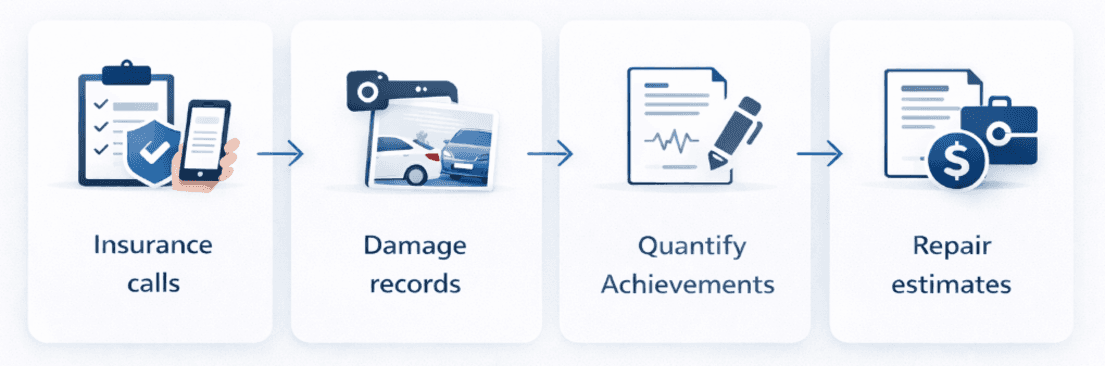
For many people, the hardest part comes after the crash itself, when the case shifts from the scene to paperwork, timelines, and supporting records. Even a relatively minor accident can become difficult to manage once those details start to accumulate.
You Might Also Like:
What to do in the first minutes after a car accident
Start with safety. Check whether anyone is hurt and call 911 if needed. If the vehicles can be moved safely, get them out of traffic. Then shift into record mode: exchange names, contact details, license plate numbers, registration details, and insurance information. If there are witnesses nearby, get their names and phone numbers before they leave. III also recommends noting the location, time of day, and weather conditions, and using your phone to record both driver information and crash details.
Take clear photos of the vehicles, visible damage, the wider scene, and anything else that helps show how the crash happened. If police respond, ask how to get the report later. NAIC says to call the number on your proof-of-insurance card as soon as possible to open the claim, and III advises asking what forms or documents the insurer will need to support it.
Which documents matter most after a car accident
The first key document is the accident or police report, if one exists. It helps fix the basic facts: time, place, parties involved, and the initial description of the crash. The second is visual evidence — photos of the vehicles, damage, road conditions, and the wider scene. These materials often show details that people later describe differently.
Then comes the claim file: insurance information, claim number, emails, letters, and messages exchanged after the accident. This creates a record of how the claim developed over time. Repair estimates also matter because they turn visible damage into a measurable loss. If there was any injury, medical records and bills become essential because they connect the accident to treatment, symptoms, and cost.
In short: a strong accident file usually starts with five key records — the report, photos, claim records, repair estimates, and medical documents.
How AI Lawyer helps turn accident details into a usable legal draft
The hardest part of preparing car accident documentation is usually not the writing. It is turning scattered details into a version that is clear, structured, and usable. Most people do not have one neat file with everything inside. They often have photos, claim numbers, repair estimates, notes, and messages stored across different places.
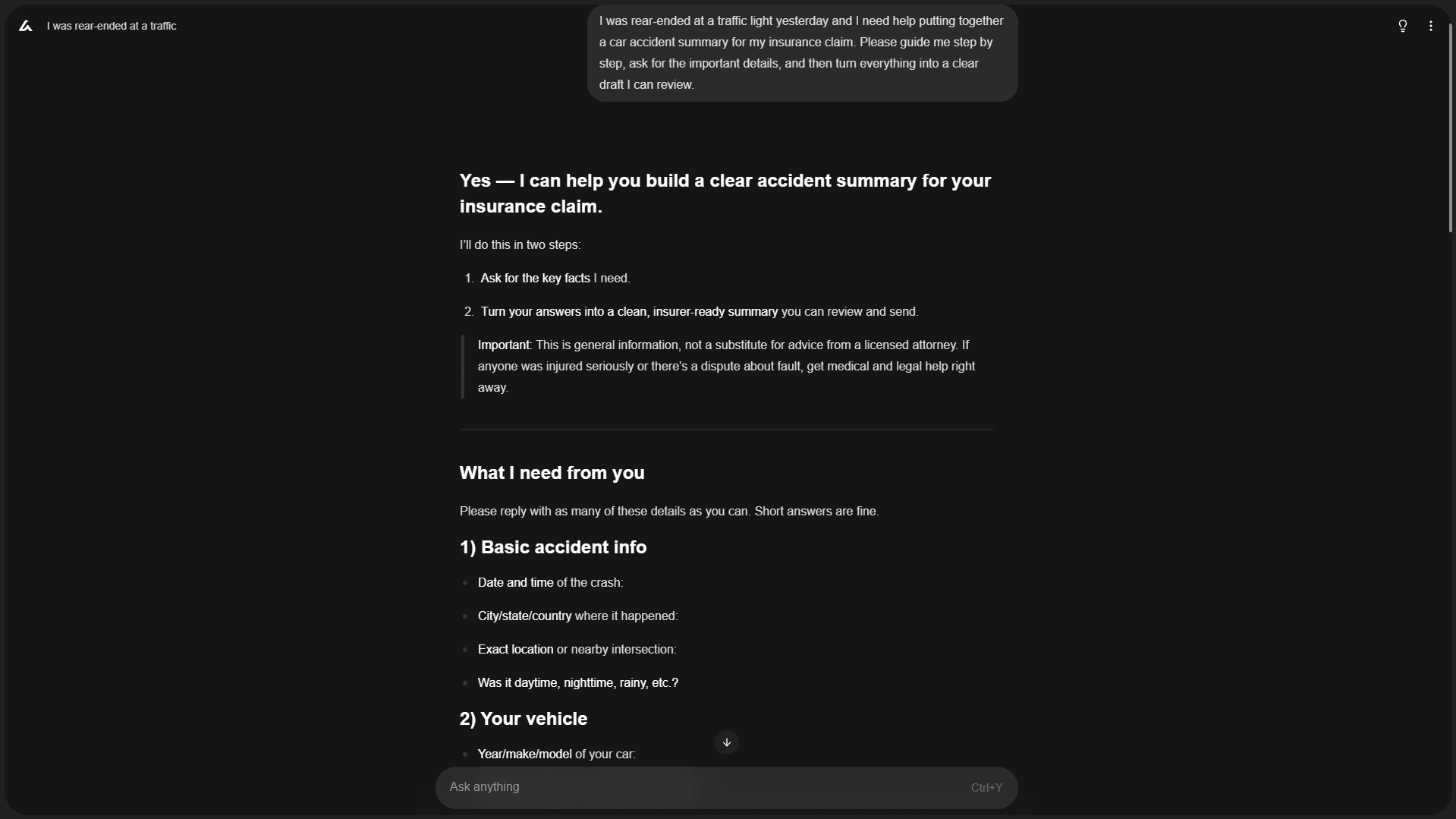
This is where AI Lawyer becomes practical. Instead of asking the user to start with a blank page, it guides the process step by step. The user adds the core facts of the accident, the parties involved, insurance details, damage, injuries, and any supporting records. As those details come in, the draft starts taking shape around the actual case instead of around a generic template.
That makes the result clearer and more practical. A document built from structured inputs is also easier to correct and adapt for the next step, whether the user needs an accident summary, a claim-related draft, or a record for legal review.
A simple example: instead of typing one vague prompt like “write a car accident letter,” the user fills in the real facts of the case. The output is then based on what actually happened, not on guesswork.
What matters most here: AI Lawyer is most useful when it turns raw accident details into a draft that is organized, readable, and easy to review.
How AI can help you communicate more clearly with the insurer
After a car accident, one of the hardest parts is not only collecting documents, but explaining the case clearly to the insurer.
This is where AI Lawyer can be especially useful. It can help turn scattered claim details into clearer communication — whether the user needs to prepare an email to the adjuster, respond to a request for more information, or organize the facts before replying. Instead of starting from scratch each time, the user works from a more structured summary of the case.
That also matters when the insurer pushes back. If an adjuster asks follow-up questions, challenges part of the timeline, or makes an early settlement offer, AI Lawyer can help the user prepare a cleaner response based on the information already collected. The goal is not to replace legal judgment, but to make communication more organized and easier to handle.
What happens after you report the accident and start a claim
Once a car accident claim is opened, the case usually moves from stress to paperwork. At this stage, the insurer starts reviewing the basic facts, checking policy details, and asking for records that support the claim. What matters now is not retelling the accident again and again, but keeping the case consistent as more information is requested.
If the damage is minor, the claim may move quickly. If injuries, disputed facts, or larger repair costs are involved, the review can slow down and become more document-heavy.
This is also the point where small gaps start to matter. A missing estimate, unclear timeline, or inconsistent detail can delay the review or create extra back-and-forth. That does not always mean the claim is weak, but it does mean the file is harder to assess.
At this stage, the priority is clear: the claim depends on consistency, documentation, and a file that is easy to review.
Average insurance payout after a car accident by claim type
After a car accident, not all claims carry the same financial weight. A property damage claim, an injury claim, or a collision claim can lead to very different payout ranges. That is why claim type matters early: it shapes both the value of the case and the amount of supporting documentation usually needed.
Claim type | Average payout | What it usually covers |
|---|---|---|
Bodily injury liability | $28,278 | Injuries, treatment costs, and related losses claimed against the at-fault driver |
Property damage liability | $6,770 | Damage to the other vehicle or property |
Collision | $5,489 | Damage to the insured driver’s own car after a crash |
Comprehensive | $2,306 | Non-collision losses, such as theft, vandalism, hail, or some other covered damage |
Can AI help estimate what a car accident claim may be worth?
One of the most common questions after a crash is simple: what might this claim actually be worth? The answer is never based on one number alone. A car accident claim usually depends on several factors working together — the extent of the vehicle damage, medical treatment, recovery time, lost income, and how clearly those losses are documented.
This is where AI can help at an early stage. Based on the information the user provides, AI Lawyer may help outline the factors that usually affect claim value and give a rough sense of how the case may be viewed. That kind of estimate can be useful when the user is trying to understand whether an offer seems low, whether more documentation may be needed, or whether the claim may be more serious than it first appeared.
At the same time, an estimate is not a final valuation. Claim value can shift depending on new medical records, disputed liability, insurance limits, and state-specific rules. That is why AI works best here as an early orientation tool, not as a promise.
FAQ
Q: What documents matter most after a car accident?
A: The most important records are the accident or police report, photos of the scene and vehicle damage, insurance claim records, repair estimates, and any medical records or bills related to injuries.
Q: Do I need a police report for every car accident case?
A: Not always. But if a report exists, it is often one of the most useful documents because it helps fix the basic facts of the accident early.
Q: Why are photos so important after a crash?
A: Photos can capture vehicle damage, road conditions, and scene details that may later be described differently. They often help support the timeline and overall claim record.
Q: What should I keep in my insurance claim file?
A: Keep the claim number, policy details, emails, letters, messages, adjuster communications, and any other updates tied to the claim. These records show how the case developed over time.
Q: How can AI Lawyer help after a car accident?
A: AI Lawyer helps organize scattered accident details into a clear, structured draft. It is especially useful for turning facts, documents, and notes into something readable and easier to review.
Q: Is AI Lawyer most useful for complex litigation?
A: Not usually. It is often most useful in smaller or mid-level cases where the main challenge is organizing documents, timelines, and claim information.
Q: What usually slows down a car accident claim?
A: Missing documents, unclear timelines, inconsistent details, or incomplete repair and medical records can all create delays and extra back-and-forth during review.
Q: What is the main goal of accident documentation?
A: The goal is to create a file that is clear, consistent, and easy to review, so the claim or legal draft is based on actual facts rather than incomplete or scattered information.
Final Thought
AI Lawyer is useful when the problem is not courtroom strategy, but getting the case into order. After a car accident, many people do not need a full legal response on day one. They need help turning scattered details, documents, and claim information into something clear enough to review, save, and use.
That is where the tool makes sense. It helps reduce chaos, speeds up the first draft, and gives the user a more structured starting point. This is especially helpful in smaller or mid-level cases where the main challenge is organization, not complex litigation.