Business
Training Proposal Template: Essential Guide + Examples (2026)
Download a professional Training Proposal Template for free. Customize it online to match your training needs, with expert tips, real-world use cases, and research.
Now organizations often struggle to secure approval for training initiatives due to vague or poorly structured proposals. This can lead to missed opportunities for employee development, decreased productivity, and potential revenue loss. A well-crafted training proposal is crucial to convey the value and ROI of the proposed program, ensuring alignment with organizational goals and securing necessary buy-in.
You Might Also Like:
What Is a Training Proposal?
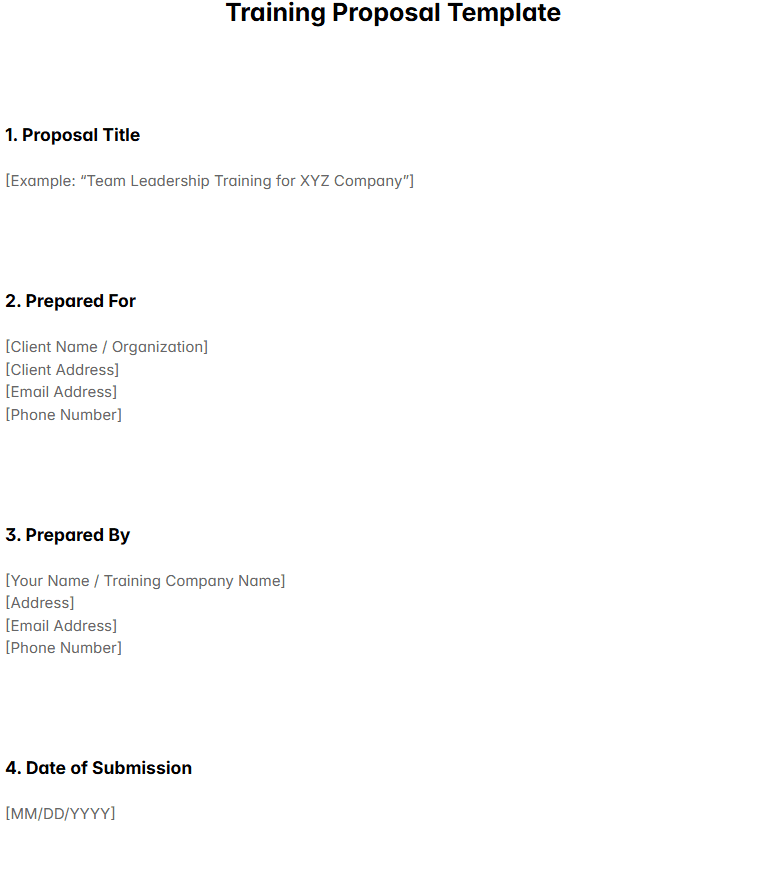
A Training Proposal template is a formal document outlining the objectives, methodology, schedule, and expected outcomes of a training program. It serves as a blueprint for stakeholders, detailing how the training aligns with organizational needs and contributes to performance improvement.
Training Proposal represents one of the many templates available within the Proposal Templates category featured on our website.
For a more comprehensive understanding of Proposal Templates — including their legal nuances, variations across jurisdictions, and practical applications — we invite you to explore our in-depth overview article dedicated to this document category.
Who Benefits Most from a Training Proposal Template?
Freelance Trainers and Coaches
Independent professionals offering corporate workshops or skills-based sessions can use templates to pitch clearly, highlight ROI, and present deliverables in a format that builds trust with clients unfamiliar with L&D processes.
HR and Learning & Development Teams
Internal teams planning large-scale training initiatives — onboarding, compliance, upskilling — benefit from templates that align proposals with strategic business goals and secure executive buy-in faster.
Agencies Offering Training Services
Consulting firms or training agencies working across industries can standardize proposal quality and quickly adapt to client needs without starting from scratch each time.
Small Businesses Implementing In-House Training
Businesses developing their first structured training plans (e.g., for sales or software adoption) can use templates to outline learning goals, justify costs, and coordinate execution with external consultants or internal teams.
Educational Institutions Seeking Partnerships
Schools, colleges, or online learning providers looking to collaborate with employers, NGOs, or grant bodies can use templates to present training models professionally and align expectations.
Why You Need a Training Proposal in 2026?
As we progress through 2026, the emphasis on continuous learning and development within organizations has intensified. According to a study published in the Journal of Public Health Management and Practice, structured training programs have shown significant improvements in participant confidence and skill application, with some areas reporting up to a 100% increase in confidence levels post-training.
Real world stats
76% of employees say they are more likely to stay at a company that offers continuous training.
The global corporate training market is projected to grow to $487.3 billion by 2030, indicating increased demand for structured training proposals.
60% of companies with curriculum-based education initiatives report increased revenue since starting their program, compared to just 22% of companies with ad-hoc education efforts
Key takeaway: A detailed proposal increases your training approval chances and shows your clients or employers that you are professional, organized, and outcome driven.
Case example
A freelance copywriter on Upwork crafted a tailored proposal highlighting relevant experience and writing samples, leading to successful client engagement.
Advantages of Using a Training Proposal Template
Utilizing a Training Proposal Template offers several benefits:
Efficiency: Streamlines the proposal creation process, saving time and resources.
Consistency: Ensures uniformity in training proposals across the organization.
Clarity: Provides a clear structure, making it easier for stakeholders to understand the training plan.
Professionalism: Presents a polished and organized document, enhancing credibility.
Customization: Allows for tailoring to specific training needs and organizational goals.
Pre-designed templates can optimize the structure of training proposals, making them more dynamic and compelling
Legal Importance and Context
While not a legally binding contract, a Training Proposal can have legal implications, especially when it includes terms related to deliverables, timelines, and costs. Ensuring clarity in these areas can prevent misunderstandings and disputes. In some cases, organizations may follow up with a formal agreement or contract to solidify the terms outlined in the proposal.
When Should You Use a Training Proposal Template?
Common Scenarios:
New Employee Onboarding: Introducing company policies and culture.
Skill Development Programs: Enhancing specific competencies among staff.
Compliance Training: Ensuring adherence to industry regulations.
Leadership Training: Preparing employees for managerial roles.
Use Cases:
Freelancers: Proposing training services to potential clients.
Business Owners: Presenting internal training plans to stakeholders.
Educational Institutions: Outlining course offerings to accreditation bodies.
Key Sections of a Training Proposal and How to Fill Them Out
A comprehensive Training Proposal should include the following sections:
Proposal Title: Clearly state the purpose of the training.
Prepared For: Include the client's name and contact information.
Prepared By: Provide your name and contact details.
Date of Submission: Indicate when the proposal is submitted.
Executive Summary: Summarize the training's objectives and benefits.
Training Objectives: List specific, measurable goals.
Target Audience: Define who will participate in the training.
Training Topics and Content: Outline the modules and subjects covered.
Delivery Format: Specify whether the training is in-person, virtual, or hybrid.
Trainer Credentials: Highlight the trainer's qualifications and experience.
Schedule and Timeline: Provide a detailed timeline of the training sessions.
Materials and Equipment: List any resources needed for the training.
Pricing: Break down the costs associated with the training.
Evaluation and Follow-Up: Describe how the training's effectiveness will be assessed.
Approval and Acceptance: Include a section for signatures to formalize the agreement.
Practical Tips for Using Training Proposal Templates Effectively
Maintain Digital Copies: Ensure easy access and updates.
Verify Information Thoroughly: Double-check all details for accuracy.
Communicate Clearly: Use straightforward language to convey objectives and methods.
Download our free Training Proposal Template or Customize with AI in just 2 minutes! Our template is crafted by professionals, easy to fill, and available in multiple formats (Word, PDF, Google Docs). Whether you're pitching to a client or applying for an internal project, this document helps you stand out.
⚖️ Legal Tip: The Training Proposal Element That Prevents Liability Issues
According to the Association for Talent Development (ATD), the most overlooked section in training proposals is the "Scope and Limitations" clause. This critical element defines not only what the training will cover, but explicitly what it will NOT address.
The absence of clear limitations can create legal exposure when:
Participants claim they weren't adequately trained for situations beyond the intended scope
Organizations implement practices based on partial training that wasn't designed to be comprehensive
Regulatory compliance is assumed but not explicitly covered
A properly drafted limitations section should include:
Explicit statements of what the training does not qualify participants to do
Clarification that the training may not cover all regulatory requirements
Acknowledgment that additional training may be necessary for certain roles or situations
Disclaimer that training materials are not substitutes for professional advice
📌 Real‑World Case: Pan Ocean Oil & Gas — ROI-Driven Leadership Training
In 2024, Pan Ocean Oil & Gas launched a leadership development program for 24 high-potential employees using Dr. Jack Phillips’ ROI methodology. Participants addressed real business challenges tied to cost savings and efficiency. The company tracked outcomes including increased productivity, improved leadership behaviors, and measurable cost reductions. The project demonstrated a positive return on investment, helping secure ongoing support for internal training initiatives.
Source: How to Measure ROI in Training — LinkedIn
Key Takeaway: Training proposals that include business-aligned objectives and a formal ROI model can win executive support and secure funding by clearly linking learning outcomes to measurable performance gains.
🔑 Additional Insight: Training Modality Effectiveness by Industry
Research from Brandon Hall Group reveals significant variations in training effectiveness by delivery method across different industries:
Industry | Most Effective Modality | Least Effective Modality |
|---|---|---|
Healthcare | Blended (in-person + simulation) | Self-paced online only |
Manufacturing | AR/VR + hands-on practice | Lecture-based classroom |
Technology | Microlearning + practical application | Traditional e-learning |
Financial Services | Scenario-based + compliance testing | Video-only instruction |
Retail | Mobile-first + gamification | Traditional classroom |
Including industry-specific effectiveness data in your proposal demonstrates expertise and increases stakeholder confidence in your methodology.
For example, manufacturing training proposals should emphasize how hands-on components will be integrated, while technology training should highlight microlearning elements and practical application opportunities.
Practical Tips for Using Training Proposal Templates Effectively:
Maintain Digital Copies: Ensure easy access and updates.
Verify Information Thoroughly: Double-check all details for accuracy.
Communicate Clearly: Use straightforward language to convey objectives and methods.
Expert Insights
“When measuring outcomes in corporate training, the authors recommend a comprehensive plan with strategy, measurement models, resources, measures and cultural readiness to determine training success.”
— Barnett & Mattox, Measuring Success and ROI in Corporate Training
“A methodology for projecting the return on investment of training proposes a framework for making projective estimations of ROI before investing in new training technology.”
— ROI estimation framework in training
How AI Lawyer Creates Your Document (Step-by-Step)
At AI Lawyer, we believe that drafting legal documents shouldn’t feel like decoding a foreign language. Whether you’re a business owner, landlord, freelancer, or someone navigating a personal matter — you should be able to create a legally sound document without needing a law degree.
That’s why we built a document experience that works like a conversation, not a form. Here’s exactly how it works:
1. You Tell AI Lawyer What You Need
It starts with a simple question:
“What type of document do you want to create?”
You choose from our list of professional templates — whether it’s a rental agreement, contractor form, invoice, publishing contract, or anything else — and AI Lawyer immediately pulls up the structure designed specifically for that use case.
Behind the scenes, the system references U.S. legal standards and best practices to make sure you’re starting from the right foundation.
2. We Highlight the Key Sections
Instead of throwing the whole document at you, AI Lawyer breaks it down.
Each key component — like payment terms, deadlines, responsibilities, clauses — is briefly explained in human language so you know what it means before you fill it out.
It’s like having a lawyer on your shoulder saying,
“Here’s what this section covers, and why it matters.”
3. You Answer Simple, Targeted Questions
AI Lawyer asks you step-by-step questions — like:
Who’s involved?
What are the key dates or timelines?
What are the terms (payments, conditions, obligations)?
Do you need special clauses like confidentiality, termination, or jurisdiction?
Each question is directly linked to a block in the final document — so your answers go exactly where they belong.
4. The Document Builds Itself As You Go
On the right side of your screen, the full document builds in real time.
Every time you answer a question, a corresponding section is added — with legally sound wording, smart defaults, and editable fields.
You’re not just answering a form — you’re watching your document take shape.
This phased process helps:
Reduce overwhelm
Catch errors early
Ensure nothing is forgotten
5. You Edit and Customize Freely
Once all the inputs are in, the full document is unlocked for editing.
You can:
Rewrite any clause
Change formatting
Add or remove sections
Rephrase terms in plain English (or more formal legal tone)
The editor works like a Google Doc — intuitive, responsive, and flexible.
6. Your Final Document Is Yours to Keep
Download in PDF, DOCX, or copy to clipboard.
You can print it, email it, or send it for signature — and revisit your answers anytime to generate updated versions.
Why This Workflow Matters
Most template tools give you a blank form.
We give you a process — one that mirrors how a real attorney would walk you through the creation of a document:
Context → Input → Assembly → Review → Delivery
It’s not magic. It’s just a smarter way to get legal work done — without getting lost in the jargon.
FAQs
Q: How should I project ROI in a training proposal?
A: Use projected ROI frameworks — like those by Barnett & Mattox or NCBI — to estimate outcomes before implementation. Include conservative, expected, and optimistic scenarios and specify metrics, costs, and benefits.
Q: What measurement models should be included?
A: Incorporate the five-component measurement plan (strategy, models, resources, measures, cultural readiness) from Barnett & Mattox, and consider Kirkpatrick’s levels for evaluation.
Q: Why emphasize compliance training design?
A: ATD research highlights that well-designed compliance training can convert mandatory sessions into meaningful learning experiences, enhancing engagement and performance.
Q: Is it enough to outline objectives and timeline?
A: No. Proposals must include impact metrics, ROI estimates, compliance considerations, evaluation plans, and scope limitations to provide a comprehensive case.
Q: Should I include follow-up assessments?
A: Yes. Measuring consolidation and application — 30–90 days post-training — demonstrates lasting impact and supports your ROI projection model.
Q: How frequently should I update the proposal template?
A: Annually or whenever new training technologies, updated ROI methods, or industry changes emerge, especially in compliance or learning strategies.
Final Thoughts:
Using a structured Training Proposal Template streamlines the planning process, enhances clarity, and increases the likelihood of approval. It serves as a vital tool in aligning training initiatives with organizational objectives, ultimately contributing to overall success.
Sources and References
Findings on training effectiveness, confidence gains, and workforce retention in this guide draw on peer-reviewed evaluations published in the Journal of Public Health Management and Practice, workplace learning research summarized in the LinkedIn Workplace Learning Report, and public-sector guidance from the U.S. Office of Personnel Management Training and Development Policy.
Market growth and revenue impact figures for corporate training and curriculum-based education initiatives are informed by industry analyses on organizational education and education-led growth, including research synthesized by Intellum on organizational education ROI and comparable benchmarking studies of structured versus ad-hoc learning programs.
Insights on ROI modelling, scope-and-limitations clauses, and modality effectiveness rely on Barnett & Mattox’s framework for measuring success and ROI in corporate training, evaluation and risk-management guidance from the Association for Talent Development (ATD), learning-modality benchmarks from Brandon Hall Group, and practitioner case material such as leadership-training ROI applications documented by the ROI Institute and shared in LinkedIn case examples on training ROI.
You Might Also Like: