Business
Vehicle Bill of Sale Guide: Transfer, Forms & Legal Use
Discover the importance of a Vehicle Bill of Sale in 2026. Learn how it protects buyers and sellers, with real-world examples and legal insights.
Selling a car should be simple. But trouble often starts after the handshake. A toll charge appears, the buyer delays registration, the payment is unclear, or the paperwork turns out to be incomplete.
A Vehicle Bill of Sale records the deal in writing. It shows who sold the vehicle, who bought it, what was sold, how much was paid, and when the transfer happened. That record helps if the timeline, payment, mileage, title status, or ownership details are questioned later.
It also supports registration, tax, and transfer steps. But it does not replace the title process. After a private sale, the safer approach is to keep a signed copy, complete the title handoff properly, and file any required DMV seller notice right away.
If you do not want to start from a blank form, AI Lawyer can help you prepare a clean Vehicle Bill of Sale before the keys change hands.
You Might Also Like:
Why this document matters
People often treat this paperwork like a formality. It is more useful than that.
For the buyer, it helps show the terms of the purchase. For the seller, it helps show when the car left their hands. If something goes wrong later — a dispute over payment, a mileage issue, a toll bill, a parking ticket, or a delay in registration — this is one of the first records that matters.
This is not just a receipt. It is the document that makes the sale easier to prove.
When you should use it
This document is most useful when the deal happens outside a dealership and the paperwork is your responsibility.
Private vehicle sale
This is the most common case. If you are selling through Facebook Marketplace, Craigslist, a local listing, or a direct private sale, the Bill of Sale becomes the written record of the deal.
Private sales are where missing paperwork causes the most avoidable problems.
Gifting a vehicle
Even when no money changes hands, the transfer should still be documented. Mark it as a gift instead of inventing a symbolic sale price. For example, New York DMV says a gifted vehicle should be marked as a gift with a price of “$0.”
A gifted car still needs clean paperwork.
Out-of-state transaction
If the vehicle will be titled in a different state, a clear paper trail matters even more. The Bill of Sale helps document the deal, but the buyer may still need the signed title, tax documents, inspection documents, or state-specific transfer forms.
The more complicated the transfer, the more valuable clear supporting paperwork becomes.
Sale with a deposit or delayed pickup
If the buyer pays a deposit before pickup, include the deposit amount, whether it is refundable, the remaining balance, and the payment deadline. If pickup happens later, the actual transfer date should be clear.
Payment timing and vehicle handoff timing should not be left to memory.
How to prepare a Vehicle Bill of Sale without missing key details
A Vehicle Bill of Sale may look simple, but it should match the real transaction exactly. Before signing, check the buyer and seller names, VIN, mileage, sale price, payment terms, transfer date, and condition language against the title and state requirements.
The goal is not just to fill out a form. The goal is to create a record that still makes sense if payment, ownership, mileage, or liability is questioned later.
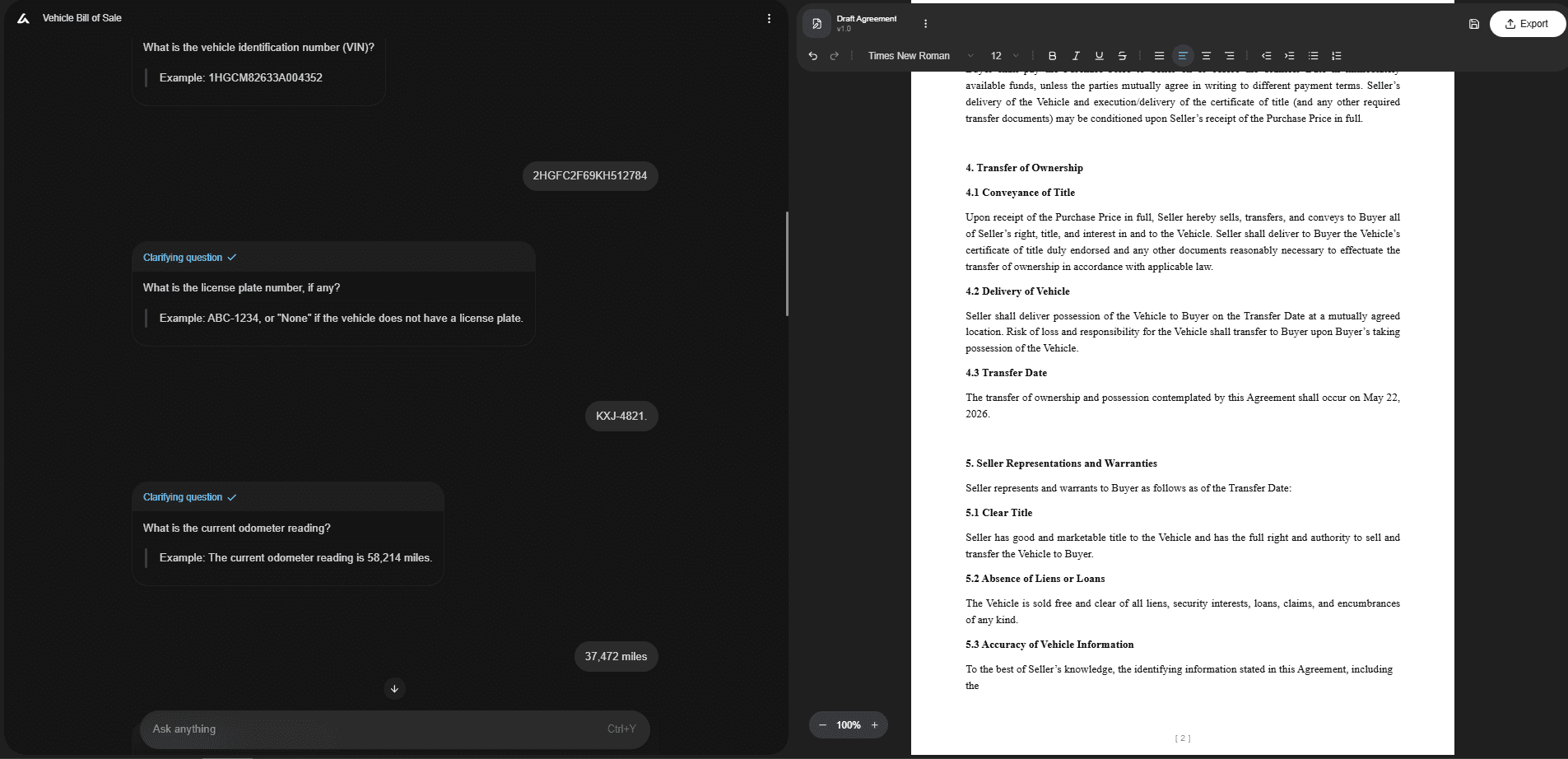
A guided document flow can help here. Instead of starting from a blank page, you can use the AI Lawyer Vehicle Bill of Sale generator to organize the key fields, then review the draft against your state DMV rules before signing.
A strong Bill of Sale should make the transfer easy to prove, easy to review, and easier to support during title or registration steps.
What to include in a Vehicle Bill of Sale
A good document should make the transaction easy to follow. At minimum, include:
Section | What to include | Common mistake |
|---|---|---|
Buyer and seller details | Full legal names and current addresses | Nicknames, missing co-owner, incomplete address |
Vehicle details | Year, make, model, VIN, body type if needed | VIN copied from an old listing or typed incorrectly |
Sale price | Exact amount paid or gift status | Using a fake low price |
Payment terms | Cash, cashier’s check, wire transfer, deposit, or balance due | Saying the car is paid before payment is confirmed |
Date of transaction | Real handoff date | Backdating or leaving the date vague |
Odometer reading | Exact mileage if required | Rounding, guessing, or leaving it blank |
Condition | “As is,” known issues, warranty limits if any | Relying only on a verbal conversation |
Signatures | Signatures from both sides, plus copies for both parties | Signing incomplete paperwork |
Use the same details your state asks for on an official form. For example, New York DMV provides form MV-912, which includes seller, buyer, vehicle description, price, terms, signatures, and dates.
Buyer and seller details
Use full legal names, not shortcuts. Add the current address for each side. If there are co-owners, include them too.
Example:
Instead of “Mike Johnson, Tampa,” write “Michael A. Johnson, 1458 West Pine Ave, Tampa, FL 33602.”
If identity details are messy, fixing the transfer later gets harder.
Vehicle details
List the year, make, model, and VIN exactly as shown on the title. If your state form asks for body type, color, plate number, title number, or other identifying details, include those too.
The most common mistake here is a bad VIN. People copy it from an old ad, a blurry photo, or memory. That one error can derail registration.
Example:
If the listing said “2017 Honda Civic EX” but the title shows a different trim or VIN, correct the paperwork before anyone signs.
A wrong VIN can make an otherwise complete document useless.
Sale price and payment terms
Write the real price and the real handoff date. Do not leave either one vague. If the vehicle is a gift, mark it clearly instead of inventing a symbolic sale.
Payment should also be documented clearly. A Vehicle Bill of Sale should say whether the buyer paid in cash, by cashier’s check, by wire transfer, through a deposit, or with a remaining balance due. If the seller has not received full payment yet, the document should not say the vehicle is fully paid.
Example:
If the buyer sends a $500 deposit on Monday but pays the remaining $8,000 on Thursday, the Bill of Sale should separate the deposit date from the actual transfer date.
The date and payment terms often become key details if liability or payment questions come up later.
Odometer reading
If the transfer requires an odometer disclosure, use the exact mileage. Do not round it. Do not estimate it. Do not leave it blank because it is “close enough.”
Example:
If the odometer reads 84,213 miles, write 84,213 — not 84,000.
Mileage is one of the easiest places for a simple sale to turn into a credibility problem.
Condition of the vehicle
Private vehicle sales are often made “as is,” but that should still be clear in writing. If the seller is not giving a warranty, say so. If the vehicle has known issues, list them instead of relying on a conversation.
Example:
“Vehicle is sold as is, with no seller warranty. Buyer has inspected the vehicle and accepts its condition. Seller disclosed check-engine light and cracked rear bumper before sale.”
Condition language helps prevent a later argument about what the buyer knew before signing.
How state rules change the process
State rules matter because the Bill of Sale is only one part of the transfer. Different states handle seller liability, title transfer, license plates, odometer disclosure, gift transfers, and post-sale notices differently.
The real question is not only which form to use. It is what the seller must do after the buyer leaves with the car.
California: seller notice matters after the sale
California requires sellers to submit a Notice of Transfer and Release of Liability after selling or transferring a vehicle. California also explains that the NRL helps with violations after the sale date, but the buyer still has to complete the ownership transfer.
Example:
A seller signs the Bill of Sale, hands over the keys, and assumes the deal is finished. The buyer delays title transfer and later gets parking tickets or drives through toll roads. In that situation, the Bill of Sale helps prove the deal, but the NRL gives the seller a stronger DMV record.
California sellers should file the NRL and keep confirmation.
Washington: report of sale and plate removal are separate steps
Washington tells sellers to file a Vehicle Report of Sale and follow its Sell a Vehicle checklist. The state also warns sellers about plates, tolls, tickets, towing charges, and liability tied to the vehicle after the sale.
Example:
A buyer pays for the car and asks to keep the seller’s plates “just to get home.” That can create risk for the seller if tolls, tickets, or towing issues appear later.
Washington sellers should remove plates and file the Report of Sale.
Texas: delayed title transfer can create problems
Texas says the buyer must title the vehicle in their name within 30 days from the sale date. If the buyer fails to do that, the seller could face tickets, toll violations, or other problems. Texas recommends filing a Vehicle Transfer Notification, and its VTR-346 form explains that it should be submitted within 30 days.
Example:
A Texas seller gives the buyer a signed title and a Bill of Sale. The buyer says they will title the car next week but does not do it. The seller may then receive notices connected to a vehicle they no longer control.
Texas sellers should not rely only on the buyer’s promise to register later.
Florida: notice of sale and plate removal protect the seller
Florida says sellers should remove the plate, record the odometer reading, complete the title transfer, and file HSMV 82050. The state’s Selling a Vehicle checklist also warns sellers to handle the notice of sale properly.
Example:
A Florida seller completes a private sale but does not file the Notice of Sale. If the buyer fails to complete the title process, later problems may still point back to the seller.
Florida sellers should treat the Notice of Sale and plate removal as closing steps, not optional follow-up.
New York: bill of sale should match ownership and tax records
New York allows buyers and sellers in a private sale to use MV-912 Vehicle Bill of Sale. The state’s ownership transfer guide explains how bills of sale, gifts, and ownership documents connect.
Example:
If a vehicle is gifted, the Bill of Sale should not show a fake sale price. New York says a gifted vehicle should be marked as a gift with a purchase price of “$0.”
The Bill of Sale should match the title, tax, and registration documents.
What to do before and after handing over the keys
Before the buyer leaves with the car:
Confirm payment.
Match the VIN on the title, vehicle, and Bill of Sale.
Write the exact odometer reading if required.
Make sure all required owners sign.
Give both sides a copy.
Remove personal items, toll tags, garage remotes, insurance cards, and registration papers.
Check whether your state requires plate removal, seller notice, report of sale, or a specific DMV form.
After the sale:
Complete the title handoff properly.
File any required DMV notice right away.
Save proof that you filed it.
Remove plates if your state requires it.
Keep payment proof, messages, and a scan of the signed paperwork.
Do not hand over the keys and say, “We’ll finish the paperwork tonight.”
Finish the paperwork first, then release the vehicle.
Final thoughts
A Vehicle Bill of Sale helps document the transfer, support registration and tax steps, and reduce post-sale confusion. But it works best when paired with the title process and required DMV follow-up.
The document is not just a formality. It is the written record that helps both sides prove what happened, when it happened, and what terms applied.
FAQs
Q: Should I let the buyer take the car before the paperwork is complete?
A: No. Confirm payment, complete the Bill of Sale, sign the title documents, record the odometer if required, and make copies before the buyer leaves.
Q: Should the seller keep or remove the license plates?
A: It depends on the state. Florida says plates stay with the seller, and Washington tells sellers to remove plates before the buyer leaves. Always check your state DMV rules before the sale.
Q: What if the buyer promises to register the vehicle later?
A: Do not rely only on the buyer’s promise. File any required seller notice or report of sale yourself and save proof. Texas and California both explain that seller notices can matter when the buyer delays the title or registration process.
Q: Can I sell a vehicle if the title is missing?
A: Usually, the Bill of Sale alone is not enough. You may need a replacement title or another acceptable proof of ownership before the transfer can be completed. New York DMV explains acceptable ownership proof in its vehicle ownership guide.
Q: Should known problems be written into the Bill of Sale?
A: Yes. If the car is sold “as is,” that should be written clearly. If the seller knows about major issues — for example, a check-engine light, accident damage, title branding, or missing parts — listing them can help prevent a later dispute.
Sources and References
California DMV — Notice of Transfer and Release of Liability
California DMV — Title Transfers and Changes
California DMV — Notice of Transfer and Release of Liability REG 138 Manual
Washington State Department of Licensing — Sell a Vehicle
Washington State Department of Licensing — Vehicle Report of Sale
Texas Department of Motor Vehicles — Buying or Selling a Vehicle
Texas Department of Motor Vehicles — Vehicle Transfer Notification Form VTR-346
Florida Highway Safety and Motor Vehicles — Selling a Vehicle
Florida Highway Safety and Motor Vehicles — HSMV 82050 Notice of Sale and/or Bill of Sale
New York DMV — Buy, Sell, or Transfer Vehicle Ownership
New York DMV — Vehicle Bill of Sale Form MV-912
New York DMV — Acceptable Proofs of Ownership for Vehicles