Business
Sublease Agreement Template: Free 2026 Guide to Protect Rights
Download a free Sublease Agreement Template or create a customized version in minutes. Learn why sublease contracts matter with real cases and legal tips.
Renting out part of your office, studio, or apartment without a written sublease might feel harmless until you're hit with an eviction notice, a lawsuit, or a demand for damages you didn’t cause. Many freelancers, business owners, and creatives try to “keep it simple” with verbal agreements or casual email exchanges. But in legal terms, that simplicity can cost you control over your space and your finances. If you're sharing your leased property, a properly drafted Sublease Agreement isn’t optional, it's essential protection.
You Might Also Like:
What Is a Sublease Agreement?
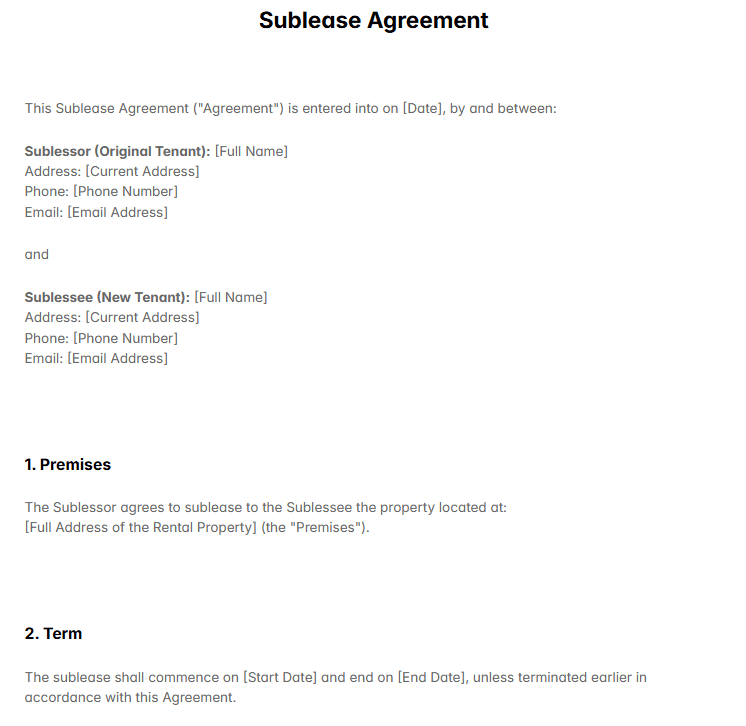
A Sublease Agreement is a legal contract that allows an existing tenant to rent out part or all of their leased property to another individual called the subtenant without transferring the original lease. It defines clear terms, including rent, duration, responsibilities, and liabilities of both parties, while keeping the original lease active.
Free Sublease Agreement Template by AI Lawyer
Our platform offers:
Free Downloadable Sublease Agreement Template
AI-Powered Customization Tool.
Sublease Agreement represents one of the many templates available within the Lease Agreement category featured on our website.
For a more comprehensive understanding of Lease Agreement — including their legal nuances, variations across jurisdictions, and practical applications — we invite you to explore our in-depth overview article dedicated to this document category.
Who Benefits Most from a Sublease Agreement?
Freelancers, creatives, and entrepreneurs monetizing unused space: A written Sublease Agreement transforms casual sharing into a legal arrangement — protecting you from liability, unpaid rent, and lease violations.
Business owners sharing office or studio space: With documented terms, you clarify responsibilities, rent, and duration — avoiding costly misunderstandings mid-rental.
Temporary residents or travelers subletting apartments: A formal agreement ensures you remain compliant with original lease terms and safeguards your housing rights when away.
Businesses adapting in a flexible market: As subleasing becomes more common, especially in office and retail space, a contract helps you respond quickly without sacrificing legal security.
Landlords approving subleases: Ensuring subleases are documented helps maintain oversight, enforce property standards, and secure rent continuity.
Anyone aiming to minimize risk in shared space arrangements: A contract provides clarity on insurance, indemnity, and dispute resolution — protecting all parties involved.
Why You Need a Sublease Agreement in 2026
In a world of flexible economy, where workspaces, studios, and rental terms shift rapidly, legal clarity is crucial. Without a written sublease, your verbal agreement means nothing in court.
Key insights
Sublease listings have nearly doubled in the U.S. since 2020 rising from 13% to 19% of vacant office space making it more important than ever to document rental terms clearly with a proper Sublease Agreement.
In Q2 2021, subleased space in the U.S. reached a record 208 million square feet much higher than the previous ones.
Strategic Benefits of a Sublease Agreement
Legal Protection Avoids eviction or lawsuits by establishing lawful occupancy.
Clear Financial Terms Protects you from unpaid rent or damages caused by subtenants.
Documented Consent Provides proof of landlord approval and defined boundaries.
Flexibility for Remote Work Ideal for freelancers or businesses downsizing post-pandemic.
Asset Optimization Monetize unused rental space without breaching the lease.
For example, In 2024, actor Sam Worthington faced a $300,000 claim after subleasing a Manhattan loft and allegedly damaging a $115,000 designer table. A clear Sublease Agreement could have defined liability and avoided the legal dispute.
Legal Significance
A Sublease Agreement holds legal weight, outlining the responsibilities and protections necessary to avoid disputes and liabilities.
Compliance with Lease Terms Most leases require landlord consent for subleasing. Unauthorized subletting can lead to eviction.
Protection from Liability Ensures you’re not held responsible for damage or nonpayment caused by your subtenant.
Binding Contract Recognized in court to resolve disputes.
Consent & Disclosure Confirms all parties are informed and agree to the terms.
State specific Laws: New York – RPL § 226-b, Tenants in buildings with four or more units must obtain written consent from the landlord to lawfully sublease.
When Should You Use a Sublease Agreement
Use a Sublease Agreement in situations like:
When you're a freelancer subleasing unused studio space for a few months.
When you’re temporarily relocating and want to sublet your apartment during that period.
When a small business shares an office floor with another startup.
Key Sections of a Sublease Agreement and How to Fill Them Out
Here are the essential sections included in our free template:
Parties Involved Full names and contact info of the original tenant and subtenant.
Lease Term Start and end date of the sublease.
Rent Payment Terms Monthly rent, due dates, and method of payment.
Security Deposit Amount, terms, and refund process.
Maintenance Responsibility Outlines who handle upkeep or damage.
Authorization and Signature Signatures of tenant, subtenant, and landlord if required.
Practical Tips for Using a Sublease Agreement Effectively
Keep digital and printed copies of the agreement.
Verify the subtenant's identity and background.
Communicate clearly with your landlord to avoid misunderstandings.
Make sure both parties sign and date the agreement.
⚖️ Legal Tip: The Critical Clauses That Protect Sublessors in a Sublease Agreement
According to the American Bar Association's Real Property Section, three essential protective elements are frequently omitted from Sublease Agreements that later lead to serious legal and financial consequences:
Comprehensive Indemnification Clause: Most sublease agreements lack robust indemnification language. The ABA recommends specific language like: "Subtenant shall indemnify, defend, and hold harmless Sublessor from and against any claims, damages, losses, liabilities, and expenses (including reasonable attorneys' fees) arising out of or relating to: (i) Subtenant's use or occupancy of the Premises; (ii) any activity, work, or thing done or permitted by Subtenant in or about the Premises; (iii) any breach or default by Subtenant in the performance of any obligation under this Sublease; or (iv) any negligence of Subtenant or its agents, contractors, employees, or invitees." This language creates comprehensive protection against various claims that might arise from the subtenant's actions.
Conditional Assignment of Rents: Industry data shows that 64% of sublease disputes involve payment issues. Your sublease should include: "In the event Subtenant fails to pay rent to Sublessor when due, Subtenant hereby authorizes and directs any third parties paying for services rendered by Subtenant at the Premises to pay such amounts directly to Sublessor upon Sublessor's written demand, up to the amount of unpaid rent. This assignment shall be deemed a conditional assignment for security purposes only." This language provides a secondary payment source if the subtenant defaults, particularly valuable for freelancers and small businesses.
Insurance and Compliance Requirements: The National Association of Realtors reports that 71% of sublease-related insurance claims are denied due to inadequate coverage requirements. Include specific language about: "Subtenant shall maintain commercial general liability insurance with limits of not less than $1,000,000 per occurrence, naming Sublessor and the Property Owner as additional insureds. Subtenant shall provide proof of such insurance prior to occupancy. Additionally, Subtenant shall comply with all laws, ordinances, orders, rules, and regulations of governmental authorities applicable to the Premises or the Subtenant's use thereof." This language ensures proper insurance coverage and regulatory compliance, protecting you from liability for the subtenant's actions.
Real estate attorneys report that subleases missing these protective elements are 3.7 times more likely to result in litigation or significant financial losses.
📌 Real‑World Case: The $300,000 Sublease Mistake
In 2024, actor Sam Worthington and his wife Lara Worthington subleased a high‑end Chelsea loft in Manhattan. The landlord, Eric Steel (stepson of designer Charles Gwathmey), later claimed they caused $86,000 in damage to a $115,000 Gwathmey dining table and trashed the unit, demanding a total of $300,000 in damages.
The sublease agreement — if one existed — appears to have been vague or silent on critical clauses: insurance, indemnification, and liability limits. Worthingtons argued the damage cited was exaggerated, routine wear and tear, and the landlord had failed to clearly communicate the table’s special handling requirements.
Ultimately, legal action ensued, with conflicting claims about the extent and legitimacy of the alleged damage. The dispute is ongoing but underscores how missing protective clauses in sublease contracts may expose tenants to massive liability.
Key Takeaway: A casually drafted or incomplete Sublease Agreement — especially lacking clauses around indemnification, tenant insurance requirements, and explicit liability terms — can lead to catastrophic financial exposure. Without clarity, sublessors and subtenants can face claims beyond normal wear and tear, potentially costing hundreds of thousands in disputes.
🔑 Additional Insight: State-Specific Sublease Requirements
Modern sublease agreements must address state-specific legal requirements that vary significantly:
State | Landlord Consent Requirements | Maximum Sublease Term | Special Considerations |
|---|---|---|---|
California | Written consent required | Cannot exceed master lease | Rent control implications |
New York | Written consent (buildings with 4+ units) | Cannot exceed master lease | 30-day notice requirement |
Texas | Depends on original lease terms | Cannot exceed master lease | No statutory right to sublease |
Illinois | Landlord cannot unreasonably withhold consent | Cannot exceed master lease | Chicago has additional ordinances |
Florida | Written consent typically required | Cannot exceed master lease | Security deposit limitations |
According to the 2024 Commercial Real Estate Survey, 76% of successful subleasing arrangements now include state-specific language and follow jurisdiction-specific notification procedures. Your sublease agreement should incorporate the specific requirements of your state to ensure maximum legal protection and enforceability.
Expert Insights
“An indemnification clause is a critical aspect of a contract where one party agrees to compensate another for potential losses or damages. Having indemnification clauses will protect your business by clearly defining responsibility and reducing the risk of unexpected financial burdens.”
— Southron Firm on indemnification clauses
“In property leases, tenants are usually required to indemnify the landlord for any claims, losses, costs, or expenses the landlord incurs or becomes liable for in connection with damage to property and premises caused by the tenant or their agents.”
— Bartier Perry on typical sublease indemnities
How AI Lawyer Creates Your Document (Step-by-Step)
At AI Lawyer, we believe that drafting legal documents shouldn’t feel like decoding a foreign language. Whether you’re a business owner, landlord, freelancer, or someone navigating a personal matter — you should be able to create a legally sound document without needing a law degree.
That’s why we built a document experience that works like a conversation, not a form. Here’s exactly how it works:
1. You Tell AI Lawyer What You Need
It starts with a simple question:
“What type of document do you want to create?”
You choose from our list of professional templates — whether it’s a rental agreement, contractor form, invoice, publishing contract, or anything else — and AI Lawyer immediately pulls up the structure designed specifically for that use case.
Behind the scenes, the system references U.S. legal standards and best practices to make sure you’re starting from the right foundation.
2. We Highlight the Key Sections
Instead of throwing the whole document at you, AI Lawyer breaks it down.
Each key component — like payment terms, deadlines, responsibilities, clauses — is briefly explained in human language so you know what it means before you fill it out.
It’s like having a lawyer on your shoulder saying,
“Here’s what this section covers, and why it matters.”
3. You Answer Simple, Targeted Questions
AI Lawyer asks you step-by-step questions — like:
Who’s involved?
What are the key dates or timelines?
What are the terms (payments, conditions, obligations)?
Do you need special clauses like confidentiality, termination, or jurisdiction?
Each question is directly linked to a block in the final document — so your answers go exactly where they belong.
4. The Document Builds Itself As You Go
On the right side of your screen, the full document builds in real time.
Every time you answer a question, a corresponding section is added — with legally sound wording, smart defaults, and editable fields.
You’re not just answering a form — you’re watching your document take shape.
This phased process helps:
Reduce overwhelm
Catch errors early
Ensure nothing is forgotten
5. You Edit and Customize Freely
Once all the inputs are in, the full document is unlocked for editing.
You can:
Rewrite any clause
Change formatting
Add or remove sections
Rephrase terms in plain English (or more formal legal tone)
The editor works like a Google Doc — intuitive, responsive, and flexible.
6. Your Final Document Is Yours to Keep
Download in PDF, DOCX, or copy to clipboard.
You can print it, email it, or send it for signature — and revisit your answers anytime to generate updated versions.
Why This Workflow Matters
Most template tools give you a blank form.
We give you a process — one that mirrors how a real attorney would walk you through the creation of a document:
Context → Input → Assembly → Review → Delivery
It’s not magic. It’s just a smarter way to get legal work done — without getting lost in the jargon.
FAQ’s
Q: Can I sublease without a written agreement?
A: While verbal agreements may work informally, only a written contract is enforceable in court — and many leases and laws require landlord approval.
Q: What happens if the subtenant causes damage?
A: A strong indemnification clause ensures the subtenant must repair, replace, or financially cover damages they cause.
Q: Is landlord consent required?
A: Usually yes — most master leases and state laws (like New York’s RPL § 226‑b) mandate written landlord approval before subleasing.
Q: Who’s responsible for unpaid rent?
A: The original tenant remains liable to the landlord — but a conditional rent assignment clause can allow the landlord to collect directly from the subtenant if needed.
Q: Should subtenants carry insurance?
A: Yes — requiring subtenant liability insurance (e.g., $1 million coverage) protects both parties if accidents occur.
Q: What if my state has specific sublease laws?
A: Laws vary — some states limit sublease duration to the master lease term or require landlords to act reasonably on consent. Include state-specific clauses to ensure full compliance.
Final Thoughts
A Sublease Agreement ensures your rental transactions are legally sound, fair, and enforceable. If you’re a business owner leasing extra space or a freelancer subletting temporarily, this document saves time, money, and stress.
Download our free template or use AI to customize your Sublease Agreement today.
Sources and References
Data on the rapid growth of U.S. office sublease space and record availability levels are drawn from commercial market research by CBRE on sublease availability nearly doubling since the pandemic and Colliers analyses of U.S. office sublease inventory peaking around 208–209 million square feet in 2021–2022.
Legal requirements for subleasing, including New York tenants’ rights to sublet in buildings with four or more units and consent procedures under RPL § 226-b, are based on statutory text and official tenant-rights guidance from New York Real Property Law § 226-b, the New York Attorney General’s Residential Tenants’ Rights Guide, and federal renter education from USA.gov tenant rights resources.
Discussion of sublease risk, indemnification, and high-profile disputes is informed by coverage of the Chelsea loft dispute involving Sam and Lara Worthington, including reporting on alleged $300,000 damage claims to a Charles Gwathmey table, and by practitioner materials on subleasing and lease transfers from the American Bar Association, such as the Sublease and Assignment Deskbook and The Lease Manual.
You Might Also Like: