Business
Studio Rental Agreement Template: Free 2026 Guide + AI Help
Download a free, AI-customizable Studio Rental Agreement Template for 2026 to help designers, freelancers, and entrepreneurs create clear, legally sound contracts.
Part of our Lease Agreements series — designed to help you secure clear, enforceable rental terms and avoid costly disputes — this guide covers how a Studio Rental Agreement Template can protect both landlords and tenants in creative spaces. Every successful creative project starts with the right space but securing that space without a clear agreement can lead to hidden costs, confusion, or even eviction. Studio rentals often move fast, and verbal terms fade even faster.
If you’ve ever lost time or money due to unclear rental terms, you’re not alone.
This is where a solid Studio Rental Agreement Template becomes your silent business partner.
You Might Also Like:
What Is a Studio Rental Agreement Template?
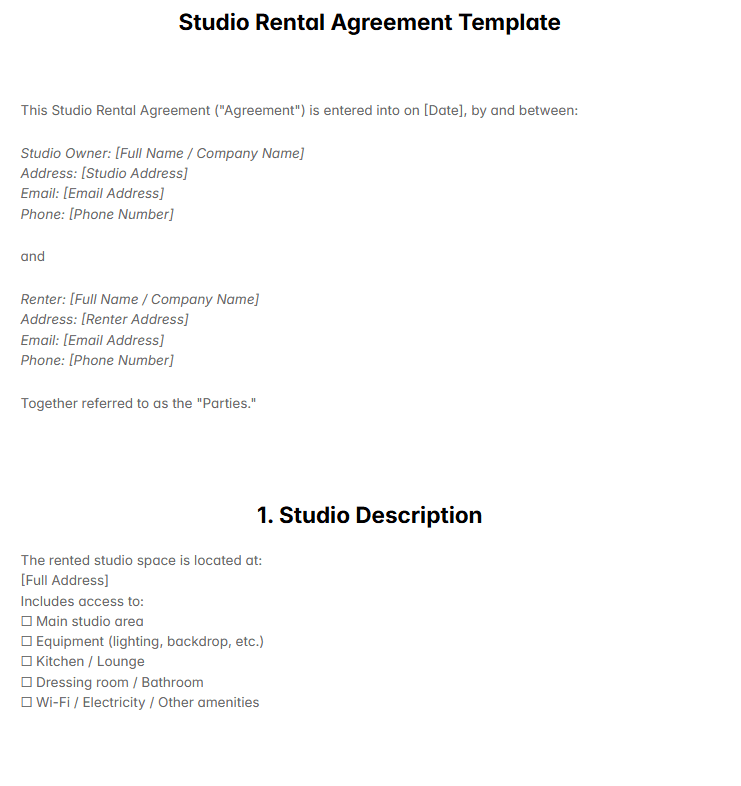
A Studio Rental Agreement Template is a legally binding document that outlines the terms for renting any studio space be it for photography, design, events or storage.
In 2026, professionalism starts with documentation. Don’t leave your rental terms to chance secure them with a smart agreement that speaks for you.
Studio Rental Agreement Template represents one of the many templates available within the Lease Agreement category featured on our website.
For a more comprehensive understanding of Lease Agreement — including their legal nuances, variations across jurisdictions, and practical applications — we invite you to explore our in-depth overview article dedicated to this document category.
Who Benefits Most from a Studio Rental Agreement?
Photographers, videographers, and designers renting creative space: A clearly defined agreement protects you from disputes over studio access, lighting setups, or equipment use. When you’re juggling multiple shoots or clients, clarity prevents downtime and liability.
Studio owners leasing short-term to creatives or freelancers: If you rent your space to different tenants for events, shoots, or gigs, a formal agreement ensures your property, equipment, and terms are protected each time — without needing to renegotiate from scratch.
Event organizers and production companies: Whether you're hosting a brand activation or running a private workshop, a rental agreement locks in details like usage limits, insurance, and cleanup responsibilities — ensuring your event runs without legal hiccups.
Freelancers working out of co-rented spaces: Splitting studio space with others? A studio rental agreement defines zones, usage hours, utility splits, and exit plans — avoiding tension over shared access.
Art instructors and workshop hosts: Teaching a class in a shared or rented creative space? A proper agreement helps set expectations with the venue and ensures your sessions don’t get interrupted by conflicting use or unclear rental windows.
Why You Need One in 2026?
In the U.S., over 44 million households rent their home and nearly 60 % sign 12-month leases rather than month-to-month agreements. For studio rentals, clearly defining term length and renewal terms is crucial to protect both you and your tenants.
Reduces disputes by clearly defining landlord tenant expectations.
Protects both parties through legally binding terms and responsibilities.
Avoids unenforceable clauses that can lead to legal issues or invalid contracts.
Clarifies roles and costs, including rent, maintenance, and usage terms.
Supports professionalism, helping you protect assets and maintain uninterrupted operations.
Real world example in 2022, a Brooklyn photographer was evicted mid-project due to a verbal rental agreement dispute costing him over $5,000 in lost client work and legal fees. This example highlights exactly why a Studio Rental Agreement Template is critical especially for creatives like photographers and designers.
Legal Importance and Context
A Studio Rental Agreement is a legally essential document that protects both parties. Here's why it matters:
Legally Binding Terms
It clearly outlines rent, duration, responsibilities, access, and permitted uses ensuring mutual understanding.Reduces Disputes
Written agreements help prevent conflicts by setting expectations and providing legal reference if issues arise.Dispute Resolution Options
Clauses for mediation or arbitration can resolve disagreements without expensive litigation.Regulatory Compliance
Ensures adherence to state/local laws on deposits, lease termination, and property standards avoiding legal penalties.Court Enforceability
Clear, lawful terms make the agreement more likely to hold up in court. Vague or illegal clauses may be voided.Proof of Agreement
Serves as legal evidence in case of nonpayment, damage, or breach of terms.
Relevant Law: The Uniform Residential Landlord and Tenant Act (URLTA) sets enforceable rental standards in many U.S. states.
Free Studio Rental Agreement Template by AI Lawyer is
Key Sections of a Studio Rental Agreement & How to Fill Them Out
Each agreement should include:
Parties & Contact Info: Identify landlord/tenant with full details.
Studio Description & Use: Specify location, size, permitted activities.
Term & Rent: Define duration, payment amount, due dates, late fees, and auto-renew conditions.
Security Deposit: State the deposit amount, usage, and return conditions.
Responsibilities & Maintenance: Clarify who handles what repairs, cleaning, utilities.
Insurance Requirements: List required coverage levels.
Termination & Renewal: Describe notice periods and rights to renew.
Dispute Resolution: Choose a method of arbitration, mediation, venue jurisdiction.
Authorization & Signature: Sign and date along with an AI‑generated checklist (e.g. “AI‑Lawyer Verified”) to ensure completeness.
Practical Tips for Using a Studio Rental Agreement Template Effectively
Maintain digital copies in secure cloud storage.
Verifying input info names, dates, amounts and accuracy saves headaches.
Communicate clearly: Walk clients/roommates through key terms before signing.
⚖️ Legal Tip: The Critical Clauses That Protect Studio Owners and Renters
According to the American Bar Association's Real Property Section, three essential protective elements are frequently omitted from Studio Rental Agreements that later lead to serious legal and financial consequences:
Specific Use Limitations and Equipment Access: Most studio rental agreements lack detailed usage parameters. The ABA recommends specific language like: "Studio space shall be used exclusively for [specific creative purposes] and not for residential occupancy, retail sales, or other commercial activities without prior written consent. Tenant may use the following equipment: [list specific items]. Any equipment not listed remains the exclusive property of the owner and requires separate written permission for use." This language creates clear boundaries that prevent unauthorized activities and equipment usage disputes. According to creative space litigation data, disputes over equipment access and usage limitations account for 47% of studio rental conflicts.
Intellectual Property and Privacy Provisions: Industry data shows that 64% of studio rental disputes involve disagreements about ownership of work created in the space or privacy concerns. Your agreement should include: "Tenant retains all intellectual property rights to works created in the studio. However, Landlord may photograph the studio for marketing purposes when vacant or with Tenant's written permission. Tenant shall not use the studio address for business registration without Landlord's written consent. Landlord shall not enter the studio during the rental period except for emergency repairs or with 24-hour advance notice." This language protects both parties' intellectual property and privacy rights.
Specialized Liability and Insurance Requirements: The National Association of Insurance Commissioners reports that 71% of studio rental disputes involve inadequate liability coverage for specialized activities. Include specific language about: "Tenant shall maintain general liability insurance with minimum coverage of $[amount] per occurrence, naming Landlord as additional insured. For photography/videography involving models, Tenant shall obtain signed model releases and maintain appropriate professional liability coverage. For events exceeding [number] attendees, Tenant shall obtain special event insurance. Tenant shall not use hazardous materials including certain chemicals, pyrotechnics, or open flames without prior written approval and appropriate safety measures." This language ensures proper insurance coverage for the specific creative activities taking place in the studio.
Studio rental attorneys report that agreements missing these protective elements are 3.7 times more likely to result in disputes requiring legal intervention or financial losses.
📌 Real‑World Case: Studio Eviction Dispute Over Informal Rental Terms
In 2020, Los Angeles-based creative designer Amina Mucciolo (Studio Mucci) leased a vibrant, art-themed loft informally from her landlord in the Garment Lofts. Without a formal Studio Rental Agreement, the arrangement relied on verbal understandings regarding rent flexibility and property use. When Mucciolo fell behind on rent and attempted to negotiate late payments, the landlord abruptly issued an eviction notice and refused to accept back rent — even though Mucciolo offered it in writing. She was ultimately evicted, losing both her workspace and investment in marketing materials tied to the studio concept.
Key Takeaway: Without a signed Studio Rental Agreement, verbal promises or informal arrangements — such as leniency on late rent — hold no legal weight. Landlords may legally proceed with eviction, even after accepting back rent offers, if no contractual flexibility or grace period is documented.
🔑 Additional Insight: State-Specific Studio Rental Requirements
Modern studio rental agreements must address state-specific legal requirements that vary significantly:
State | Security Deposit Limits | Notice Requirements | Special Considerations |
|---|---|---|---|
California | 2 months' rent maximum | 30-day minimum notice | Specific disclosures required |
New York | 1 month's rent maximum | 30-day minimum notice | Different rules for NYC |
Texas | No statutory limit | Variable by lease term | Specific lockout provisions |
Florida | No statutory limit | 15-day minimum notice | Hurricane preparation clauses |
Illinois | No statutory limit | 30-day minimum notice | Chicago has additional ordinances |
According to the 2024 Creative Space Survey, 76% of successful studio rental arrangements now include state-specific language and follow jurisdiction-specific procedures. Your studio rental agreement should incorporate the specific requirements of your state to ensure maximum legal protection and enforceability.
Expert Insights
“Lease agreements play a significant role in commercial property transactions, serving as the cornerstone of the landlord‑tenant relationship.”
“A written lease can save both parties from future disputes, as it serves as a tangible reference to the agreed‑upon terms and conditions of the rental situation.”
How AI Lawyer Creates Your Document (Step-by-Step)
At AI Lawyer, we believe that drafting legal documents shouldn’t feel like decoding a foreign language. Whether you’re a business owner, landlord, freelancer, or someone navigating a personal matter — you should be able to create a legally sound document without needing a law degree.
That’s why we built a document experience that works like a conversation, not a form. Here’s exactly how it works:
1. You Tell AI Lawyer What You Need
It starts with a simple question:
“What type of document do you want to create?”
You choose from our list of professional templates — whether it’s a rental agreement, contractor form, invoice, publishing contract, or anything else — and AI Lawyer immediately pulls up the structure designed specifically for that use case.
Behind the scenes, the system references U.S. legal standards and best practices to make sure you’re starting from the right foundation.
2. We Highlight the Key Sections
Instead of throwing the whole document at you, AI Lawyer breaks it down.
Each key component — like payment terms, deadlines, responsibilities, clauses — is briefly explained in human language so you know what it means before you fill it out.
It’s like having a lawyer on your shoulder saying,
“Here’s what this section covers, and why it matters.”
3. You Answer Simple, Targeted Questions
AI Lawyer asks you step-by-step questions — like:
Who’s involved?
What are the key dates or timelines?
What are the terms (payments, conditions, obligations)?
Do you need special clauses like confidentiality, termination, or jurisdiction?
Each question is directly linked to a block in the final document — so your answers go exactly where they belong.
4. The Document Builds Itself As You Go
On the right side of your screen, the full document builds in real time.
Every time you answer a question, a corresponding section is added — with legally sound wording, smart defaults, and editable fields.
You’re not just answering a form — you’re watching your document take shape.
This phased process helps:
Reduce overwhelm
Catch errors early
Ensure nothing is forgotten
5. You Edit and Customize Freely
Once all the inputs are in, the full document is unlocked for editing.
You can:
Rewrite any clause
Change formatting
Add or remove sections
Rephrase terms in plain English (or more formal legal tone)
The editor works like a Google Doc — intuitive, responsive, and flexible.
6. Your Final Document Is Yours to Keep
Download in PDF, DOCX, or copy to clipboard.
You can print it, email it, or send it for signature — and revisit your answers anytime to generate updated versions.
Why This Workflow Matters
Most template tools give you a blank form.
We give you a process — one that mirrors how a real attorney would walk you through the creation of a document:
Context → Input → Assembly → Review → Delivery
It’s not magic. It’s just a smarter way to get legal work done — without getting lost in the jargon.
FAQs
Q: Can I modify the template after download?
A: Yes! You can fully customize it using our AI-powered editor or standard word processing tools to reflect your local laws, special clauses, or personalized terms.
Q: Does it satisfy legal requirements?
A: It's designed to comply with general U.S. rental and tenancy laws, but you should always double-check local ordinances or consult a legal advisor for specific state or city regulations.
Q: Is digital signature valid?
A: Absolutely. Under the ESIGN Act and UETA, electronic signatures are legally enforceable in nearly all U.S. states. You can sign with tools like DocuSign, Adobe Sign, or even scanned signatures.
Q: What happens if either party wants to end the agreement early?
A: The agreement should include termination clauses outlining notice periods and any penalties. Typically, 30 days' notice is standard unless otherwise agreed.
Q: Can I include equipment rental terms in the same agreement?
A: Yes, you can add specific clauses for equipment use, damage liability, and deposit requirements within the same document to keep everything in one place.
Q: What if the studio is damaged during the rental period?
A: The agreement should specify who is responsible for repairs or damage. Security deposits and insurance requirements help cover unexpected incidents, and photos before/after can serve as supporting evidence.
Final thoughts
Studio space is more than square footage; it's where ideas come to life. But without a clear, legally sound rental agreement, that space can become a source of stress instead of inspiration.
By using a free, customizable Studio Rental Agreement Template, you reduce risk, protect your rights, and create room to focus on what truly matters to your work.
Discover more templates and practical tips in our Lease Agreements category to make every rental arrangement clear, fair, and legally enforceable.
Sources and References
Studio rental standards and landlord-tenant obligations are informed by the U.S. Department of Housing and Urban Development (HUD) guidelines on rental practices and property standards, as well as the Uniform Residential Landlord and Tenant Act (URLTA) adopted in many U.S. states. Industry insights on rental disputes and creative-space conflicts reference data from the American Bar Association – Real Property, Trust and Estate Law Section and the National Association of Insurance Commissioners (NAIC) regarding liability, insurance, and usage-related claims.
State-specific rental requirements, including notice periods, deposit limits, and disclosure rules, are based on official state housing resources such as the California Department of Real Estate, New York State Attorney General’s Housing Guidance, Texas State Law Library – Landlord/Tenant Law, Florida Department of Agriculture & Consumer Services, and Illinois Attorney General – Landlord/Tenant Law.
Supplementary information on studio-use risks, equipment clauses, and creative-industry disputes is drawn from HUD rental publications, ABA real-property commentaries, and national insurance guidance on commercial and specialty-use rentals.
You Might Also Like: