Business
Stock Purchase Agreement Template: Free AI-Powered 2026 Guide
Stock Purchase Agreement Template (2026): download free and customize with AI to protect deals — ideal for freelancers, startups, and small businesses.
Think about the time and effort you’ve invested in establishing your brand or independent work only to face disputes over ownership or share of profits because there's no formal agreement. Without a Stock Purchase Agreement (SPA), you're risking ambiguity in control, trust, and future investor confidence. What you don’t document today can cost you tomorrow lost capital, legal fees, or even your business's reputation.
You Might Also Like:
What is a Stock Purchase Agreement?
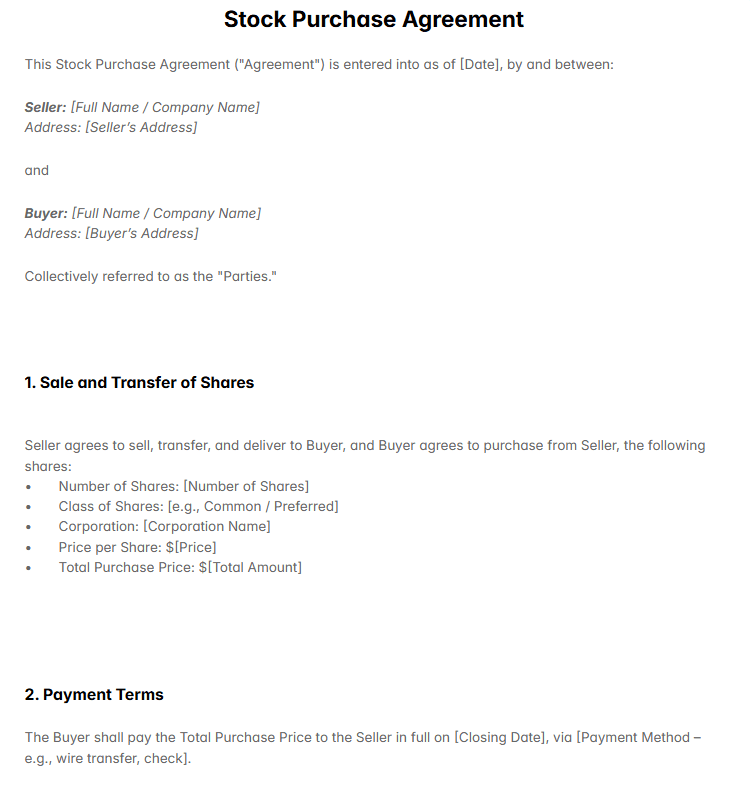
A Stock Purchase Agreement (SPA) is a legal contract between a buyer and a seller of company shares.
It outlines key terms such as the purchase price, payment method, and number of shares.
The SPA also includes representations and warranties to protect both parties.
It defines closing conditions, timelines, and legal obligations.
This document ensures transparency, reduces risk, and provides a clear legal framework for share transact.
Why a Stock Purchase Agreement Matters: Data‑Backed Reasons Every Buyer & Seller Should Know
A strong SPA provides clarity and assurance, particularly when stock not cash is involved.
Key statistics shows
A Harvard‑affiliated study highlights that after acquisitions in biotech, inventor retention dropped by 13.5% and patent productivity by 35% especially when SPAs fail to enforce post‑closing integration or retention clauses.
In 2021, 58% of tech M&A deals were equity-based, signalling the popularity of stock‑financed transactions in high‑growth sectors even during a SPAC boom.
Real world Case: Fort Effect Corp
In March 2021, Luum’s SPA included detailed closing deliverables: lien releases, officer resignations, escrow agreements, and post‑closing indemnity structure, Such tailored clauses ensured a clean title transfer, lower risk, and provided a mechanism for adjustments.
Stock Purchase Agreement represents one of the many templates available within the Business Document category featured on our website.
For a more comprehensive understanding of Business Document — including their legal nuances, variations across jurisdictions, and practical applications — we invite you to explore our in-depth overview article dedicated to this document category.
Who Benefits Most from a Stock Purchase Agreement?
Startup founders and co-founders rely on a Stock Purchase Agreement to formally document share ownership, prevent future disputes, and ensure transparency during fundraising, founder exits, or restructuring.
Angel investors and venture capitalists benefit from clear terms on equity allocation, rights, and protections. An SPA helps them mitigate risks while ensuring proper legal recognition of their investment.
Freelancers and independent creators entering equity deals — such as sweat equity arrangements or creative partnerships — use SPAs to safeguard their interests and establish ownership terms from the beginning.
Small business owners use SPAs when bringing on partners, transferring shares to family members, or reorganizing ownership to ensure a legally enforceable, conflict-free process.
Legal and financial advisors rely on well-drafted SPAs to protect their clients during M&A activity or stock-based compensation arrangements. A clear agreement limits liability and facilitates smoother closings.
Creative agencies and service firms with equity-sharing models or employee ownership plans use SPAs to define roles, expectations, and exit strategies — ensuring alignment across leadership and teams.
Private buyers and sellers engaged in company acquisitions or internal stock transfers depend on SPAs to guarantee clean title, fair pricing, and protection from post-sale liability.
Legal Importance and Context
A Stock Purchase Agreement (SPA) provides a robust legal framework for the transfer of company ownership, safeguarding all parties involved:
Clarifies core transaction terms such as share count, purchase price, payment structure, and closing conditions minimizing misunderstandings and aligning expectations
Enforces representations & warranties, ensuring sellers disclose material facts about the business (e.g., financial health, compliance), while offering buyers recourse if misstatements occur.
Imposes indemnification obligations, protecting buyers from post-closing liabilities including cybersecurity incidents not caught during due diligence.
Designates governing law and dispute resolution mechanisms (e.g., arbitration, court jurisdiction), providing clarity in case conflicts arise.
Ensures compliance with corporate and securities laws, fulfilling regulatory prerequisites such as shareholder approvals, antitrust filings, and confidentiality controls.
Some other Key Benefits of a Stock Purchase Agreement
Clarity & Transparency: Clearly outlines terms, reducing misunderstandings and building trust.
Investor Appeal: Signals professionalism and preparedness attracts serious investors.
Financial Planning: Helps both parties align on valuation, payment terms, and closing timelines.
Smooth Transitions: Facilitates internal equity transfers with minimal disruption.
Operational Continuity: Pre-defines roles post-sale to ensure business stability.
Faster Deal Execution: Streamlines negotiations, saving time and reducing back-and-forth.
When Should You Use a Stock Purchase Agreement
Co‑founders joining or leaving: When someone enters or exits your venture.
Investor funding rounds: Anytime you're selling shares to angel investors or VC.
Internal equity redistribution: Reallocating stock among team members or consultants.
These scenarios are common among freelancers, designers, organizers, and small business owners who value clarity and trust in their ventures.
Key Sections of a Stock Purchase Agreement and How to Fill Them
Parties & Recitals Identify buyer, seller, and context.
Purchase Price & Consideration Specify share count, pricing mechanism, payment method.
Representations & Warranties Statements confirming company’s legal, financial, and operational status.
Covenants & Conditions Pre‑closing obligations (e.g., escrow release, board approvals).
Indemnification Liability protection terms, survival period, and caps.
Authorization & Signature Include date, signatory details, and placeholders for electronic signatures.
Practical Tips for Using a Stock Purchase Agreement Effectively
Keep secure digital copies and backups.
Verify all provided information, share counts, valuations, names, dates.
Communicate the process clearly explain expectations to partners, investors, and legal counsel to avoid surprises.
Free Download: Stock Purchase Agreement Template
⚖️ Legal Tip: The Critical Clauses That Protect Buyers and Sellers in Stock Purchase Agreements
According to the American Bar Association's Mergers & Acquisitions Committee, three essential protective clauses are frequently omitted from Stock Purchase Agreements that later lead to costly post-closing disputes:
Material Adverse Change (MAC) Clause: Most SPAs use generic language that courts find unenforceable. The ABA recommends specific language like: "A Material Adverse Change shall mean any event, occurrence, fact, condition, or change that is materially adverse to the business, results of operations, financial condition, or assets of the Target Company, or the ability of the Seller to consummate the transactions contemplated hereby; provided, however, that none of the following shall be deemed to constitute a Material Adverse Change: [list specific carve-outs relevant to industry and transaction]."
Sandbagging Provision: Industry data shows that 67% of M&A disputes involve knowledge issues. Your SPA should clearly state: "The rights of the Buyer to indemnification or any other remedy under this Agreement shall not be impacted or limited by any knowledge that the Buyer may have acquired, or could have acquired, whether before or after the closing date, nor by any investigation or diligence by the Buyer. The Seller hereby acknowledges that, regardless of any investigation made (or not made) by or on behalf of the Buyer, and regardless of the results of any such investigation, the Buyer has entered into this transaction in express reliance upon the representations and warranties of the Seller made in this Agreement."
Earnout Protection Mechanism: The American College of Corporate Counsel reports that 78% of earnout disputes involve operational control issues. Include specific language about: "During the Earnout Period, the Buyer shall operate the Target Business as a separate profit center, maintain separate books and records for the Target Business, not allocate corporate overhead to the Target Business in excess of historical allocations, provide the Seller with monthly financial statements and reasonable access to the books and records of the Target Business, and not take any action with the purpose of avoiding or reducing the Earnout Payment."
The Harvard Law School Forum on Corporate Governance reports that disputes involving these missing clauses account for approximately 71% of all post-closing SPA litigation.
📌 Real‑World Case: J&J Ordered to Pay $1 Billion Over Earnout Mismanagement
In 2024, the Delaware Court of Chancery ruled that Johnson & Johnson breached its Stock Purchase Agreement with Auris Health, a surgical robotics company it had acquired in 2019. The deal included over $2 billion in potential earnout payments contingent on meeting post-closing commercial and regulatory milestones. The SPA obligated J&J to use “commercially reasonable efforts” to support those milestones, but allowed the company to define those efforts using its own internal business practices.
After the acquisition, J&J redirected resources, merged Auris with other divisions, and slowed product advancement — making it nearly impossible to achieve the earnout targets. The court found that J&J failed to operate in good faith and violated the intent of the SPA. It awarded the former Auris shareholders over $1 billion in damages, one of the largest post-deal awards in M&A history.
Key Takeaway: A vague “efforts” clause in a Stock Purchase Agreement can become a major liability if it gives one party too much discretion over post-closing operations. Without specific, enforceable commitments about how the acquired business would be supported, J&J was free to make decisions that undermined earnout success. A well-drafted SPA should include clear performance obligations, limits on buyer discretion, and defined operational covenants to align both parties on post-closing expectations and avoid costly disputes.
🔑 Additional Insight: Industry-Specific SPA Considerations
Modern Stock Purchase Agreements should include industry-specific sections that address unique regulatory and operational concerns:
Industry | Key SPA Elements | Special Considerations | Risk Factors |
|---|---|---|---|
Technology | IP ownership verification | Open source contamination | Customer concentration |
Healthcare | Regulatory compliance reps | Payor relationship stability | HIPAA/privacy exposure |
Manufacturing | Environmental compliance | Supply chain disruption | Product liability |
Financial Services | Regulatory approvals | Customer remediation | Capital requirements |
Professional Services | Key person provisions | Client portability | Work-in-progress valuation |
According to the Mergers & Acquisitions Research Institute's 2024 Transaction Documentation Report, 83% of successful transactions now use industry-specific SPA formats rather than generic templates. Your SPA should reflect your specific industry with tailored representations and warranties addressing sector-standard risks.
Expert Insights
“Material Adverse Change (‘MAC’) clauses are key provisions designed to allow parties to opt out of a transaction when an unforeseen risk arises that materially affects the business operations of a target company … typically until the closing date of the transaction.”
— Public Administration Review, summarizing M&A clause design
“A ‘sandbagging’ or ‘pro‑sandbagging’ provision provides that a buyer’s remedies against the seller under the governing agreement are not impacted regardless of whether the buyer had knowledge, at or prior to closing, of the facts … giving rise to an indemnification claim.”
— Dentons
How AI Lawyer Creates Your Document (Step-by-Step)
At AI Lawyer, we believe that drafting legal documents shouldn’t feel like decoding a foreign language. Whether you’re a business owner, landlord, freelancer, or someone navigating a personal matter — you should be able to create a legally sound document without needing a law degree.
That’s why we built a document experience that works like a conversation, not a form. Here’s exactly how it works:
1. You Tell AI Lawyer What You Need
It starts with a simple question:
“What type of document do you want to create?”
You choose from our list of professional templates — whether it’s a rental agreement, contractor form, invoice, publishing contract, or anything else — and AI Lawyer immediately pulls up the structure designed specifically for that use case.
Behind the scenes, the system references U.S. legal standards and best practices to make sure you’re starting from the right foundation.
2. We Highlight the Key Sections
Instead of throwing the whole document at you, AI Lawyer breaks it down.
Each key component — like payment terms, deadlines, responsibilities, clauses — is briefly explained in human language so you know what it means before you fill it out.
It’s like having a lawyer on your shoulder saying,
“Here’s what this section covers, and why it matters.”
3. You Answer Simple, Targeted Questions
AI Lawyer asks you step-by-step questions — like:
Who’s involved?
What are the key dates or timelines?
What are the terms (payments, conditions, obligations)?
Do you need special clauses like confidentiality, termination, or jurisdiction?
Each question is directly linked to a block in the final document — so your answers go exactly where they belong.
4. The Document Builds Itself As You Go
On the right side of your screen, the full document builds in real time.
Every time you answer a question, a corresponding section is added — with legally sound wording, smart defaults, and editable fields.
You’re not just answering a form — you’re watching your document take shape.
This phased process helps:
Reduce overwhelm
Catch errors early
Ensure nothing is forgotten
5. You Edit and Customize Freely
Once all the inputs are in, the full document is unlocked for editing.
You can:
Rewrite any clause
Change formatting
Add or remove sections
Rephrase terms in plain English (or more formal legal tone)
The editor works like a Google Doc — intuitive, responsive, and flexible.
6. Your Final Document Is Yours to Keep
Download in PDF, DOCX, or copy to clipboard.
You can print it, email it, or send it for signature — and revisit your answers anytime to generate updated versions.
Why This Workflow Matters
Most template tools give you a blank form.
We give you a process — one that mirrors how a real attorney would walk you through the creation of a document:
Context → Input → Assembly → Review → Delivery
It’s not magic. It’s just a smarter way to get legal work done — without getting lost in the jargon.
FAQs
Q: Do I need an attorney to draft a SPA?
A: While templates can guide the process, legal review is essential to tailor clauses — like MAC, sandbagging, and earnouts — to your jurisdiction and deal specifics.
Q: Can I modify the stock purchase terms later?
A: Yes. SPAs often include amendment provisions — but major changes (e.g. valuation, closing conditions) typically require mutual consent from both parties.
Q: What's the difference between a SPA and an asset purchase agreement?
A: An SPA transfers shares (and all liabilities), while an asset purchase only transfers specific assets, allowing the buyer to avoid assumed liabilities.
Q: Can I use a SPA for internal share transfers among team members?
A: Absolutely. Whether reallocating shares between founders or granting equity to employees, a SPA ensures proper documentation and reduces risk of future disputes.
Q: Is a SPA required for early-stage investments?
A: It’s highly recommended. Even at the pre-seed or seed level, a SPA ensures legal clarity and shows professionalism to both investors and regulators.
Q: Does the SPA need to include valuation or just price per share?
A: It should include both. Stating the total valuation and the per-share price adds context and supports transparency for future investors or audits.
Sources and References
Empirical insights in this article, including figures on post-acquisition inventor retention and patent productivity and the prevalence of earnout litigation, draw on a Harvard-affiliated study on biotech acquisitions in the Journal of Business Research (“The impact of biotech acquisitions on inventor productivity”), commentary on earnout design in the Harvard Law School Forum on Corporate Governance. Drafting recommendations for MAC clauses, sandbagging provisions, and earnout protections are informed by the American Bar Association Mergers & Acquisitions Committee’s Private Target Deal Points Studies, practitioner analysis from Dentons on sandbagging in M&A transactions, the International Bar Association’s guidance on anti-sandbagging provisions in SPAs, and related surveys cited by the Mergers & Acquisitions Research Institute and corporate-governance scholars in the Harvard Law School Forum on Corporate Governance. The regulatory background on stock sales, private offerings, and investor protection relies on U.S. securities-law materials, including the SEC’s guidance on accredited investors, its FAQ on exempt offerings, and investor education bulletins from Investor.gov and related alerts on risks in private oil and gas offerings.
Final thoughts
A solid SPA is your shield defining ownership, protecting against future disputes, and boosting professionalism. With our AI-powered, attorney-grade template, you're not just filling out a form, you're establishing control, credibility, and clarity from day one. Don’t leave your equity to chance. Download, customize, and execute your SPA with the confidence of a dealmaker.
You Might Also Like: