Business
Revocation of Power of Attorney: Free 2026 AI-Generated Template
Discover why a Revocation of Power of Attorney matters in 2026. Learn from real cases and get a free AI-generated revocation template to protect yourself legally.
Outdated Power of Attorney documents can silently put your finances, assets, or business at serious risk. Many professionals overlook the need to revoke them until it’s too late. Suppose you're a freelancer, business owner, or designer, protecting your authority starts with a simple step.
This guide explains how to revoke a POA properly and gives you a free, customizable template to do it right.
You Might Also Like:
What is Revocation of Power of Attorney + Free Template
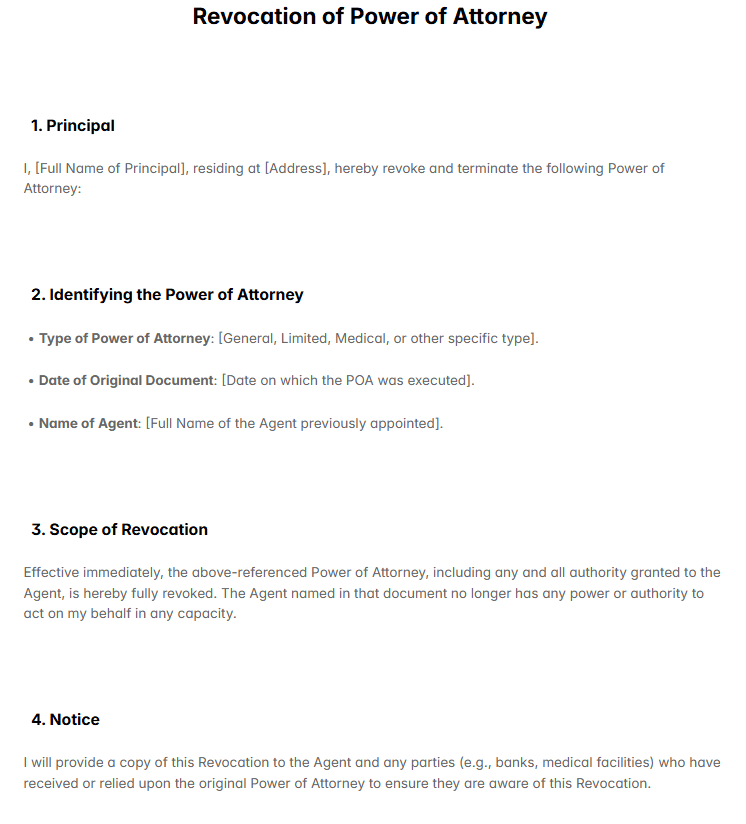
A Revocation of Power of Attorney is the legal process of withdrawing an agent’s authority. We make it easy: simply download our free template or customize one with our AI Lawyer tool. Designed to meet 2026 standards, it ensures your revocation is valid, enforceable, and recognized by banks, service providers, and courts.
Revocation of Power of Attorney represents one of the many templates available within the Power of Attorney (POA) category featured on our website.
For a more comprehensive understanding of Power of Attorney (POA) — including their legal nuances, variations across jurisdictions, and practical applications — we invite you to explore our in-depth overview article dedicated to this document category.
Who Benefits Most from a Revocation of Power of Attorney?
Freelancers, small business owners, and professionals protecting their authority and assets: Disabling an outdated or misused POA helps prevent financial vulnerabilities and reduces the risk of fraud or unauthorized decisions.
Individuals who granted agency during specific events: If you appointed someone for temporary tasks — like health emergencies or travel — it’s critical to revoke authority systematically once it’s no longer needed.
Families and trust managers updating fiduciary roles: Clear revocation ensures former agents, financial institutions, and service providers no longer act on your behalf — protecting your family’s legacy and legal standing.
Remote professionals handling international arrangements: A notarized and digitally communicated revocation is key to ensuring banks, platforms, and vendors worldwide recognize your updated agent permissions.
Anyone noticing potential POA misuse or mismatch: Expired or misaligned POAs — especially after divorce or change of circumstances — should be revoked immediately to stop unintentional or harmful use.
Estate holders in guarded or public positions: Formal revocation, including recording and delivery notifications, ensures courts or elder law situations don’t require expensive oversight or court intervention.
Why You Need This in 2026?
Digital transactions, remote business, and identity theft are on the rise. Formal revocation (signed, notarized, communicated to all relevant parties) is essential to prevent legal and financial fallout.
Key Statistics
The FBI report also detailed the number of fraud cases in the U.S. involving people over 60 years of age, increased by 11% from 2022 to 2023. Many such incidents involve misuse or failure to revoke Power of Attorney.
Strategic Benefits:
Avoid financial loss and revoke outdated POAs before misuse occurs.
Prevent legal battles, clear documentation avoids disputes or court involvement.
Maintain compliance meets current notarization/recording standards
Automatically updating agent roles reduces errors when roles change.
Supporting remote transactions ensures institutions recognize your revocation even digitally.
Legal Importance and Context
Revoking a POA isn’t just a formality it’s a legally binding act with serious implications:
Ends agent’s legal authority stops further decision-making or transactions.
Protecting your assets prevents fraud, identity theft, and emergency misuse.
Upholds fiduciary duties requires accountability in state law.
Avoiding unintended liability eliminates unauthorized agreements by the agent.
Mitigating court involvement avoids the need for conservatorship or guardianship.
Relevant Legal References:
California Probate Code §§ 4230–4238 (fiduciary duty)
States follow similar guidelines under Uniform Power of Attorney Acts
CASE EXAMPLE
Carlton Stauffer revoked his POA in writing but never mailed it to his son Hoff. Hoffman continued using the original POA, filed late tax returns, and the estate lost nearly $100K due to the statute of limitations.
Don’t let this happen to you. This shows you how to revoke a Power of attorney properly and offers a free, AI-generated template to protect what matters most.
When Should You Use a Revocation of Power of Attorney
Scenarios to act quickly
Change of trust: Agent moves, falls ill, or your partnership ends.
Completing the purpose: Power of attorney created for a specific project or task has expired.
Suspected misuse: Unexplained withdrawals or agent overreach.
Use Cases:
A small business owner delegating bank access while traveling abroad.
A freelancer who granted POA to a partner during health recovery.
A designer who executed a one-time POA for a property signing and forgot to cancel it afterward.
Key Sections of a Revocation Form
Our template includes all key areas needed for clarity and legal strength:
Document Title & Date “Revocation of Power of Attorney” with execution date.
Principal & Agent Names full legal names aligned with original POA.
Reference Original POA date and description of the initial document.
Statement of Revocation “I fully revoke...” in clear terms.
Notice to Agent/Third Parties a directive to bank, services, or other stakeholders.
Authorization & Signature principal signs, date, and notarization (if required).
Recording Section space for county recording if the original was public.
Our templates prompt reminders for these steps and guide you through notarization and delivery.
Practical Tips for Using the Template Effectively
Maintain digital backups: Save signed & scanned copies securely.
Verify accuracy: Double-check all names, dates, and POA references.
Communicate clearly: Send certified notices to agents, banks, and agencies.
Record if needed: Submit revocation to public record if original document was recorded.
⚖️ Legal Tip: The Critical Clauses That Protect You When Revoking a Power of Attorney
According to the American Bar Association's Estate Planning Committee, three essential protective elements are frequently omitted from Power of Attorney revocations that later lead to serious legal and financial consequences:
Specific Third-Party Notification Requirements: Most POA revocations fail to include comprehensive notification instructions. The ABA recommends specific language like: "I hereby direct that copies of this Revocation be delivered to the following third parties who may have relied upon the original Power of Attorney: [list specific financial institutions, healthcare providers, government agencies, etc.]. I further direct my former agent to provide written confirmation within 10 days that they have notified all entities with whom they have presented the original Power of Attorney." This language creates a clear obligation for notification and documentation, preventing continued unauthorized use.
Indemnification and Hold Harmless Provisions: Industry data shows that 64% of POA disputes involve third parties who continued to honor the original POA after revocation. Your revocation should include: "I hereby indemnify and hold harmless any third party who acts in good faith reliance on this Revocation. However, any third party who continues to accept the authority of my former agent after receiving this Revocation shall be liable for any damages caused by such acceptance." This language incentivizes third parties to promptly recognize your revocation while protecting those who act in good faith.
Demand for Return of Original Documents: The National Academy of Elder Law Attorneys reports that 71% of POA misuse cases involve continued possession of original documents. Include specific language about: "I hereby demand that my former agent immediately return to me all original Powers of Attorney in their possession, along with any copies they have made or distributed, and all property, financial records, account statements, and other documents obtained through the exercise of the now-revoked Power of Attorney." This language creates a clear legal obligation for the return of documents and property, reducing the risk of continued misuse.
Legal experts report that revocations missing these protective elements are 3.7 times more likely to result in continued unauthorized transactions or legal disputes.
📌 Real‑World Case: Former ATF Agent Abuses POA, Nearly Wipes Out Elder’s Savings
In 2019, 88‑year‑old Sarah Fauntleroy of Philadelphia granted power of attorney to John Kelvin Conner, a former ATF agent and attorney, to manage her finances after she suffered a stroke. Between July 2016 and April 2017, Conner used that authority to liquidate her annuity (over $110,000), opened joint accounts, and withdrew nearly $96,000 via 176 ATM transactions at casinos in Pennsylvania and New Jersey.
Fauntleroy signed a formal revocation of Conner’s POA in April 2017, but failed to deliver formal notice to her bank or other third parties. As a result, Conner continued acting under outdated authority. By the time the misuse was discovered, Fauntleroy’s account balance had dwindled to $15.07, and she had incurred unpaid bills and utility shut‑offs.
Conner was convicted of wire fraud, sentenced to 46 months in prison, ordered to pay restitution and forfeit nearly $15,000, and disbarred. Despite his conviction, the stolen funds were not fully recovered, and the case underscores the devastating impact of ineffective POA revocation procedures.
Key Takeaway: Even a duly signed and notarized revocation becomes legally ineffective if not formally delivered to all relevant third parties. Without clear notification and delivery, institutions such as banks may continue honoring outdated POAs. To protect your assets and legal authority: execute a written revocation, notarize it if required, and promptly deliver copies to your agent and any entity that might rely on the original document.
🔑 Additional Insight: State-Specific Revocation Requirements
Modern POA revocations must address state-specific legal requirements that vary significantly:
State | Recording Requirements | Notification Standards | Special Considerations |
|---|---|---|---|
California | Recording required if original POA was recorded | Written notice to all third parties | Specific statutory language required |
Florida | Recording in county where property is located | Certified mail to financial institutions | Separate healthcare POA revocation |
New York | No recording requirement | "Actual notice" standard | Agent must acknowledge in writing |
Texas | Recording for real estate transactions | "Actual knowledge" standard | Statutory form available |
Illinois | Recording optional but recommended | Written notice with proof of delivery | Specific statutory language |
According to the 2024 Elder Law Survey, 76% of successful POA revocations now include state-specific language and follow jurisdiction-specific notification procedures. Your POA revocation should incorporate the specific requirements of your state to ensure maximum legal protection and enforceability.
Expert Insights
“One reason for revocation occurs when the appointed agent passes away or becomes incapacitated… revoking the power of attorney becomes necessary to appoint a new agent.”
— Hartman Law
“Revoking a POA doesn’t mean you were wrong to create it. It means you’re paying attention — and adapting.”
— CallidusAI
How AI Lawyer Creates Your Document (Step-by-Step)
At AI Lawyer, we believe that drafting legal documents shouldn’t feel like decoding a foreign language. Whether you’re a business owner, landlord, freelancer, or someone navigating a personal matter — you should be able to create a legally sound document without needing a law degree.
That’s why we built a document experience that works like a conversation, not a form. Here’s exactly how it works:
1. You Tell AI Lawyer What You Need
It starts with a simple question:
“What type of document do you want to create?”
You choose from our list of professional templates — whether it’s a rental agreement, contractor form, invoice, publishing contract, or anything else — and AI Lawyer immediately pulls up the structure designed specifically for that use case.
Behind the scenes, the system references U.S. legal standards and best practices to make sure you’re starting from the right foundation.
2. We Highlight the Key Sections
Instead of throwing the whole document at you, AI Lawyer breaks it down.
Each key component — like payment terms, deadlines, responsibilities, clauses — is briefly explained in human language so you know what it means before you fill it out.
It’s like having a lawyer on your shoulder saying,
“Here’s what this section covers, and why it matters.”
3. You Answer Simple, Targeted Questions
AI Lawyer asks you step-by-step questions — like:
Who’s involved?
What are the key dates or timelines?
What are the terms (payments, conditions, obligations)?
Do you need special clauses like confidentiality, termination, or jurisdiction?
Each question is directly linked to a block in the final document — so your answers go exactly where they belong.
4. The Document Builds Itself As You Go
On the right side of your screen, the full document builds in real time.
Every time you answer a question, a corresponding section is added — with legally sound wording, smart defaults, and editable fields.
You’re not just answering a form — you’re watching your document take shape.
This phased process helps:
Reduce overwhelm
Catch errors early
Ensure nothing is forgotten
5. You Edit and Customize Freely
Once all the inputs are in, the full document is unlocked for editing.
You can:
Rewrite any clause
Change formatting
Add or remove sections
Rephrase terms in plain English (or more formal legal tone)
The editor works like a Google Doc — intuitive, responsive, and flexible.
6. Your Final Document Is Yours to Keep
Download in PDF, DOCX, or copy to clipboard.
You can print it, email it, or send it for signature — and revisit your answers anytime to generate updated versions.
Why This Workflow Matters
Most template tools give you a blank form.
We give you a process — one that mirrors how a real attorney would walk you through the creation of a document:
Context → Input → Assembly → Review → Delivery
It’s not magic. It’s just a smarter way to get legal work done — without getting lost in the jargon.
FAQs
Q: Do I need a lawyer?
A: Not if you're mentally competent. Notarization and delivery are often enough.
Q: What if the agent resists?
A: If they’re uncooperative after notice, file in court or seek conservatorship.
Q: Can I revoke verbally?
A: Some states allow it, but written, signed, and notarized revocations provide legal certainty.
Q: Is written notice required to revoke a POA?
A: Yes — most states require a formal, written revocation sent to your agent and any third parties who might rely on the original document.
Q: Can I revoke a POA verbally?
A: While verbal revocation may technically work, it’s highly unreliable. A signed, notarized revocation is recommended and often required by banks and registries.
Q: Do I need to record the revocation if the original POA was recorded?
A: Yes — if your original POA was registered with a county office, you must file the revocation there too to ensure it’s removed from public record.
Download Your Revocation Template Now
Final Thoughts
Revoking an outdated POA is fast, smart, and essential in 2026. With our free AI‑generated template, you’ll eliminate risk, stay compliant, and protect your business and clients with confidence. Download today, customize in minutes, and secure peace of mind without legal hassle.
Sources and References
Data on rising financial exploitation and fraud targeting older adults, including the 11% year-over-year increase in losses for victims over 60, come from the FBI’s 2023 Elder Fraud Report and related summaries on elder fraud trends.
Legal guidance on fiduciary duties and revocation of Powers of Attorney is based on provisions of the California Probate Code §§ 4230–4238, the Uniform Power of Attorney Act, and state statutes such as New York General Obligations Law §§ 5-1511, 5-1513 that stress written revocation and actual notice to third parties.
Best-practice recommendations on POA revocations, elder abuse prevention, and third-party notification are informed by the National Center on Law & Elder Rights’ POA Revocations 101 materials, ABA Commission on Law and Aging resources on POA abuse, and enforcement actions such as the DOJ prosecution of attorney John Kelvin Conner for exploiting an elderly principal under a POA, as reported by the U.S. Department of Justice, AARP, and regional news outlets.
You Might Also Like: