Business
Job Description Template Guide: When to Use & Legal Requirements
Download a customizable Job Description Template for clear roles, 2026 legal compliance, and hiring success. Free AI-powered version for freelancers and business owners.
A job description acts as your silent ambassador, outlining the purpose, responsibilities, and value of a position before the first interview. For freelancers, founders, and managers alike, it’s a simple tool that prevents costly missteps and confusion. With the right structure, it turns vague tasks into a clear roadmap for success.
You Might Also Like:
What Is a Job Description Template?
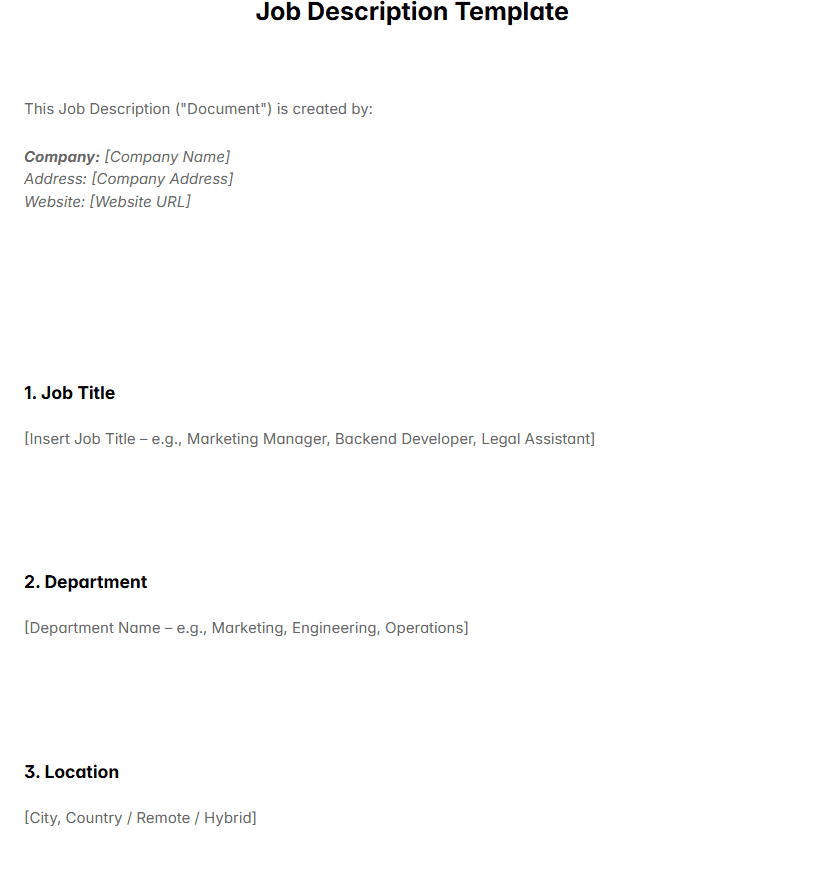
A job description template is a structured outline that standardizes role details title, responsibilities, qualifications, work conditions, and legal disclaimers.
Job Description Template represents one of the many templates available within the Employment Legal Templates category featured on our website.
For a more comprehensive understanding of Employment Legal Templates — including their legal nuances, variations across jurisdictions, and practical applications — we invite you to explore our in-depth overview article dedicated to this document category.
Who Benefits Most from a Job Description Template?
Hiring managers and recruiters use job description templates to align expectations across departments, reduce bias in candidate evaluation, and improve time-to-fill rates with clearer role visibility.
Startup founders and small business owners benefit by creating consistent, professional job listings without needing internal HR teams — avoiding vague role scopes that slow down hiring.
Freelancers and consultants can present better project offers by clearly outlining deliverables, timelines, and responsibilities based on job template logic.
HR professionals rely on standardized descriptions to enforce equitable job structures, track compliance, and ensure roles reflect current operational needs.
Legal and compliance teams gain clarity for classifying roles (exempt vs. non-exempt), preparing for audits, or defending employment decisions in court.
Employees themselves benefit from knowing their responsibilities, performance metrics, and reporting lines — increasing satisfaction, reducing burnout, and improving internal mobility.
Why does the Job description template need to be a must have in 2026?
Key Statistics
Job posts <300 words receive 8.4% more responses than longer ones; candidates only spend ~14.6 sec reviewing requirements.
Real world example:
Susan was hired as a Sales Administrator in Uk firm . Her job description detailed her purpose: “provide effective and efficient administration support to the sales team and relieve them of administrative duties.”
Legal / Regulatory Use (ResearchGate): Companies using standardized job descriptions align employee roles with strategic goals and support performance management leading to better engagement and retention.
Legal Importance and Context
Well-structured job descriptions serve critical legal purposes:
Disability Accommodation: Defines essential tasks for accommodation requests
Discrimination Protection: Justifies hiring decisions based on objective criteria
Wage & Hour Clarity: Shows roles, duties, and overtime status essential for exempt vs non-exempt classification
Advantages of using Job description template
Improves Hiring Accuracy
A well-defined template outlines exact expectations, helping recruiters match candidates to the role more precisely reducing hiring mismatches and turnover.
Streamlines Onboarding
New hires understand their responsibilities from day one, allowing faster integration into the team and minimizing early-stage confusion.
Enhances Role Clarity Across Teams
Standardized descriptions align internal teams on duties and reporting lines, promoting smoother collaboration and workflow transparency.
Supports Performance Management
Managers can set measurable goals and conduct fair evaluations based on clearly stated duties and objectives in the job description.
Saves Time and Ensures Consistency
Templates reduce the need to create each document from scratch, ensuring consistency in structure and language across departments.
When Should You Use a Job Description Template?
Templates can be used for:
Hiring a first team member or assistant: Use to clearly define role scope and set expectations.
Scaling projects or outsourcing: Standardized roles help contractors integrate smoothly.
Applying for grants or legal compliance: Having standard documents signals organizational maturity.
Key Sections of a Job Description Template & How to Fill Them
Job Title: Use a specific, clear title (e.g., “Registered Graphic Designer”).
Department & Reports To: State the department and direct supervisor.
Position Summary: Briefly summarize the role’s purpose and impact in 2–4 sentences.
Key Responsibilities: List main duties in bullet points for clarity.
Required & Preferred Qualifications: Separate essential requirements from desirable skills.
Skills & Competencies: Include relevant soft and technical skills.
Working Conditions & Compensation: Specify hours, location, and salary details if applicable.
Equal Opportunity Statement & Approval: Add a non-discrimination clause and approval section.
Authorization & Signature: Include space for official sign-off.
Practical Tips for Using a Job Description Template Effectively
Maintain both editable and digital PDF versions.
Verify all fields ensure accuracy in reporting lines, qualifications, and ADA compliance.
Communicate the hiring process clearly to the applicant's timeline, steps, and decision criteria.
Update annually, or when duties evolve.
Downloading the Job Description Template
Easy, free access to professionally designed templates.
Compatible with common file formats for immediate use.
⚖️ Legal Tip: The Critical Clauses That Protect Employers in Job Descriptions
According to the Society for Human Resource Management, three essential protective clauses are frequently omitted from job descriptions that later lead to employment disputes:
At-Will Employment Statement: Most employers need to explicitly state the at-will nature of employment. The SHRM recommends including specific language like: "This position is at-will, meaning either the employee or the employer may terminate employment at any time, with or without cause or advance notice. This job description is not an employment contract."
Essential Functions Designation: The Americans with Disabilities Act (ADA) requires clear identification of essential job functions. Your job description should clearly state: "The following functions are considered essential to this position:" followed by a bulleted list. This designation is crucial for determining reasonable accommodations and defending against disability discrimination claims.
Duty Modification Clause: Industry data shows that 43% of job description disputes involve changing responsibilities. Include specific language about: "This job description is not designed to cover all duties an employee may be required to perform. Duties, responsibilities, and activities may change at any time with or without notice as business needs require."
The Equal Employment Opportunity Commission reports that disputes involving these missing clauses account for approximately 52% of all job description-related employment conflicts.
📌 Real‑World Case: The $86,000 Essential Functions Dispute
In a 2023 ADA lawsuit — Butler v. City of Charlotte — a police officer working the third shift developed PTSD and requested a daytime shift as an accommodation. However, his job description included “working rotating shifts” as an essential job function. Because the requested shift change would have removed that essential duty, the court upheld his termination, finding no reasonable accommodation was possible. The written list of essential functions in the job description proved decisive in the outcome
Key Takeaway: A job description that clearly designates essential functions can be crucial in defending against ADA accommodation claims. By identifying required duties — such as rotating shifts or physical responsibilities — a well‑structured job description helps employers avoid ambiguity and legal exposure.
🔑 Additional Insight: Industry-Specific Job Description Considerations
Modern job descriptions should include industry-specific sections that address unique requirements:
Industry | Key Job Description Elements | Special Considerations | Risk Factors |
|---|---|---|---|
Healthcare | Licensure requirements, patient interaction protocols | HIPAA compliance responsibilities | Credential verification importance |
Technology | Technical skill specifications, project methodologies | Remote work expectations, on-call duties | Rapid skill obsolescence |
Education | Certification requirements, student interaction guidelines | Academic calendar considerations | Mandatory reporting obligations |
Manufacturing | Safety protocol responsibilities, equipment operation | Physical requirements specifications | OSHA compliance elements |
Financial Services | Compliance responsibilities, fiduciary duties | Regulatory certification requirements | Background check specifications |
According to the Bureau of Labor Statistics' 2024 Employment Practices Report, 67% of successful employers now use industry-specific job description formats rather than generic templates. Your job description should reflect your specific industry with tailored sections addressing sector-standard requirements.
Expert Insights
“Define essential functions: to aid in evaluating Americans with Disabilities Act (ADA) accommodation requests, define which tasks are a requirement… and potential for task reassignment.”
— SHRM, How to Write a Job Description
“A job analysis provides a way for organizations to fully understand the nature of a job. It helps draft better job descriptions and develop effective training and development programs, leads to a safer work environment and more effective and future‑ready workforce planning, and is pivotal in performance management.”
— AIHR, Job Analysis: A Practical Guide
How AI Lawyer Creates Your Document (Step-by-Step)
At AI Lawyer, we believe that drafting legal documents shouldn’t feel like decoding a foreign language. Whether you’re a business owner, landlord, freelancer, or someone navigating a personal matter — you should be able to create a legally sound document without needing a law degree.
That’s why we built a document experience that works like a conversation, not a form. Here’s exactly how it works:
1. You Tell AI Lawyer What You Need
It starts with a simple question:
“What type of document do you want to create?”
You choose from our list of professional templates — whether it’s a rental agreement, contractor form, invoice, publishing contract, or anything else — and AI Lawyer immediately pulls up the structure designed specifically for that use case.
Behind the scenes, the system references U.S. legal standards and best practices to make sure you’re starting from the right foundation.
2. We Highlight the Key Sections
Instead of throwing the whole document at you, AI Lawyer breaks it down.
Each key component — like payment terms, deadlines, responsibilities, clauses — is briefly explained in human language so you know what it means before you fill it out.
It’s like having a lawyer on your shoulder saying,
“Here’s what this section covers, and why it matters.”
3. You Answer Simple, Targeted Questions
AI Lawyer asks you step-by-step questions — like:
Who’s involved?
What are the key dates or timelines?
What are the terms (payments, conditions, obligations)?
Do you need special clauses like confidentiality, termination, or jurisdiction?
Each question is directly linked to a block in the final document — so your answers go exactly where they belong.
4. The Document Builds Itself As You Go
On the right side of your screen, the full document builds in real time.
Every time you answer a question, a corresponding section is added — with legally sound wording, smart defaults, and editable fields.
You’re not just answering a form — you’re watching your document take shape.
This phased process helps:
Reduce overwhelm
Catch errors early
Ensure nothing is forgotten
5. You Edit and Customize Freely
Once all the inputs are in, the full document is unlocked for editing.
You can:
Rewrite any clause
Change formatting
Add or remove sections
Rephrase terms in plain English (or more formal legal tone)
The editor works like a Google Doc — intuitive, responsive, and flexible.
6. Your Final Document Is Yours to Keep
Download in PDF, DOCX, or copy to clipboard.
You can print it, email it, or send it for signature — and revisit your answers anytime to generate updated versions.
Why This Workflow Matters
Most template tools give you a blank form.
We give you a process — one that mirrors how a real attorney would walk you through the creation of a document:
Context → Input → Assembly → Review → Delivery
It’s not magic. It’s just a smarter way to get legal work done — without getting lost in the jargon.
FAQs
Q: Can I use the same job description template for contractors and full-time employees?
A: With adjustments. Core responsibilities and qualifications may remain similar, but legal clauses, benefits, and compensation must differ to reflect employment status.
Q: Should job descriptions include salary ranges?
A: In many U.S. states and globally, yes — laws now require transparency in salary postings. Including a range improves trust and application rates.
Q: How often should job descriptions be reviewed or updated?
A: At least annually, or when roles shift due to promotions, restructuring, or regulatory changes. Outdated descriptions may create legal risks.
Q: Is it okay to use generic job titles like “Marketing Ninja”?
A: Avoid informal or unclear titles. Use industry-standard language to attract qualified candidates and maintain professionalism in documentation.
Q: Do job descriptions have to match performance review metrics?
A: Absolutely. Performance expectations should flow directly from responsibilities listed in the job description to ensure fairness and clarity.
Q: Can AI help me generate job descriptions faster?
A: Yes. AI tools like AI Lawyer allow you to auto-fill responsibilities, requirements, and compliance language based on industry and role, saving hours of manual drafting.
Sources and References
Data on job-post length and applicant behavior, including evidence that short job descriptions (1–300 words) generate roughly 8.4% more applications and that candidates scan requirements only briefly, comes from LinkedIn talent acquisition research on job posts and 2025 hiring-trend summaries such as Insight Global’s job description statistics and HRTechTrend’s analysis of job-post performance.The legal role of job descriptions in defining “essential functions” under the ADA and defending against disability-discrimination claims is grounded in EEOC guidance on employer responsibilities and employee rights, state and university materials on writing ADA-compliant job descriptions, and case-law commentary such as HRMorning’s analysis of Butler v. City of Charlotte cited in AI Lawyer’s overview of job description templates. Research on standardized job descriptions as a strategic HR and legal tool draws on recent empirical work linking clear role design to performance and alignment—such as studies on job descriptions and employee performance and job descriptions as a strategic tool—alongside practice guidance from SHRM’s job description guides and templates and recruiter resources on writing effective job descriptions.
Final thoughts
Using a clear, AI-customizable job description template saves time, promotes legal compliance, and attracts better applicants. In 2026’s digital-first world, it demonstrates professionalism and helps you focus on strategic growth. Download our free template now, customize it within minutes and make hiring one less thing to worry about.
You Might Also Like: