Business
General Bill of Sale Guide: When to Use & Legal Requirements
Secure your transactions with a free General Bill of Sale template. Customize it with AI and learn its legal importance, key uses, and how to protect both parties.
Selling a used laptop, camera, tools, furniture, or other personal property often feels simple: the buyer pays, and the item changes hands. But problems can appear later if the buyer claims the item was damaged, the payment terms were different, or the sale never happened.
A general bill of sale gives both sides a simple way to avoid confusion before money or property changes hands. As Nolo explains, a bill of sale can confirm the transfer of ownership and serve as written evidence of the transaction.
This guide explains when to use a general bill of sale, how to fill out the form, and when a printable PDF template is enough for a private personal property sale.

You Might Also Like:
What Is a General Bill of Sale?
A general bill of sale is a document that records the sale of personal property from one person to another. It shows who sold the item, who bought it, what was sold, how much was paid, and when the transfer happened.
It can also include the item’s condition, serial number, payment method, and “as is” terms. That makes it more useful than a basic receipt when you are selling something valuable, like a laptop, camera, bicycle, furniture, tools, or business equipment.
eForms describes a generic bill of sale as a receipt that records transaction details and can serve as proof of ownership for the buyer.
If you sell a used MacBook for $850 and the buyer later says a charger was included, the bill of sale can show the exact terms: “Apple MacBook Pro, 14-inch, serial number X, charger not included, sold as is.”
When Should You Use a General Bill of Sale?
Use a general bill of sale when you need a paper trail for a private sale or transfer of personal property. It is especially useful when:
you sell an item directly to another person, not through a store;
the item is valuable enough that a payment screenshot is not enough;
the buyer pays in cash, by Zelle, Venmo, PayPal, or another payment app;
the item is sold “as is”;
the buyer picks up the item in person;
you transfer property to a friend, roommate, family member, contractor, or business partner;
you may need proof later for taxes, accounting, insurance, or a dispute.
Private sales can become messy because there is usually no store receipt, no return policy, and no official record unless the parties create one. That is why Adobe’s bill of sale guide recommends including clear details about the buyer, seller, item, price, date, and signatures.
Create a General Bill of Sale Form
Once the sale terms are agreed, create the document before the handoff. A ready-to-sign General Bill of Sale from AI Lawyer can help you add the buyer and seller details, item description, price, payment method, sale date, and “as is” terms in one printable PDF.
After signing, both parties should keep a copy with payment confirmation and item photos. It is much easier to prepare the form before the sale than to recreate the details after something goes wrong.
What Should a General Bill of Sale Include?
A general bill of sale should be clear enough that someone who was not part of the deal can understand what happened. At minimum, include:
full names and contact details of the buyer and seller;
sale date;
detailed item description;
serial number, model, size, color, or other identifying details, if available;
purchase price and payment method;
item condition;
“as is” terms, if the buyer accepts the item in its current condition;
buyer and seller signatures.
The item description is where many private sales go wrong. “Used camera” is too vague. “Canon EOS R6 camera, serial number X, body only, minor scratches on bottom, tested and working” is much safer.
FindLaw explains that a bill of sale should include details such as the item description, sale date, purchase price, and the names of the buyer and seller.
How to Fill Out a General Bill of Sale Form
Fill out the form in the same order the deal happens.
First, identify the buyer and seller using full legal names and contact details. Then describe the item in enough detail that it cannot be confused with another one. For example, instead of “used laptop,” write “Apple MacBook Air, 13-inch, serial number 123456789, silver, tested and working, charger included.”
Next, record the sale price, payment method, and whether the amount was paid in full. Before signing, review the form with the other party and make sure the date, item details, price, and signatures are correct.
FindLaw’s guide on writing a bill of sale also recommends including payment terms and any important conditions of the sale.
What Does “As Is” Mean in a General Bill of Sale?
“As is” means the buyer accepts the item in its current condition at the time of sale. For the seller, this can reduce arguments about repairs, replacements, or refunds after the item changes hands. For the buyer, it is a reminder to inspect the item before paying.
Still, “as is” does not give the seller permission to hide problems or lie about the item. If a seller knows the camera does not turn on, or the tool has a broken part, that should be disclosed before signing. Under UCC § 2-316 from Cornell’s Legal Information Institute, warranty disclaimers may need clear written language, especially when implied warranties are being limited.
A simple version can sound like this: “The buyer accepts the item in its current condition after inspection.” For valuable items, add short condition notes and photos.
The key point: “as is” works best when the item’s real condition is written down, not just assumed.
Does a General Bill of Sale Need to Be Notarized?
In many private sales, a general bill of sale does not have to be notarized. The buyer and seller can usually sign the form and keep copies for their records.
Notarization can still help when the item is expensive, the parties do not know each other, or the document may be used later for insurance, taxes, registration, or a dispute. A notary confirms the identities of the people signing, which makes the document harder to challenge.
Some property types, such as vehicles, boats, or trailers, may require separate state forms. Adobe notes that not every bill of sale needs notarization, but it can be useful for high-value transactions and future paperwork.
When Not to Use a General Bill of Sale
A general bill of sale is useful for many private sales, but it is not the right document for every transaction. Use a more specific form when the item has special registration, title, or legal requirements.
You should not rely only on a general bill of sale when:
selling a car, motorcycle, boat, trailer, ATV, or other titled property;
transferring real estate or a share in real estate;
selling services instead of physical property;
selling a business, business shares, or intellectual property;
using a payment plan where the buyer will pay over time;
transferring regulated items that may require special state or federal paperwork.
For example, vehicle sales often require a state-specific bill of sale, title transfer, and additional DMV forms. The New York DMV explains that private vehicle transfers may require a vehicle bill of sale along with other proof of ownership documents.
A general bill of sale works for ordinary personal property, but not for transactions that need a title transfer, registration, or a specialized legal agreement.
Digital or Printable General Bill of Sale: Which One Is Better?
A digital general bill of sale is convenient when the buyer and seller are not in the same place. You can fill it out online, sign it electronically, email a copy, and store it with payment records. Under the federal E-SIGN Act, electronic signatures and records generally cannot be denied legal effect only because they are in electronic form.
A printable general bill of sale is better when the sale happens in person. If the buyer is picking up furniture, tools, or equipment, both sides can review the form, sign it on paper, and leave with a copy.
Format | Best for | What to keep |
|---|---|---|
Digital form | Remote sales, emailed documents, e-signatures | Final signed file and payment confirmation |
Printable form | In-person pickup, cash sales, local private deals | Paper copy signed by both parties |
PDF copy | Long-term storage, taxes, insurance, disputes | Saved version that can be reopened and printed |
For higher-value items, the safest approach is to keep both: a signed PDF copy and a printed copy. The E-SIGN Act also notes that an electronic record may need to be retained and accurately reproduced for later reference, so saving the final signed version matters.
Use digital for remote deals, paper for in-person handoffs, and always save the signed final version.
General Bill of Sale vs. Receipt vs. Invoice
A general bill of sale, receipt, and invoice can all mention money, but they do not do the same job. The difference matters because using the wrong document can leave a gap in your records.
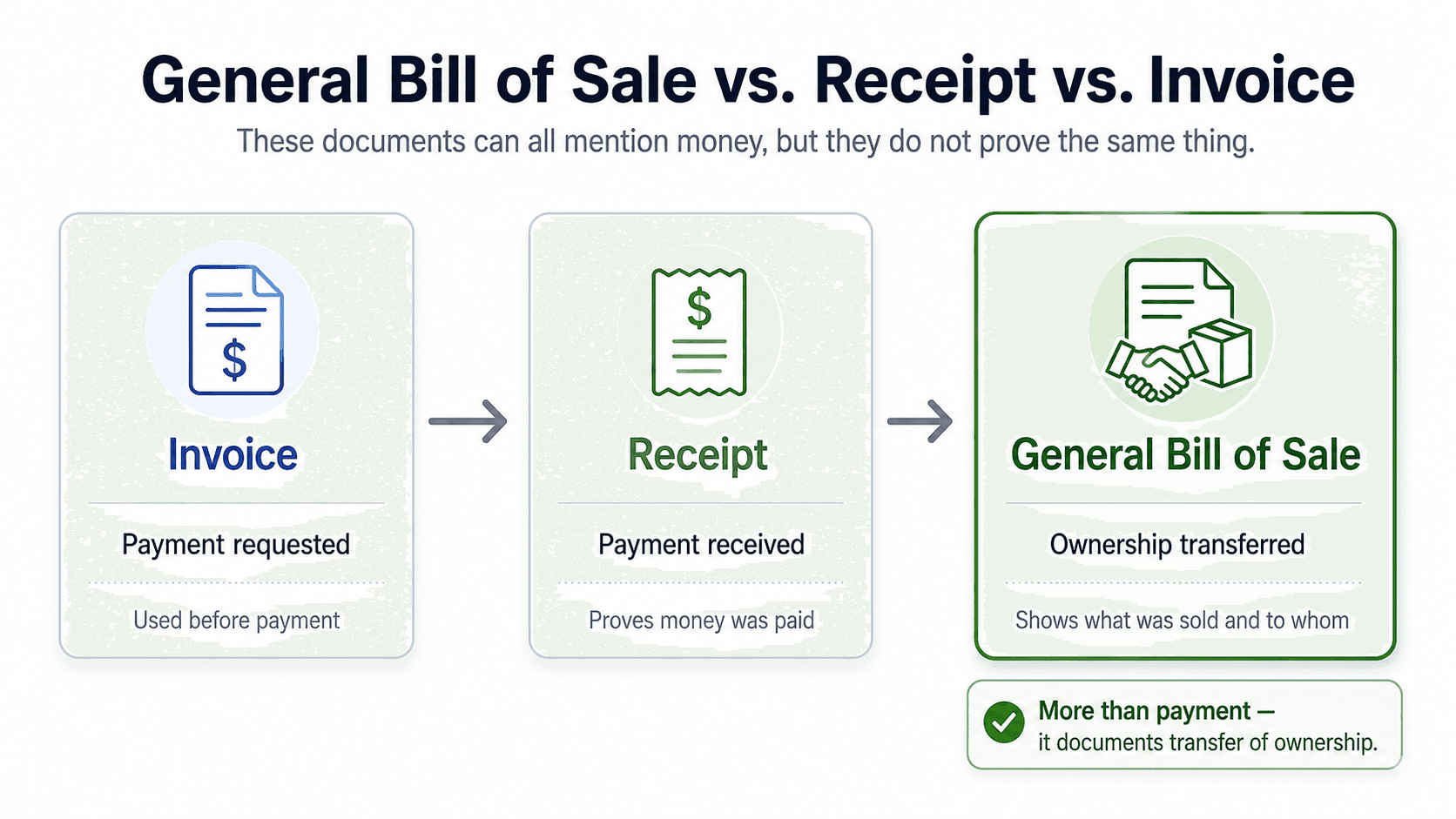
Document | When it is used | What it proves |
|---|---|---|
General bill of sale | When personal property is sold or transferred | Ownership changed from seller to buyer |
Receipt | After payment is made | Money was received |
Invoice | Before payment is made | Payment is being requested |
For a private sale, a receipt may show that the buyer paid $600, but it may not describe the item, condition, serial number, or transfer of ownership. An invoice is usually better for business transactions where a seller is asking a customer to pay. SumUp explains that an invoice is issued before payment, while a receipt is issued after payment.
A general bill of sale is more useful when the main question is not only “Was money paid?” but also “What exactly was sold, and who owns it now?”
Common Mistakes to Avoid With a General Bill of Sale
Even a simple general bill of sale can lose value if it is filled out carelessly. The biggest mistakes are usually small: vague item descriptions, missing signatures, no copy for one of the parties, or signing the form after the item has already been handed over.
Avoid these common problems:
writing “used laptop” instead of adding the brand, model, condition, and serial number;
forgetting to state whether the payment was made in full;
leaving out the sale date or signatures;
keeping only one signed copy;
using a general form when the sale needs a state-specific document.
The FTC’s online shopping guidance recommends keeping records such as receipts and emails. For a private sale, the bill of sale should become part of that record, along with payment confirmation and any messages about the deal.
A clean, specific form is much easier to rely on later than scattered screenshots or memory.
FAQs
Q: Is a general bill of sale legally binding?
A: It can be legally binding when both parties agree to the terms, sign it voluntarily, and the sale is lawful. Clear item details, price, date, and signatures make the document stronger.
Q: Do I need a general bill of sale for a low-cost item?
A: Usually, no. For small everyday items, a payment receipt may be enough. A general bill of sale is more useful when the item has meaningful value, could be resold, or may cause disagreement later.
Q: Does each party need a copy?
A: Yes. The buyer and seller should each keep a signed copy, either printed or saved as a PDF. This helps both sides prove what was agreed.
Q: Can I use it for used electronics or furniture?
A: Yes. A general bill of sale works well for private sales of used laptops, cameras, phones, furniture, tools, appliances, and similar personal property.
Q: What if payment is made through Venmo or PayPal?
A: You can still use a general bill of sale. Write down the payment method, the amount paid, and whether the payment was made in full. Keep the payment confirmation with the signed form.
Q: Can I use a general bill of sale for a gift?
A: Yes. If you are giving away valuable personal property, the form can show that ownership was transferred as a gift. Instead of a purchase price, you can write “gift” or “$0.”
Q: What if the buyer refuses to sign the bill of sale?
A: Do not rush the transaction. A refusal may mean the buyer does not agree with the item description, condition notes, payment terms, or “as is” language.
Q: Can I use one bill of sale for multiple items?
A: Yes, if all items are part of the same transaction. List each item separately, especially if they have different values, conditions, serial numbers, or accessories.
Q: Can I change a general bill of sale after signing?
A: Only if both parties agree. Small corrections should be initialed by both sides. For major changes, it is cleaner to create and sign a new version.