Business
Free Room Rental Agreement Template: AI-Powered (2026)
Secure your rental in 2026 with a free AI-generated Room Rental Agreement template—learn benefits, key legal terms, and tips for smooth roommate rentals.
A homeowner rents out a spare bedroom. At first, everything feels easy. Then the renter’s partner starts staying over most nights. The electric bill goes up. The shared bathroom becomes a problem. Nothing was written down because the arrangement seemed simple.
A written Room Rental Agreement could have set clear rules from the start: rent, utilities, guests, shared spaces, house rules, and move-out terms.
This guide explains when to use a Room Rental Agreement, what to include, and which details to write clearly before anyone moves in.
You Might Also Like:
TL;DR
A Room Rental Agreement is used when someone rents one private room in a shared home. It covers the bedroom itself and the shared spaces, such as the kitchen, bathroom, laundry area, parking, or living room.
The agreement should make everyday rules clear before move-in. Rent, deposit, utilities, guests, cleaning, quiet hours, repairs, and move-out terms should not be left to memory or text messages.
It is not the same as a roommate agreement or a full lease. A Room Rental Agreement focuses on one renter, one room, and the rules for sharing the rest of the property.
The most common problems come from vague details. Guest limits, utility splits, parking access, and deposit deductions should be written in plain language.
A simple written agreement is better than an informal deal. Even if the renter is a friend or family member, clear terms help prevent confusion later.
What Is a Room Rental Agreement?
A Room Rental Agreement is used when someone rents one private room inside a shared home. The renter may also use common areas, such as the kitchen, bathroom, laundry room, or living room.
UC Santa Cruz describes a typical room rental as a setup where a person has a private bedroom while sharing common areas with others in the home. This is the key difference: a Room Rental Agreement covers one room in a shared property, not the entire home.
Room Rental Agreement vs Roommate Agreement vs Sublease Agreement
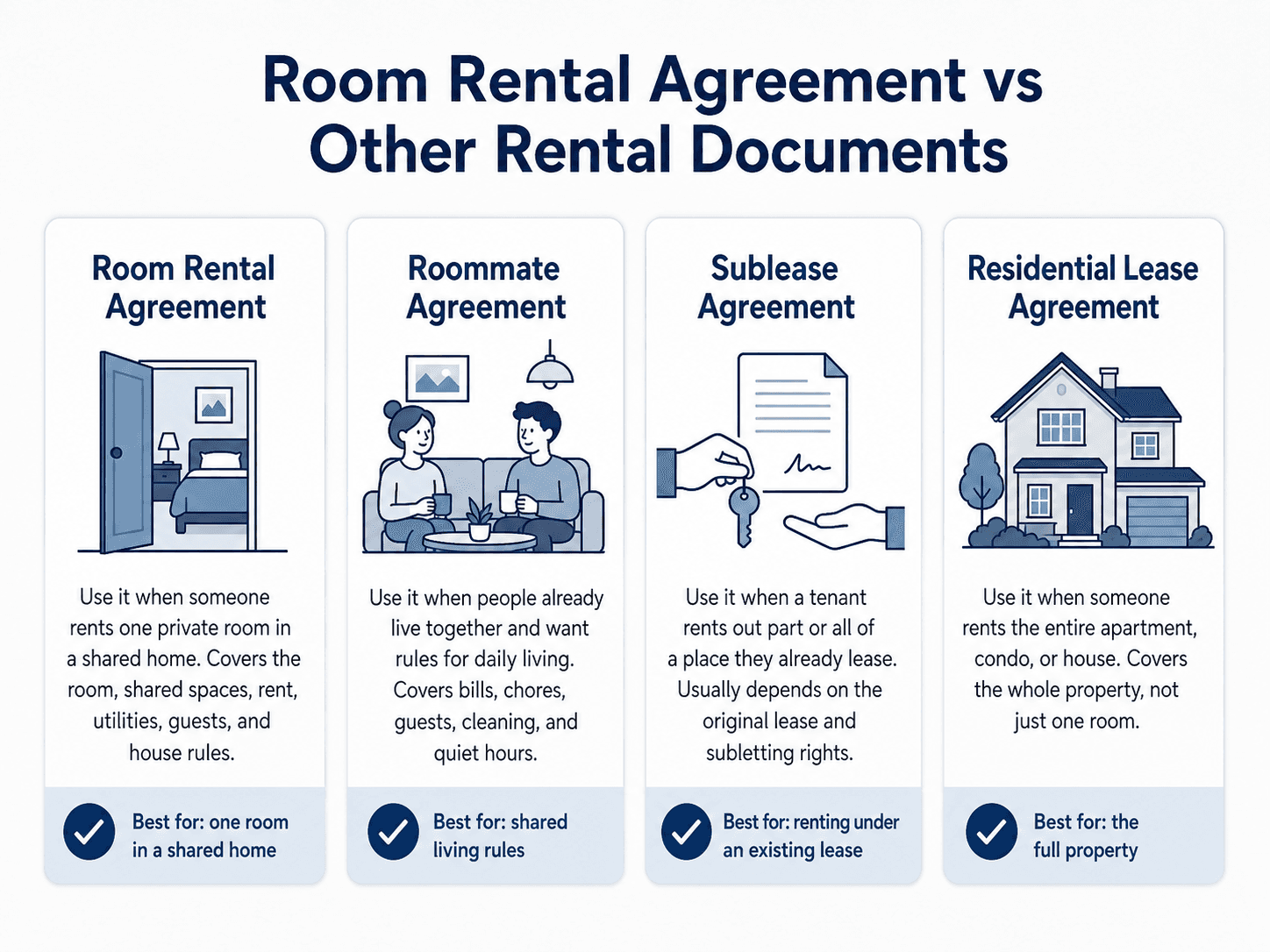
These documents can look similar, but they are used in different situations. The main difference is what the person is renting: one room, shared responsibilities, part of an existing lease, or the whole property.
Document | Use it when | Main difference |
|---|---|---|
Room Rental Agreement | Someone rents one private room in a shared home. | It covers the room, rent, shared spaces, guests, utilities, and house rules. |
Roommate Agreement | People already live together and want rules for daily living. | It focuses on bills, chores, quiet hours, guests, cleaning, and shared responsibilities. |
Sublease Agreement | A tenant rents out part or all of a place they already lease. | It usually depends on the original lease and the tenant’s right to sublet. |
Residential Lease Agreement | Someone rents the entire apartment, condo, or house. | It covers the whole property, not just one room. |
If the renter’s rights are unclear, choose the document that matches the real living setup — not just the name people use casually.
When Should You Use a Room Rental Agreement?
Renting a room is one way people deal with high housing costs. In 2026, the Harvard Joint Center for Housing Studies reported that 22.7 million U.S. renter households spent more than 30% of their income on rent and utilities in 2024. That pressure makes shared housing and spare-room rentals more common.
Use a Room Rental Agreement when someone rents one bedroom but still shares part of the home with others.
Common situations include:
You rent out a spare bedroom.
The renter has their own room but may use the kitchen, bathroom, laundry room, driveway, or living room.You rent one room in a shared apartment.
The agreement can explain utilities, cleaning, guests, and quiet hours.You are the main tenant and want to rent out one room.
Check the original lease first. It may not allow another person to move in.You want a month-to-month room rental.
The agreement can explain rent, notice, and move-out rules.You are renting to someone you know.
Friends and family can still disagree about money, guests, cleaning, or bills.
Room Rental Agreement Checklist
Before signing, both sides should be able to answer these questions the same way:
Which exact room is being rented?
The agreement should name the room clearly, not just say “one room.”Which spaces are shared, and which are off-limits?
This can include the kitchen, bathroom, laundry room, driveway, backyard, storage area, or living room.How much is rent, and when is it due?
The agreement should state the rent amount, due date, payment method, and any late-payment rules.What happens with the security deposit?
It should explain the deposit amount, possible deductions, and when the remaining deposit may be returned.How are utilities handled?
The agreement should say what is included, what is split, and how bills are shared.What are the guest rules?
Overnight guests should not be left to assumptions. The agreement should explain limits and when approval is needed.What house rules matter most?
Noise, smoking, pets, cleaning, quiet hours, and use of shared areas should be written in plain language.Who gets keys, parking, mailbox access, or storage access?
These details are easy to forget before move-in and easy to argue about later.How does the rental end?
The agreement should explain notice, move-out condition, key return, final payments, and deposit review.Do both sides have a signed copy?
A saved PDF, printed copy, or digital version is much better than relying on messages or memory.
If both sides answer these questions differently, the agreement is not ready to sign.
A Simple Room Rental Agreement Example
The example below is not a full legal document. It shows how the main terms of a basic Room Rental Agreement can look in plain English.
Basic Room Rental Agreement
1. Parties
This agreement is between Sarah Mitchell, the property owner, and Daniel Rivera, the person renting the room.
2. Property and room
Daniel will rent Bedroom 2 in the property located at 1846 Maple Street, Austin, TX 78704.
Daniel is renting one private bedroom, not the entire home.
3. Shared spaces
Daniel may use the kitchen, shared bathroom, laundry room, living room, and one driveway parking space.
Daniel may not use Sarah’s bedroom, the locked garage storage area, or any space not listed in this agreement.
4. Rent
Daniel will pay $850 per month. Rent is due on the 1st day of each month.
Rent will be paid by bank transfer, unless both sides agree to another payment method in writing.
5. Security deposit
Daniel will pay an $850 security deposit before moving in.
The deposit may be used for unpaid rent, damage, missing keys, or cleaning beyond normal use. Any remaining deposit will be returned after move-out, based on the terms of this agreement.
6. Utilities
Internet and water are included in rent.
Electricity and gas will be split equally between Sarah and Daniel. Sarah will share the bill before payment is due.
7. Guests
Daniel may have overnight guests up to two nights per week.
Longer stays need written approval from Sarah. Guests must follow the same house rules as Daniel.
8. House rules
No smoking indoors. Quiet hours are from 10 PM to 7 AM.
Shared spaces must be cleaned after use. Pets are not allowed unless both sides agree in writing.
9. Repairs and damage
Daniel must report damage, leaks, or safety issues as soon as possible.
Daniel is responsible for damage caused by him or his guests.
10. Move-out notice
Either Sarah or Daniel may end this agreement with 30 days’ written notice.
Before moving out, Daniel must return all keys, remove personal items, and leave the room clean.
11. Signatures
Landlord: Sarah Mitchell
Date: March 1, 2026
Renter: Daniel Rivera
Date: March 1, 2026
A real agreement may need more detail.
When Can Money Be Deducted From the Security Deposit?
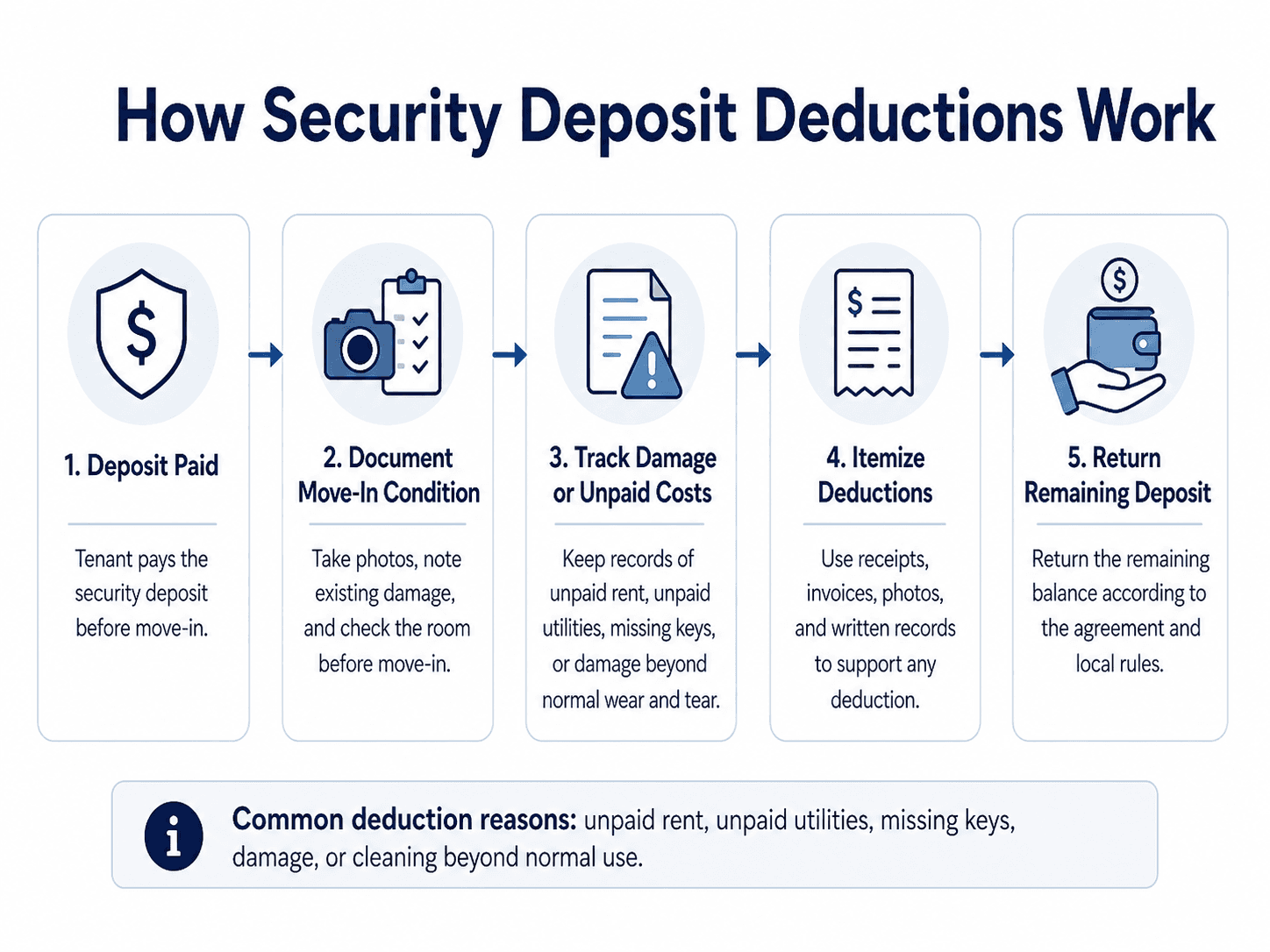
A security deposit is not extra rent. It should only be used for clear issues that are allowed by the agreement and supported by records.
Common reasons include unpaid rent, unpaid utilities, missing keys or access items. New York’s Attorney General notes that a security deposit may be used for unpaid rent or reasonable repair costs beyond normal wear and tear.
The agreement should also explain how deductions will be documented. This can include move-in photos, move-out photos, repair receipts, cleaning invoices, unpaid bills, rent records, or written messages about the issue.
If the deduction is not written down or supported by proof, it is easier to dispute. That is why deposit terms should be clear before the renter moves in, not decided after move-out.
What Happens After Signing?
Signing the Room Rental Agreement is not the final step. The move-in should match what the agreement says.
Keep the signed copy
Each side should keep the same final version. A saved PDF or printed copy is better than relying on messages or memory.
Check the room before move-in
Both sides should look at the room before the renter moves in. Check the walls, floor, windows, locks, furniture, and any existing damage.
HUD’s sample inspection form shows the same logic: condition should be checked at move-in and again at move-out. Photos can help prevent deposit arguments later.
Match access to the agreement
The renter should receive only the access listed in the agreement. This may include keys, fobs, mailbox access, parking, storage, or a gate code.
Access should not be left to assumptions.
Keep payment records
First rent, the security deposit, and shared utility payments should be easy to track. Maryland’s Attorney General notes that rent receipts are required for cash payments or when requested.
Write down changes
If a guest starts staying often, utilities change, parking is added, or storage access changes, update the agreement in writing.
A Room Rental Agreement works best when it matches the real living setup.
Create a Room Rental Agreement with AI Lawyer
Once you know that a Room Rental Agreement fits your situation, the next step is choosing the right version of the document.
Start with the main Room Rental Agreement Template if you need a general agreement for renting one room in a shared home.
For a more location-specific version, use one of the state templates:
AI Lawyer lets you review the document, edit the wording, and download the final version as PDF or DOCX.
FAQs
Q: Does a Room Rental Agreement need to be notarized?
A: Usually, no. In most simple room rental situations, signatures from both sides are enough. Notarization may help prove that the signatures are real, but it is not always required. Local rules can vary.
Q: Can a Room Rental Agreement be signed online?
A: Yes. Electronic signatures are commonly used for rental documents. The federal E-SIGN Act gives electronic signatures legal effect in many U.S. transactions when the parties agree to use them. Both sides should keep the final signed copy.
Q: Is a verbal Room Rental Agreement enough?
A: It may create problems because it is hard to prove what was agreed. One person may remember the guest rule, utility split, or move-out notice differently. A written agreement is safer because the terms are easier to show later.
Q: Can the landlord enter the rented room?
A: The agreement should explain when entry is allowed. Normal entry usually needs notice. Emergencies may be different. The renter’s room should not be treated like an open common area.
Q: Can house rules be changed after the renter moves in?
A: Yes, if both sides agree. The safest option is to put the change in writing. This matters for guests, pets, parking, storage, utilities, or any rule that affects daily living.
Q: What happens if the renter stops paying rent?
A: The agreement helps show the rent amount, due date, and payment method. The next steps depend on state and local landlord-tenant rules. Do not use lockouts or informal pressure. Follow the legal process in your area.
Q: Can a Room Rental Agreement limit guests?
A: Yes, but the rule should be clear and applied fairly. A guest policy can limit overnight stays or long visits. It should not be used in a discriminatory way. The U.S. Department of Justice explains that the Fair Housing Act protects people from housing discrimination based on protected characteristics.