Business
Employment Offer Letter: Key Terms, Conditions & Legal Effect
Download a free Employment Offer Letter template. Ensure legal protection and hiring clarity in 2026 with expert-backed tips and best practices for employers.
Imagine spending hours searching for the perfect designer or freelancer, negotiating the pay, and agreeing on responsibilities only to lose them before onboarding due to misunderstandings. Worse, some may accept the job, only to dispute terms later due to unclear agreements.
You Might Also Like:
What Is an Employment Offer Letter?
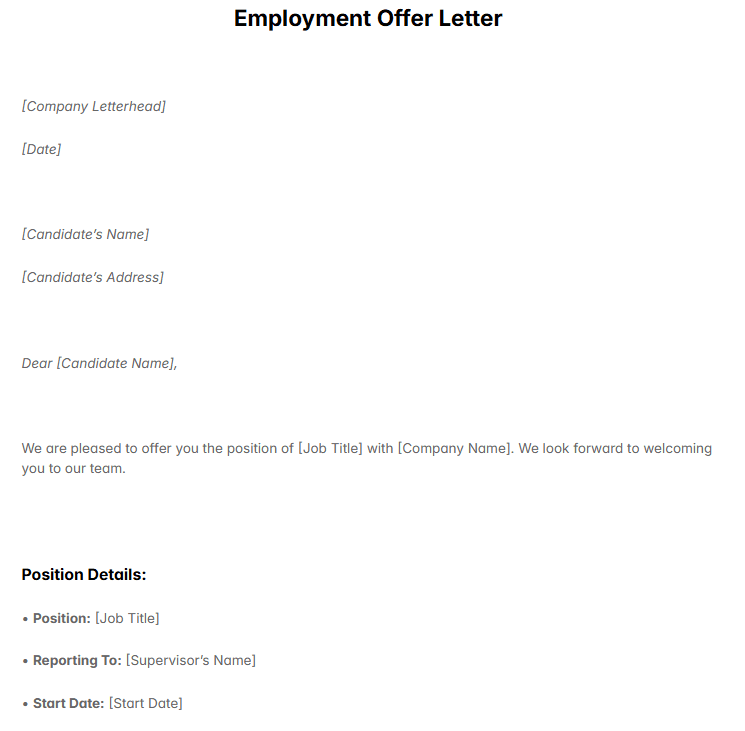
An Employment Offer Letter is a formal document that confirms a job offer in writing. It outlines essential employment terms such as:
Job title and role
Reporting structure
Salary and benefits
Work schedule and location
Employment status
It serves as a pre-contract agreement, offering both the employer and the candidate clarity before employment formally begins.
Employment Offer Letter represents one of the many templates available within the Employment Legal Templates category featured on our website.
For a more comprehensive understanding of Employment Legal Templates — including their legal nuances, variations across jurisdictions, and practical applications — we invite you to explore our in-depth overview article dedicated to this document category.
Who Benefits Most from an Employment Offer Letter?
Startup founders and small business owners benefit from structured offer letters by reducing onboarding confusion, protecting against legal claims, and presenting a polished brand image to new hires.
Freelancers and remote teams gain clear expectations around scope, deliverables, and timelines. A written offer letter reinforces professionalism and reduces the risk of ghosting or miscommunication in distributed teams.
Recruiters and HR managers use standardized offer letters to maintain legal compliance and ensure equitable treatment across candidates — while saving time on administrative tasks.
Legal and compliance officers rely on offer letters to reduce exposure to misclassification or false promise claims. Proper disclaimers and at-will language can prevent implied contract disputes.
New hires themselves benefit from having written terms they can refer to — such as salary, start date, benefits, and reporting lines. It builds trust and encourages timely acceptance.
Corporate teams onboarding multiple roles use offer templates to align operations (HR, payroll, IT), accelerating setup and minimizing onboarding errors.
Why You Need This in 2026: Facts, Legal significance, and Real Examples
Verbal job offers and informal emails are not enough in today’s professional and legal landscape. Without a formal Employment Offer Letter, you risk:
Legal disputes over salary, job scope, or benefits
Unclear expectations leading to early resignations
Damage to your brand's professionalism.
Survey Insight: A 2022 Upwork Report shows that over 60% of freelancers prefer a written offer or contract before accepting any work.
Legal Importance and Context
In many jurisdictions, issuing an Employment Offer Letter is considered a best practice, even when not legally mandatory.
Here’s why it matters legally:
Demonstrates transparency in hiring
Protects against misinterpretation or litigation
Complies with fair employment practices and disclosures
Serves as preliminary evidence in case of disputes
Relevant laws:
Fair Labor Standards Act (FLSA) U.S. Dept. of Labor
Equal Employment Opportunity laws (EEOC)
Real-World Example: Sui v. Hungry Panda Tech Ltd.
Mr. Sui accepted a job offer via email that included salary, start date, and benefits later ruled a legally binding contract. When the company tried to change terms with a new agreement, the court rejected it due to lack of new benefits. As a result, Mr. Sui was awarded six months’ salary about $64,527 for breach of the original offer.
Clarity for New Hires
It sets clear expectations about the role, salary, and benefits. This avoids confusion and builds trust from day one.
Professional First Impression
A well-written offer letter reflects your company’s professionalism. It shows that you value structure and transparency in your hiring process.
Efficient Onboarding
Having key terms documented speeds up HR and onboarding processes. It ensures all teams from payroll to IT are aligned from the start.
Reduces Miscommunication
Written terms help prevent misunderstandings about job duties or compensation. It creates a single reference point for both parties to revisit if needed.
When Should You Use a Job Offer Letter Template?
There are several common hiring scenarios where a job offer letter template is essential:
Hiring freelancers or remote workers for long-term projects
Recruiting designers for fixed-scope contracts or full-time employment
Expanding your business team and offering roles to new employees
Onboarding contractors or interns with defined start dates and compensation
Key Sections of an Employment Offer Letter and How to Fill Them Out
Here’s what your offer letter should include:
Job Title & Role – Clearly mention the job position and main duties.
Start Date – Write the exact day the employee will begin work.
Reporting To – State who the new hire will report to (manager or supervisor).
Compensation – Include the salary amount and how often it will be paid.
Employment Type – Specify if the job is full-time, part-time, freelance, or at-will.
Benefits – List perks like health insurance, paid time off, or remote work.
Contingencies – Mention conditions like background or reference checks.
Signature Fields – Leave space for both you and the new hire to sign and date the letter.
Practical Tips for Using an Employment Offer Letter Effectively
Keep a digital and physical copy for both parties
Verify all job details before sending the letter
Set expectations for how the candidate should return the signed document.
Customize Your Offer Letter with AI or download your free Employment Offer Letter Download.
⚖️ Legal Tip: The Critical Clauses That Protect Employers in Offer Letters
According to the Society for Human Resource Management, three essential protective clauses are frequently omitted from offer letters that later lead to employment disputes:
At-Will Employment Statement: Most employers need to explicitly state the at-will nature of employment. The SHRM recommends including specific language like: "This offer letter is not a contract of employment and either you or the company may terminate employment at any time, with or without cause or advance notice. No representative of the company has authority to enter into any agreement contrary to the foregoing."
Contingency Clause: Industry data shows that 43% of offer letter disputes involve candidates who fail background checks or reference verifications. Include specific language about: "This offer is contingent upon successful completion of reference checks, background verification, and any other pre-employment screenings the company deems necessary. Failure to meet these requirements may result in withdrawal of this offer or termination of employment."
Offer Expiration Date: The National Labor Relations Board reports that 37% of offer-related disputes involve candidates who delay acceptance while pursuing other opportunities. Your offer letter should clearly state: "This offer will remain open until [specific date], after which time it will expire unless extended in writing by the company."
The Equal Employment Opportunity Commission reports that disputes involving these missing clauses account for approximately 41% of all offer letter-related employment conflicts.
📌 Real‑World Case: $149,000 Commission Award from Oral Offer
In California, M&C Hotel Interest, Inc. v. Chen, a hotel hired Jackie Chen with a written offer stating it superseded “any oral statements.” Later, her supervisor promised a 5% commission on room revenue — not included in her base duties. When the hotel refused to pay, citing the written offer’s supremacy over oral promises, the court disagreed. It found the commission agreement was independent and supported by new consideration. Consequently, the plaintiff was awarded $149,283 in damages for breach of the oral commission promise.
Key Takeaway: To avoid implied contract disputes, ensure your offer letters fully reflect all compensation terms — and include clear integration clauses (e.g., “this letter supersedes prior statements”) that cover future promises or oral commitments. Any verbal assurances — such as bonus or commission promises — must be included in writing or clearly excluded from enforceability to prevent unexpected liabilities.
🔑 Additional Insight: Industry-Specific Offer Letter Considerations
Modern offer letters should include industry-specific sections that address unique requirements:
Industry | Key Offer Letter Elements | Special Considerations | Risk Factors |
|---|---|---|---|
Technology | IP assignment clauses, remote work policies | Stock option explanations | Non-compete enforceability |
Healthcare | Licensure verification requirements | Patient privacy obligations | Credential verification timing |
Sales | Commission structure details | Territory definitions | Quota establishment timing |
Education | Academic year specifications | Tenure track explanations | Grant funding dependencies |
Financial Services | Regulatory certification requirements | Client relationship policies | Background check depth |
According to the Bureau of Labor Statistics' 2024 Employment Practices Report, 57% of successful employers now use industry-specific offer letter formats rather than generic templates. Your offer letter should reflect your specific industry with tailored sections addressing sector-standard employment elements.
Expert Insights
“A prospective employee’s first impression of a company may be created by its employment offer letter. A well-crafted job offer letter provides legal protection and builds a productive, successful, and professional workplace.”
— LegalZoom, Employment Agreement Template – How‑to Guide
“By providing written employment terms — including compensation, position, and at‑will status — the company creates a legal document that, when signed, can prove valuable if disputes occur. A job offer letter lists employment terms, limiting later confusion and disagreement about those provisions.”
— LegalZoom, Employment Offer Letter Template – How‑to Guide
How AI Lawyer Creates Your Document (Step-by-Step)
At AI Lawyer, we believe that drafting legal documents shouldn’t feel like decoding a foreign language. Whether you’re a business owner, landlord, freelancer, or someone navigating a personal matter — you should be able to create a legally sound document without needing a law degree.
That’s why we built a document experience that works like a conversation, not a form. Here’s exactly how it works:
1. You Tell AI Lawyer What You Need
It starts with a simple question:
“What type of document do you want to create?”
You choose from our list of professional templates — whether it’s a rental agreement, contractor form, invoice, publishing contract, or anything else — and AI Lawyer immediately pulls up the structure designed specifically for that use case.
Behind the scenes, the system references U.S. legal standards and best practices to make sure you’re starting from the right foundation.
2. We Highlight the Key Sections
Instead of throwing the whole document at you, AI Lawyer breaks it down.
Each key component — like payment terms, deadlines, responsibilities, clauses — is briefly explained in human language so you know what it means before you fill it out.
It’s like having a lawyer on your shoulder saying,
“Here’s what this section covers, and why it matters.”
3. You Answer Simple, Targeted Questions
AI Lawyer asks you step-by-step questions — like:
Who’s involved?
What are the key dates or timelines?
What are the terms (payments, conditions, obligations)?
Do you need special clauses like confidentiality, termination, or jurisdiction?
Each question is directly linked to a block in the final document — so your answers go exactly where they belong.
4. The Document Builds Itself As You Go
On the right side of your screen, the full document builds in real time.
Every time you answer a question, a corresponding section is added — with legally sound wording, smart defaults, and editable fields.
You’re not just answering a form — you’re watching your document take shape.
This phased process helps:
Reduce overwhelm
Catch errors early
Ensure nothing is forgotten
5. You Edit and Customize Freely
Once all the inputs are in, the full document is unlocked for editing.
You can:
Rewrite any clause
Change formatting
Add or remove sections
Rephrase terms in plain English (or more formal legal tone)
The editor works like a Google Doc — intuitive, responsive, and flexible.
6. Your Final Document Is Yours to Keep
Download in PDF, DOCX, or copy to clipboard.
You can print it, email it, or send it for signature — and revisit your answers anytime to generate updated versions.
Why This Workflow Matters
Most template tools give you a blank form.
We give you a process — one that mirrors how a real attorney would walk you through the creation of a document:
Context → Input → Assembly → Review → Delivery
It’s not magic. It’s just a smarter way to get legal work done — without getting lost in the jargon.
FAQs
Q: Do I need to provide a reason or include at-will language in the offer letter?
A: It’s best practice to include a clear at‑will employment statement to avoid creating unintended contractual obligations. For example, note that the letter isn’t a contract and that either party may terminate employment at any time. This clarity helps avoid disputes or misinterpretation of permanence.
Q: Can the offer letter be sent by email and signed electronically?
A: Yes. Offer letters sent as time-stamped PDFs via email with e-signatures (e.g. DocuSign) are legally enforceable under U.S. ESIGN/UETA laws. They must include secure mechanisms and signature tracking.
Q: Should the offer letter include contingencies like background checks or reference checks?
A: Absolutely. Best practices require specifying that the offer is contingent on successful background/reference checks or proof of work eligibility. Omitting this can lead to disputes if the candidate fails screening.
Q: Do I need to specify compensation details and pay schedule?[
A: Yes. Clearly state salary, bonus structure (if any), pay frequency, and any special benefits like PTO or equity grants. This prevents misunderstandings and serves as a legal reference.
Q: Should I include an expiration date for the offer?
A: It’s recommended. Including a deadline for acceptance helps manage candidate decisions and avoid prolonged open offers, which often lead to disputes.
Q: Can I use the same offer letter template for full-time and contractor roles?
A: Yes — with modifications. Make clear distinctions on employment type (e.g., contractor vs. employee), benefits eligibility, and legal classifications. Use separate documents or clauses relevant to each status
Sources and References
Legal and compliance principles in this guide are grounded in U.S. wage-and-hour and equal-employment frameworks, including the Fair Labor Standards Act (FLSA), the U.S. Department of Labor’s handy reference guide to the FLSA, and federal anti-discrimination rules enforced by the Equal Employment Opportunity Commission (EEOC) and summarized in the DOL’s Equal Employment Opportunity resources.
Insights on freelancer expectations for written offers and contracts draw on Upwork’s Freelance Forward 2022 and Freelance Forward 2023 research series, as well as the platform’s broader research library tracking remote-work and contracting trends. The discussion of offer-letter enforceability and the risks of unclear or conflicting terms is informed by Canadian case law commentary on Sui v. HungryPanda Tech Ltd. and related analyses of conditional offers and fresh consideration requirements from employment law firms, alongside practical offer-letter guidance such as LegalZoom’s and AI Lawyer’s own overview of employment offer letters.
Final Thoughts
Hiring the right person is half the job the other half is making the offer official. A clear, legally sound Employment Offer Letter isn’t just paperwork it’s protection. It helps you avoid future disputes, clarify expectations, and boost candidate confidence. Like if you’re a solo entrepreneur or scaling up your team, don’t skip this step.
You Might Also Like: