Business
Employee Non-Solicitation Agreement - A Complete Guide
Discover why an Employee Non-Solicitation Agreement is essential in 2026. Protect your business with legal tips, case studies, and a free AI-customizable template.
If someone leaves your team, the last thing you want is for them to take your clients or coworkers with them. That’s where an Employee Non Solicitation Agreement comes in. In 2026, especially with non-compete agreements mostly off the table, this simple contract helps you protect the relationships that keep your business running. In this guide, we’ll break down what it is, why it matters, and how you can create your own quickly — with the help of AI and a free, easy-to-use template.
You Might Also Like:
Background Check Authorization Form: Why You Need It in 2026 (Free Template)
Streamline Your Discipline Process in 2026: Free, AI-Powered Employee Warning Letter templates
What Is an Employee Non-Solicitation Agreement?
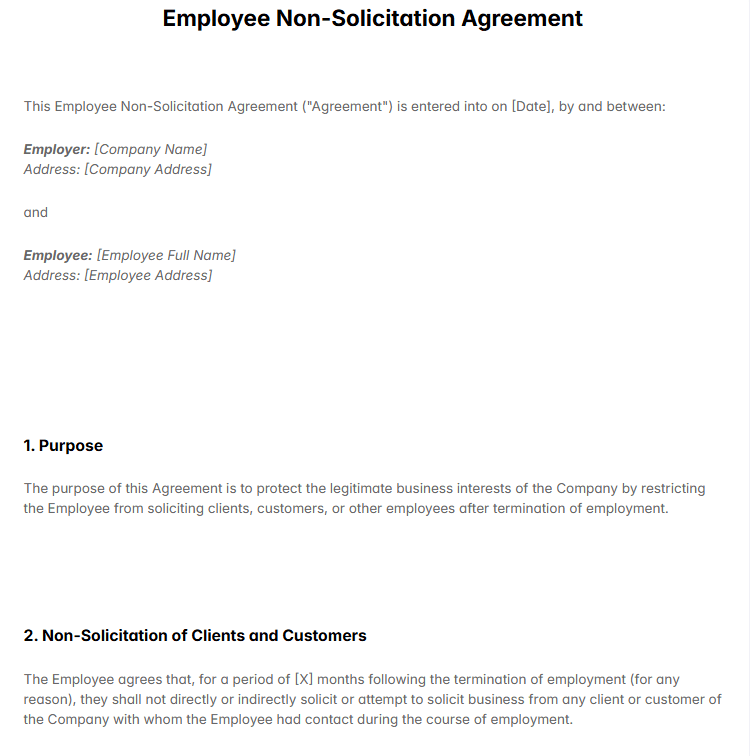
An Employee Non-Solicitation Agreement is a legal contract that prevents a departing employee from enticing your current clients, vendors, or staff to leave your business or follow them to a competitor. Unlike a non-compete agreement, which restricts where someone can work, a non-solicitation agreement simply says: “You can work anywhere but you can’t take my team or clients with you.”
This approach is more enforceable in most U.S. states and helps balance business protection with employee rights.
Employee Non-Solicitation Agreement represents one of the many templates available within the Employment Legal Templates category featured on our website.
For a more comprehensive understanding of Employment Legal Templates — including their legal nuances, variations across jurisdictions, and practical applications — we invite you to explore our in-depth overview article dedicated to this document category.
Who Benefits Most from an Employee Non‑Solicitation Agreement?
Business owners and leadership teams protect client lists, vendor relationships, and key staff from being poached after an employee departs, preserving the foundation of your company.
HR and legal teams gain enforceable, compliant protections — especially vital as non‑compete agreements face increasing scrutiny and regulation.
Freelancers and contractors with client access use these agreements to clarify boundaries and reduce risk of disputes.
Remote and hybrid organizations avoid talent and client losses by formally restricting post‑employment solicitation, ensuring stability across work modes.
Service‑based agencies and consultancies secure their goodwill and client networks, sustaining business continuity when employees move on.
Why to use the Employee Non-Solicitation Agreement in 2026?
If you’re a small business or freelancer in 2026, having a clear, enforceable Employee Non-Solicitation Agreement isn’t just smart, it's essential for staying protected while remaining compliant.
Real-World Legal Shifts and Case Studies
Courts usually find non-solicit clauses fairer and easier on employees than non-compete agreements. They’re seen as more limited and less likely to block someone from finding new work.
In 2010, the DOJ forced Apple, Google, Intel, Adobe, Pixar (and others) to settle a “no cold call” employee recruitment agreement. The settlement prohibited such conduct for five years, affecting six big tech companies.
The FTC banned non-compete agreements in most cases as of April 2024 (Federal Trade Commission, 2024), forcing employers to turn to non-solicit clauses as a viable alternative.
Legal Importance and Context
Non-solicitation agreements offer real legal power when used appropriately:
Protect client and employee relationships from post-employment poaching
Support enforceability in most U.S. jurisdictions especially after the FTC non-compete ban.
Avoid overly broad clauses to comply with state-specific employment laws
Provide clarity for both the employer and the employee
Relevant Laws:
FTC Final Rule on Non-Competes (2024).
State-level employment contract standards (e.g., CA §16600, NY labor laws).
Strategic Benefits of a Non-Solicitation Agreement
Retains Your Core Team
Your most valuable employees stay with you, not your competitors preserving productivity, trust, and team synergy.
Strengthens Client Relationships
Clients stay loyal to your business, not individuals who leave ensuring stability and continued growth.
Protects Confidential Know-How
Sensitive business knowledge, pricing models, and project strategies remain in-house avoiding unfair competitive advantage.
Ensures Operational Continuity
Staff transitions don’t shake your foundation clients feel secure, and internal workflows remain smooth.
Enhances Business Credibility
A well-structured agreement signals professionalism and preparedness making your business more attractive to investors, partners, and buyers.
Case example
In the Catch Engineering v. Mai case, a former employee was ordered to pay $112,320 for breaching a non-solicitation clause. This highlights how enforceable agreements can safeguard client relationships and penalize misconduct.
When Should You Use an Employee Non-Solicitation Agreement?
When hiring a full-time designer, developer, or marketing expert with access to your client list.
When onboarding freelancers who interact directly with clients
When a key team member exits your company and starts a competing business
When working with consultants who might later approach your staff
Key Sections of an Employee Non-Solicitation Agreement and How to Fill Them Out
A clear agreement includes the following:
Introduction and Purpose
Explains the reason for the agreement, including business confidentiality and client protection.Non-Solicitation Clause
Specifies the duration (usually 6–24 months) and what actions are prohibited such as poaching staff or clients.Exceptions and Limitations
Clarifies acceptable conduct, such as general advertising not targeting specific employees.Jurisdiction and Governing Law
Indicates which state laws apply to the agreement.Authorization and Signature
Final section where both parties agree and sign.
Practical Tips for Using an Employee Non-Solicitation Agreement Effectively
Always keep digital copies backed up securely.
Verify employee understanding and walk them through the agreement.
Communicate its purpose during onboarding or exit interviews.
Customize Your Agreement with AI in Minutes
⚖️ Legal Tip: The Critical Clauses That Protect Employers in Non-Solicitation Agreements
According to the American Bar Association's Business Law Section, three essential protective clauses are frequently omitted from non-solicitation agreements that later lead to enforceability challenges:
Precise Definition of "Solicitation": Most employers use vague language that courts find unenforceable. The ABA recommends specific language like: "Solicitation includes direct and indirect communication, whether initiated by the Employee or not, that encourages, invites, or requests any Client or Employee to discontinue or diminish their relationship with the Company. This includes providing information about competitive services or employment opportunities when the Employee knows or reasonably should know such information could lead to termination of the relationship with the Company."
Acknowledgment of Legitimate Business Interest: Industry data shows that 71% of non-solicitation disputes involve challenges to the employer's protectable interest. Your agreement should clearly state: "Employee acknowledges that: (1) Company has invested substantial time and resources in developing and maintaining relationships with its Clients and Employees; (2) these relationships constitute a legitimate business interest worthy of protection; and (3) Company would suffer irreparable harm if Employee were to solicit these relationships."
Severability with Reformation Clause: The National Labor Relations Board reports that 58% of non-solicitation disputes involve courts striking down overly broad provisions. Include specific language about: "If any provision of this Agreement is found by a court to be unenforceable, the parties agree that such provision shall be modified, reduced in scope, or eliminated by the court and enforced to the maximum extent permitted by law, and all remaining provisions shall remain in full effect."
The American Intellectual Property Law Association reports that disputes involving these missing clauses account for approximately 67% of all non-solicitation litigation.
📌 Real‑World Case: Catch Engineering Partnership v. Mai — $112,320 in Damages for Solicitation Breach
In Catch Engineering Partnership v. Mai, 2023 ABKB 279, the Alberta Court of King’s Bench ruled that a former employee breached a non-solicitation clause by directly contacting a key client, Canadian Natural Resources Limited (CNRL), after resigning. The clause explicitly prohibited solicitation of any client the employee had worked with in the previous 12 months.
Although the defendant argued that CNRL initiated the contact, the court found that the employee’s proactive communication offering services still constituted solicitation under the agreement’s terms. The judge awarded Catch Engineering $112,320 CAD in damages for the breach.
Source: Catch Engineering Partnership v. Mai, 2023 ABKB 279
Key Takeaway: Courts may enforce non-solicitation agreements even when former clients make the first move — if the employee responds in a way that furthers a competitive relationship. To be enforceable, your agreement must define “solicitation” clearly and demonstrate that the clause protects legitimate business interests.
🔑 Additional Insight: Industry-Specific Non-Solicitation Considerations
Modern non-solicitation agreements should include industry-specific sections that address unique relationship dynamics:
Industry | Key Non-Solicitation Elements | Special Considerations | Risk Factors |
|---|---|---|---|
Technology | Code repository access, project knowledge | Open-source community interactions | Conference networking exceptions |
Creative Services | Portfolio usage rights, attribution | Industry award submissions | Social media connection policies |
Financial Services | Client asset transition protocols | Regulatory reporting requirements | Fiduciary duty considerations |
Healthcare | Patient relationship boundaries | Referral network clarifications | Insurance panel participation |
Professional Services | RFP response limitations | Professional association activities | Speaking engagement restrictions |
According to the Society for Human Resource Management's 2024 Employment Practices Report, 73% of successful employers now use industry-specific non-solicitation formats rather than generic templates. Your non-solicitation agreement should reflect your specific industry with tailored sections addressing sector-standard relationship dynamics.
Expert Insights
“Most states simply treat prohibitions against soliciting customers like non‑compete agreements — they are generally unenforceable unless narrowly tailored.”
— Venable LLP“Post‑employment non‑solicitation … prohibits a former employee from contacting clients, prospects, employees, contractors, and/or vendors of their prior employer.”
— ICPA
How AI Lawyer Creates Your Document (Step-by-Step)
At AI Lawyer, we believe that drafting legal documents shouldn’t feel like decoding a foreign language. Whether you’re a business owner, landlord, freelancer, or someone navigating a personal matter — you should be able to create a legally sound document without needing a law degree.
That’s why we built a document experience that works like a conversation, not a form. Here’s exactly how it works:
1. You Tell AI Lawyer What You Need
It starts with a simple question:
“What type of document do you want to create?”
You choose from our list of professional templates — whether it’s a rental agreement, contractor form, invoice, publishing contract, or anything else — and AI Lawyer immediately pulls up the structure designed specifically for that use case.
Behind the scenes, the system references U.S. legal standards and best practices to make sure you’re starting from the right foundation.
2. We Highlight the Key Sections
Instead of throwing the whole document at you, AI Lawyer breaks it down.
Each key component — like payment terms, deadlines, responsibilities, clauses — is briefly explained in human language so you know what it means before you fill it out.
It’s like having a lawyer on your shoulder saying,
“Here’s what this section covers, and why it matters.”
3. You Answer Simple, Targeted Questions
AI Lawyer asks you step-by-step questions — like:
Who’s involved?
What are the key dates or timelines?
What are the terms (payments, conditions, obligations)?
Do you need special clauses like confidentiality, termination, or jurisdiction?
Each question is directly linked to a block in the final document — so your answers go exactly where they belong.
4. The Document Builds Itself As You Go
On the right side of your screen, the full document builds in real time.
Every time you answer a question, a corresponding section is added — with legally sound wording, smart defaults, and editable fields.
You’re not just answering a form — you’re watching your document take shape.
This phased process helps:
Reduce overwhelm
Catch errors early
Ensure nothing is forgotten
5. You Edit and Customize Freely
Once all the inputs are in, the full document is unlocked for editing.
You can:
Rewrite any clause
Change formatting
Add or remove sections
Rephrase terms in plain English (or more formal legal tone)
The editor works like a Google Doc — intuitive, responsive, and flexible.
6. Your Final Document Is Yours to Keep
Download in PDF, DOCX, or copy to clipboard.
You can print it, email it, or send it for signature — and revisit your answers anytime to generate updated versions.
Why This Workflow Matters
Most template tools give you a blank form.
We give you a process — one that mirrors how a real attorney would walk you through the creation of a document:
Context → Input → Assembly → Review → Delivery
It’s not magic. It’s just a smarter way to get legal work done — without getting lost in the jargon.
FAQs
Q: Are non‑solicitation agreements enforceable in all states?
A: Most states allow them if they are reasonable in scope and duration; however, places like California and North Dakota restrict or prohibit them.
Q: Is this the same as a non‑compete agreement?
A: No. A non‑compete restricts where someone can work, while a non‑solicitation agreement only restricts who they can contact or recruit after leaving.
Q: Can I use this agreement with independent contractors?
A: Yes. It’s highly recommended for freelancers or consultants with client or team access.
Q: How should I define “solicitation” in the agreement?
A: Include both direct and indirect outreach — like encouraging clients or employees to follow — and clarify what counts as solicitation.
Q: What duration is considered reasonable?
A: Typically between 6 to 24 months; narrower durations (e.g. 12 months) and defined targets enhance enforceability.
Q: What happens if a clause is too broad?
A: Courts can void the overly broad clause — unless there's a severability provision — potentially invalidating part or all of the agreement.
Sources and References
The legal backdrop for this guide—including the erosion of traditional non-compete clauses and the growing reliance on narrower non-solicitation covenants—relies on the Federal Trade Commission’s 2024 noncompete rulemaking materials, law-firm analyses of the FTC Final Non-Compete Clause Rule, and employment-law surveys tracking state-level restrictions on noncompetes and other restrictive covenants from organizations such as SHRM and commentary on recent legislative trends. Enforcement and case-law illustrations, including the U.S. Department of Justice’s action against Silicon Valley “no cold call” agreements and the Canadian decision in Catch Engineering Partnership v. Mai awarding CAD 112,320 for breach of a non-solicitation covenant, are drawn from the DOJ’s high-tech antitrust settlement and subsequent commentary by Canadian employment-law practitioners on the enforcement of non-solicitation clauses. Drafting guidance on defining “solicitation,” articulating legitimate business interests, and preserving severability is informed by the American Bar Association’s Business Law Section, ABA commentary on restrictive covenants in employment contracts, and specialist employment-law resources explaining how non-solicitation agreements operate as narrower alternatives to noncompetes and why courts scrutinize their scope and definitions in practice.
Final Thoughts
An Employee Non-Solicitation Agreement empowers you to do just that with clarity and confidence. Whatsoever your scope of job this document keeps your growth secure. It’s simple, strategic, and legally sound just the way modern business protection should be.
You Might Also Like: