Business
Disclaimer Template - Professional Use and Information
Get your free Disclaimer Template for websites and businesses. Ensure legal protection and compliance in 2026. Download or customize using AI today.
As things are going digital, even a minor oversight can lead to significant financial and reputational damage. Whether you operate a personal blog, a freelance consultancy, or a growing enterprise, failing to include a properly worded legal disclaimer exposes your business to potential lawsuits, regulatory penalties, and loss of consumer trust.
A structured disclaimer serves as a crucial legal safeguard. It clarifies the limits of your responsibility, protects against liability, and ensures users understand the scope of the information, services, or products you provide. By implementing a clear and legally sound disclaimer, businesses of all sizes can demonstrate professionalism, manage risk more effectively, and maintain transparency with their audience.
You Might Also Like:
What Is a Disclaimer?
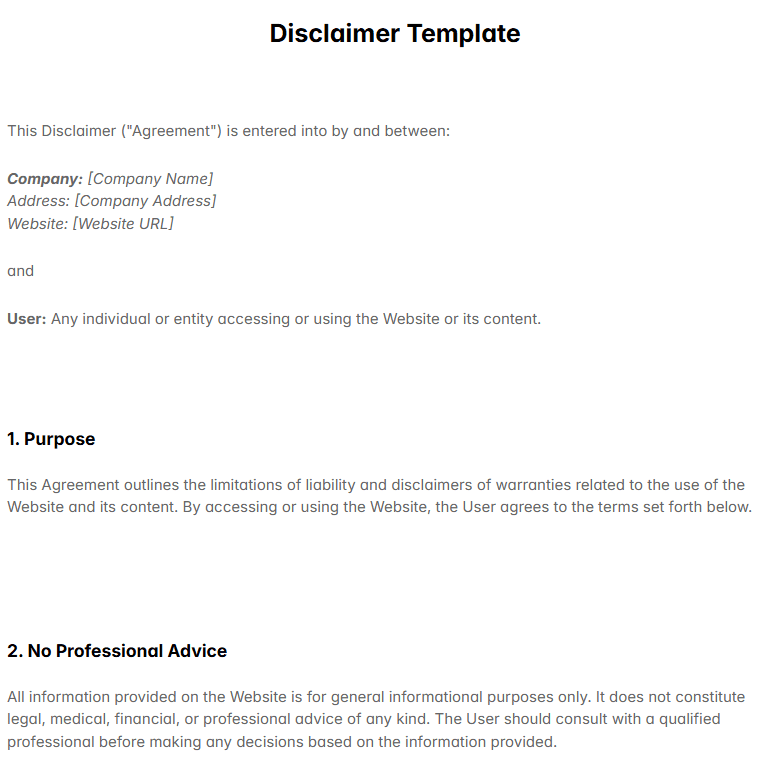
A disclaimer is a legally binding statement that informs users of potential limitations, risks, or liabilities associated with a product, service, or piece of content. It serves to limit legal responsibility and clarifies what a business or individual is and isn’t liable for.
Examples include:
“This website offers general information, not legal advice.”
“We may earn commissions from affiliate links.”
These short statements hold significant legal weight especially in cases where consumer expectations are involved.
Disclaimer represents one of the many templates available within the Policy and Compliance Documents category featured on our website.
For a more comprehensive understanding of Policy and Compliance Documents — including their legal nuances, variations across jurisdictions, and practical applications — we invite you to explore our in-depth overview article dedicated to this document category.
Who Benefits Most from a Legal Disclaimer?
Content creators and influencers gain protection from liability. Bloggers, vloggers, and social media influencers use disclaimers to clarify that opinions are personal and not professional advice, reducing risk of legal claims.
Freelancers and consultants safeguard against misuse of their work. Whether sharing templates, guides, or insights, they clarify limits of responsibility and avoid misinterpretation of their output.
Online businesses and affiliate marketers build trust and regulatory compliance. Disclosures about commissions and third-party content meet FTC requirements and maintain transparency with users.
Health, finance, and legal professionals avoid malpractice claims. Including context‑specific disclaimers — like medical or financial disclaimers — helps prevent users from substituting content for professional services.
Tech platforms and software providers prevent contractual disputes. Clear terms of use and download warnings (not buried “below the fold”) ensure users are aware of conditions before proceeding.
A well‑positioned disclaimer supports clarity, reduces disputes, and aligns user expectations across all online ventures.
Why You Need a Disclaimer in 2026?
If you’re a freelancer, blogger, startup, or established company, disclaimers help you comply with the law and protect against legal action.
Limits Legal Liability Clearly states that users act at their own risk, reducing exposure to legal claims.
Sets Expectations Defines the scope and purpose of your content, services, or products.
Builds Transparency and Trust – Demonstrates professionalism and honesty with users.
Supports Regulatory Compliance Helps meet legal requirements in fields like health, finance, and advertising.
Cost-Effective Protection Offers a simple legal safeguard without the need for full legal counsel.
Backed by Research and Real-World Examples
Legal disclaimers can significantly reduce legal risk.
According to Nolo, businesses without proper disclaimers are at higher risk of lawsuits, especially in industries like health, finance, and e-commerce.
Regulatory Compliance
Websites collecting user data are required to display disclaimers or privacy notices under laws like.
CCPA (California) Fines up to $7,500 per violation for non-compliance.
Legal Importance and Context
Disclaimers carry real legal significance. They communicate terms that can reduce or shift liability in legal disputes. Courts often examine disclaimers to assess a business’s intent and clarity regarding risk.
They are often required under:
GDPR (EU) – For privacy and data processing
CCPA (California) – For consumer data disclosures
FTC Guidelines (USA) – For transparency in sponsored content
E-Commerce & Consumer Protection Laws – For return policies and liability terms.
When Should You Use a Disclaimer Template?
Disclaimers are useful in a variety of real-world contexts. You should use one if:
You share professional advice (medical, legal, financial) on your website or blog.
You run an affiliate marketing or monetized content platform.
You collect user data or use cookies (triggering GDPR or CCPA requirements).
You publish third-party content or user-generated reviews.
Use Cases:
A health coach offers nutritional advice through blog posts.
A business consultant provides downloadable reports.
A YouTuber promotes affiliate products with referral links.
Types of Disclaimers You Can Discuss
Medical Disclaimer
Legal Disclaimer
Affiliate Disclaimer
Earnings Disclaimer
Views Expressed Disclaimer
Fair Use Disclaimer
Website Content Disclaimer
Key Sections of a Disclaimer Template and How to Fill Them Out
When creating your disclaimer, these core elements should be included:
Purpose Statement
Clarifies the intent and scope of your website or service.Limitation of Liability
States that you are not responsible for errors, losses, or damages arising from the use of your site or content.Professional Disclaimer
If you’re offering health, legal, or financial information, this section explains that your content is not a substitute for professional advice.Affiliate Disclaimer
Discloses affiliate partnerships where compensation may be earned.External Links Disclaimer
Notifies users that you are not liable for third-party websites linked from your site.Jurisdiction and Enforcement
Indicates which laws govern the disclaimer.
You can download our pre-filled template or customize these sections using our AI-powered form.
Practical Tips for Using a Disclaimer Template Effectively
Keep a digital and printed copy for compliance audits.
Customize the language to reflect your business and audience clearly.
Update your disclaimer regularly, especially after changes in content strategy, services, or laws.
Download Your Free Disclaimer Template
⚖️ Legal Tip: The Disclaimer Mistakes That Can Invalidate Your Protection
According to the American Bar Association, nearly 65% of disclaimers used by small businesses and content creators contain critical flaws that could render them legally ineffective. The most common mistakes include:
Buried Placement: Courts consistently rule against disclaimers that are difficult to find. In the landmark case of Specht v. Netscape Communications Corp., the court held that terms hidden "below the fold" of a webpage were not enforceable because users couldn't reasonably be expected to see them.
Overly Broad Language: Disclaimers that attempt to disclaim "all liability whatsoever" are frequently struck down as unconscionable. The FTC has specifically warned against blanket disclaimers that contradict express claims made elsewhere on a website.
Failure to Address Specific Risks: Generic disclaimers often fail to address industry-specific risks. For example, financial content requires specific disclaimers about investment risk that general templates don't include.
Inconsistent Messaging: If your marketing materials make promises that your disclaimer contradicts, courts typically favor the marketing claims. The 2023 case of Johnson v. Lifestyle Influencers, Inc. resulted in a $1.2 million judgment against a company whose disclaimer contradicted claims made in promotional videos.
📌 Real‑World Case: Browning v. Anheuser-Busch – Inadequate Label Disclaimer
In a 2022 case, a class-action lawsuit alleged that the branding of certain alcoholic beverages misled consumers into thinking they were distilled spirits, when in fact they were malt beverages. Although there was a small disclaimer on the label, the court found it too inconspicuous compared to the rest of the marketing. The case settled for an undisclosed amount and included revised labeling requirements.
Source: Browning et al. v. Anheuser-Busch, LLC, No. 3:20-cv-00889
Key Takeaway: If a disclaimer contradicts or is drowned out by other visual or promotional messaging, it’s unlikely to protect you from claims of misleading representation.
🔑 Additional Insight: Industry-Specific Disclaimer Requirements in 2026
Different industries face unique disclaimer requirements that go beyond general best practices:
Industry | Special Considerations | Required Elements |
|---|---|---|
Health & Wellness | FDA and FTC scrutiny of health claims | Must explicitly state content is not medical advice and cannot diagnose, treat, or cure conditions |
Financial Content | SEC and FINRA regulations | Must disclose that past performance doesn't guarantee future results and specify author’s holdings |
Educational Content | FTC Endorsement Guidelines | Must clearly distinguish between objective educational content and sponsored or affiliate content |
AI-Generated Content | Emerging regulations | Must disclose when content is AI-generated and explain limitations of AI systems |
For health and wellness content specifically, the updated FTC Health Products Compliance Guide (effective in 2024) requires:
Clear disclosure if the author is not a licensed healthcare professional
Specific language about the limitations of general health information
Prominent placement of disclaimers near health claims, not just in footers
Consulting with an attorney familiar with your specific industry can help ensure your disclaimer meets these specialized requirements.
Expert Insights
“A disclaimer is a statement denying responsibility intended to prevent civil liability arising for particular acts or omissions.”
— Wikipedia, Disclaimer (tort law)
“A consumer’s clicking on a download button does not communicate assent to contractual terms if the offer did not make clear that clicking signified agreement.”
— Specht v. Netscape (2d Cir. 2002), regarding license terms placed below the download button, not sufficient for assent
How AI Lawyer Creates Your Document (Step-by-Step)
At AI Lawyer, we believe that drafting legal documents shouldn’t feel like decoding a foreign language. Whether you’re a business owner, landlord, freelancer, or someone navigating a personal matter — you should be able to create a legally sound document without needing a law degree.
That’s why we built a document experience that works like a conversation, not a form. Here’s exactly how it works:
1. You Tell AI Lawyer What You Need
It starts with a simple question:
“What type of document do you want to create?”
You choose from our list of professional templates — whether it’s a rental agreement, contractor form, invoice, publishing contract, or anything else — and AI Lawyer immediately pulls up the structure designed specifically for that use case.
Behind the scenes, the system references U.S. legal standards and best practices to make sure you’re starting from the right foundation.
2. We Highlight the Key Sections
Instead of throwing the whole document at you, AI Lawyer breaks it down.
Each key component — like payment terms, deadlines, responsibilities, clauses — is briefly explained in human language so you know what it means before you fill it out.
It’s like having a lawyer on your shoulder saying,
“Here’s what this section covers, and why it matters.”
3. You Answer Simple, Targeted Questions
AI Lawyer asks you step-by-step questions — like:
Who’s involved?
What are the key dates or timelines?
What are the terms (payments, conditions, obligations)?
Do you need special clauses like confidentiality, termination, or jurisdiction?
Each question is directly linked to a block in the final document — so your answers go exactly where they belong.
4. The Document Builds Itself As You Go
On the right side of your screen, the full document builds in real time.
Every time you answer a question, a corresponding section is added — with legally sound wording, smart defaults, and editable fields.
You’re not just answering a form — you’re watching your document take shape.
This phased process helps:
Reduce overwhelm
Catch errors early
Ensure nothing is forgotten
5. You Edit and Customize Freely
Once all the inputs are in, the full document is unlocked for editing.
You can:
Rewrite any clause
Change formatting
Add or remove sections
Rephrase terms in plain English (or more formal legal tone)
The editor works like a Google Doc — intuitive, responsive, and flexible.
6. Your Final Document Is Yours to Keep
Download in PDF, DOCX, or copy to clipboard.
You can print it, email it, or send it for signature — and revisit your answers anytime to generate updated versions.
Why This Workflow Matters
Most template tools give you a blank form.
We give you a process — one that mirrors how a real attorney would walk you through the creation of a document:
Context → Input → Assembly → Review → Delivery
It’s not magic. It’s just a smarter way to get legal work done — without getting lost in the jargon.
FAQs
Q: Do I need a disclaimer even if I don’t sell anything?
A: Yes. Any informational, fitness, or advice content can benefit — disclaimers clarify your content isn’t professional advice and limit liability.
Q: Is a generic disclaimer legally enforceable?
A: Yes, if it’s conspicuous and aligned with your activity. Templates work when clearly visible and tailored to your content type.
Q: Where should I display my disclaimer?
A: It should appear near relevant content and be accessible via footer links or during sign-up, so users have a chance to review it.
Q: Are “all‑liability” disclaimers valid?
A: No. Courts often reject overly broad disclaimers. They must be reasonable and specific to the risks involved.
Q: Can disclaimers override user expectations in marketing claims?
A: No. Disclaimers can’t contradict clear statements in marketing content — courts will favor explicit claims over hidden disclaimers.
Q: How often should I update my disclaimer?
A: At least annually or when your content type, services, or relevant laws change — especially in regulated industries like health or finance.
Final thoughts
A well-drafted Disclaimer is a critical tool for protecting your business from legal exposure. In today’s evolving digital and regulatory environment, clarity and transparency are more important than ever. If you're an individual or an organization, incorporating a disclaimer demonstrates professionalism and foresight. Our free template provides a reliable starting point tailored to your needs. Customize it to ensure your content or services are clearly protected.
Sources and References
Insights on disclaimer obligations and online liability are grounded in major privacy and consumer-protection regimes, including the EU General Data Protection Regulation (GDPR), the California Consumer Privacy Act, and the U.S. Federal Trade Commission’s Endorsement Guides and Health Products Compliance Guidance, which set expectations for clear disclosures and substantiated claims in digital content and advertising.
Practical guidance on how disclaimers allocate risk and limit liability draws on Nolo’s overview of FTC – Enforcement Actions (Data Privacy & Security), American Bar Association commentary on law-firm websites and online client communications, and doctrinal summaries such as Wikipedia’s entry on disclaimers in tort law.
Discussion of placement, prominence, and the real-world effectiveness of disclaimers is informed by key authorities including Specht v. Netscape Communications Corp. on browse-wrap assent and notice, the Browning v. Anheuser-Busch (Ritas) labeling settlement over inconspicuous package disclaimers, and recent FTC enforcement trends and guidance on health-related advertising disclosures.
You Might Also Like: