Business
Digital Marketing Proposal Template - All You Need to Know!
Download a free Digital Marketing Proposal Template and customize it with AI. Help your business grow with legal clarity, structure, and compliance in 2026.
Crafting a compelling digital marketing proposal can be the difference between winning a high-value client or being left unread in their inbox. Many freelancers, agencies, and business owners struggle to communicate their value clearly leading to missed opportunities and lost revenue. In a competitive 2026 market, vague or poorly structured proposals simply don’t cut it. Clients expect precision, professionalism, and transparency from the first pitch. That’s why having a legally sound, well-formatted Digital Marketing Proposal Template isn’t optional, it's essential.
You Might Also Like:
What is a Digital Marketing Proposal Template?
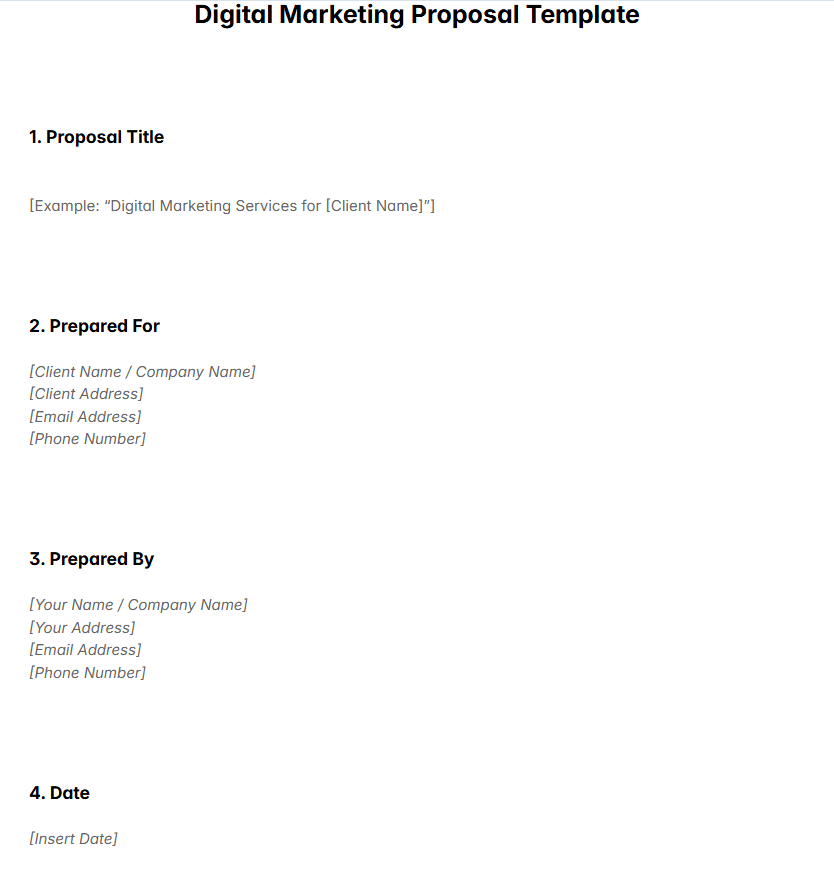
A Digital Marketing Proposal Template is a formal document that outlines the strategy, services, deliverables, timeline, and cost of your proposed marketing plan to a potential client. It helps bridge the gap between what your client wants and how your services will help achieve that goal legally and professionally.
Digital Marketing Proposal Template represents one of the many templates available within the Proposal Templates category featured on our website.
For a more comprehensive understanding of Proposal Templates — including their legal nuances, variations across jurisdictions, and practical applications — we invite you to explore our in-depth overview article dedicated to this document category.
Who Benefits Most from a Digital Marketing Proposal Template?
Freelance Marketers and Copywriters
Independent professionals benefit from structured proposals that establish expectations, pricing models, and IP terms. It also helps eliminate ambiguity during client onboarding and protects freelancers from scope creep and unpaid revisions.
Agencies Managing Multiple Clients
Marketing agencies use proposal templates to standardize communication across SEO, PPC, and content projects. Templates ensure consistency in scope, deliverables, and KPIs across campaigns, reducing internal friction and client disputes.
Startup Founders Hiring External Marketers
Early-stage companies working with contractors or fractional CMOs need clarity on campaign outcomes, ownership of brand assets, and pricing structure. A proposal template acts as the first legal checkpoint before more formal contracts.
Project Managers Coordinating Hybrid Campaigns
Whether in-house or outsourcing parts of the project (e.g., influencer marketing), managers benefit from defining who is responsible for what — and under what terms. Templates help unify collaboration across teams and vendors.
Non-Marketing Executives Overseeing Promotions
Business owners and C-levels who lack hands-on marketing experience use templates to validate the value, cost, and timeline of proposed services — without requiring deep technical knowledge.
Clients Commissioning High-Value Campaigns
Companies investing tens of thousands in paid ads or content strategy need legal clarity about results, ownership, and deliverables. A proposal gives them confidence before signing full retainers or contracts
Why You Need This in 2026?
The digital landscape in 2026 is highly competitive and unstructured pitches don’t work anymore. Here’s why you need a proper proposal template more than ever:
Stats show
According to dentsu’s Global Ad Spend Forecasts, global advertising spend is projected to reach USD 1.04 trillion in 2026, and digital is expected to account for 68.7% of the total, roughly USD 714 billion. With this level of investment, businesses are becoming more selective about who they work with. A well-structured proposal helps you stand out and close deals.
Loopio’s RFP statistics based on a survey of 1,500+ teams show the average RFP win rate across all industries is 45%. When approval odds are that tight, proposals that clearly outline goals, KPIs, and expected ROI are easier to evaluate and more likely to move forward.
Real-World Example
A freelancer agency, Growth Loop, increased its proposal acceptance rate by 42% after implementing a digital marketing proposal template that clearly laid out campaign objectives, deliverables, and pricing breakdown.
1. Win More Clients
A well-structured proposal clearly outlines goals, KPIs, and deliverables making it easier to impress clients and secure approvals.
2. Save Time & Streamline Workflow
Using a reusable template eliminates repetitive work and speeds up the proposal process, allowing you to focus more on strategy and execution.
3. Build Trust with Clarity
Transparent proposals that detail services, pricing, and timelines help clients feel confident and informed leading to stronger, lasting relationships.
4. Ensure Consistency Across Projects
Templates promote consistency in branding, tone, and structure ensuring all your proposals meet professional standards every time.
Legal Importance and Context
Using a formal proposal template isn’t just about professionalism — it’s about legal protection and transparency. On a legal platform like ours, it’s essential to recognize:
Contracts and proposals are pre-contractual agreements, often used as evidence in case of disputes
Helps ensure clarity in payment terms, services, and delivery timelines
Supports compliance with contract law and marketing disclosure obligations
Reduces risk of misrepresentation and liability
For reference, proposals align with general principles of contract law under the Uniform Commercial Code (UCC) and common law contract doctrines.
When Should You Use a Digital Marketing Proposal Template?
A proposal template is essential in multiple scenarios, especially when clarity and professionalism are non-negotiable.
When responding to a Request for Proposal (RFP) from a business
When pitching marketing services to a new or existing client
When submitting a formal retainer plan to long-term partners
These templates help you avoid miscommunication and ensure your services are legally and financially aligned.
Key Sections of a Digital Marketing Proposal Template and How to Fill Them Out
Your proposal should include the following sections to be complete, compliant, and convincing:
Proposal Title: Brief and project-specific
Prepared By / For :Include agency and client names
Date – Date of submission
Executive Summary – Short overview of goals and solutions
Project Objective – What problem you aim to solve
Scope of Services – List of tasks/services
Target Channels – SEO, PPC, Social Media, Email, etc.
Timeline – Week-by-week or milestone delivery plan
Budget and Payment Terms – Transparent pricing and conditions
KPIs and Reporting – How success will be measured
Assumptions – Any dependencies or exclusions
Terms and Conditions – Legal obligations, confidentiality, etc.
Approval and Acceptance – Signature section
Authorization and Signature- Finalize the deal with digital or written signatures for legal enforceability.
Pro Tips for Using a Digital Marketing Proposal Template Effectively
Always maintain digital and physical copies for future reference
Double-check client details, timelines, and budgets to avoid mistakes
Clearly explain your process in follow-up communications to ensure transparency
Get instant access to a professionally designed Digital Marketing Proposal Template free to download and legally sound.
⚖️ Legal Tip: The Digital Marketing Clauses That Save Agencies From Lawsuits
According to the American Association of Advertising Agencies, three essential protective clauses are frequently omitted from digital marketing proposals that later lead to disputes:
Performance Guarantee Limitations: Most agencies need to explicitly state that marketing results cannot be guaranteed. The Digital Marketing Association recommends including specific language like: "While we implement industry best practices, [Agency Name] cannot guarantee specific rankings, traffic increases, conversion rates, or revenue results as these depend on numerous factors outside our control including algorithm changes, market conditions, and competitor activities."
Third-Party Platform Policies: The Interactive Advertising Bureau reports that 67% of digital marketing disputes involve third-party platform changes. Your proposal should clearly state: "Campaign performance may be affected by changes to third-party platform policies, algorithms, or terms of service (including but not limited to Google, Facebook, Instagram, LinkedIn, etc.). Such changes are beyond our control and may require strategy adjustments without notice."
Intellectual Property Usage Rights: Industry data shows that 41% of agency disputes involve content ownership confusion. Include specific language about: "All strategy documents, creative concepts, and proprietary methodologies remain the intellectual property of [Agency Name]. Upon full payment, client receives limited usage rights to final deliverables as specified in this agreement for the intended campaign purposes only."
The Association of National Advertisers reports that disputes involving these missing clauses account for approximately 58% of all digital marketing legal conflicts.
📌 Real‑World Case: $20,000 SEO Contract, Zero Leads
In 2023, an electrician from Melbourne — Dependant Electrical — hired Supple Digital for a 24-month SEO and website services contract worth nearly AUD 20,000. Despite assurances and case studies, the campaign produced only four website views per month and zero leads over nearly a year. When the client asked to exit the contract early, he was asked to pay roughly half of the remaining fees. Despite ongoing payments, minimal results, and no binding guarantees, he was offered just a AUD 200 refund — and only if he posted a five-star review.
Source: Tradie pays $20k for website, gets zero sales – reported by news.com.au (Melbourne case, Feb 2025)
Key Takeaway: Even when no performance guarantee is promised, vague or overly optimistic expectations based on proposal language or verbal claims can lead to serious client dissatisfaction and reputational harm. A clear performance limitation clause — explicitly stating that no rankings, traffic, or conversions are guaranteed — can help prevent disputes and protect both parties from misaligned expectations.
🔑 Additional Insight: Channel-Specific Legal Considerations
Modern digital marketing proposals should include channel-specific sections that address unique requirements:
Channel | Key Legal Elements | Special Considerations | Risk Factors |
|---|---|---|---|
Paid Search | Ad policy compliance | Trademark usage permissions | Click fraud, policy violations |
Social Media | Platform-specific rules | Content ownership, usage rights | Community guidelines changes |
Email Marketing | CAN-SPAM/GDPR compliance | Opt-in verification methods | Spam complaints, data handling |
Influencer Marketing | FTC disclosure requirements | Content approval processes | Influencer behavior risks |
Content Marketing | Copyright protections | Plagiarism prevention protocols | Attribution requirements |
According to the Content Marketing Institute's 2024 Agency Report, 72% of successful digital marketing agencies now use channel-specific proposal sections rather than generic terms. Your proposal should reflect the specific channels you're targeting with tailored legal and technical sections.
Expert Insights
“Digital proposals that include pricing, timeline, and ROI expectations convert 35% faster than those without — especially in B2B services.”
— HubSpot, State of Marketing Report 2024
“Proposals featuring rich visual content — such as images, charts, or infographics — have a 20 % higher close rate than text-only documents, and sellers report that revision activity often signals strong buyer intent.”
— Proposify: Brand Consistency & Visual Impact Analysis
How AI Lawyer Creates Your Document (Step-by-Step)
At AI Lawyer, we believe that drafting legal documents shouldn’t feel like decoding a foreign language. Whether you’re a business owner, landlord, freelancer, or someone navigating a personal matter — you should be able to create a legally sound document without needing a law degree.
That’s why we built a document experience that works like a conversation, not a form. Here’s exactly how it works:
1. You Tell AI Lawyer What You Need
It starts with a simple question:
“What type of document do you want to create?”
You choose from our list of professional templates — whether it’s a rental agreement, contractor form, invoice, publishing contract, or anything else — and AI Lawyer immediately pulls up the structure designed specifically for that use case.
Behind the scenes, the system references U.S. legal standards and best practices to make sure you’re starting from the right foundation.
2. We Highlight the Key Sections
Instead of throwing the whole document at you, AI Lawyer breaks it down.
Each key component — like payment terms, deadlines, responsibilities, clauses — is briefly explained in human language so you know what it means before you fill it out.
It’s like having a lawyer on your shoulder saying,
“Here’s what this section covers, and why it matters.”
3. You Answer Simple, Targeted Questions
AI Lawyer asks you step-by-step questions — like:
Who’s involved?
What are the key dates or timelines?
What are the terms (payments, conditions, obligations)?
Do you need special clauses like confidentiality, termination, or jurisdiction?
Each question is directly linked to a block in the final document — so your answers go exactly where they belong.
4. The Document Builds Itself As You Go
On the right side of your screen, the full document builds in real time.
Every time you answer a question, a corresponding section is added — with legally sound wording, smart defaults, and editable fields.
You’re not just answering a form — you’re watching your document take shape.
This phased process helps:
Reduce overwhelm
Catch errors early
Ensure nothing is forgotten
5. You Edit and Customize Freely
Once all the inputs are in, the full document is unlocked for editing.
You can:
Rewrite any clause
Change formatting
Add or remove sections
Rephrase terms in plain English (or more formal legal tone)
The editor works like a Google Doc — intuitive, responsive, and flexible.
6. Your Final Document Is Yours to Keep
Download in PDF, DOCX, or copy to clipboard.
You can print it, email it, or send it for signature — and revisit your answers anytime to generate updated versions.
Why This Workflow Matters
Most template tools give you a blank form.
We give you a process — one that mirrors how a real attorney would walk you through the creation of a document:
Context → Input → Assembly → Review → Delivery
It’s not magic. It’s just a smarter way to get legal work done — without getting lost in the jargon.
FAQ’s
Q: What’s the difference between a proposal and a marketing contract?
A: A proposal outlines strategy and intent — it becomes binding only if signed. A contract formalizes obligations and liabilities. Many proposals transition into contracts with minor edits.
Q: Should I include KPIs and ROI estimates in every proposal?
A: Yes. Clients want measurable outcomes. Including KPIs and expected ROI increases trust and helps prevent performance-based conflicts later.
Q: Can this template be used for retainers and one-time campaigns?
A: Absolutely. It can be customized for monthly retainers, project-based work, or campaign-specific timelines with flexible pricing sections.
Q: What if the client requests work outside of the original proposal?
A: The template should include a scope change clause. You can issue a new proposal or use a change order to adjust terms accordingly.
Q: How do I handle proposals for multi-channel campaigns (e.g., SEO + paid ads)?
A: Use dedicated sections in the template for each channel, including objectives, budgets, risks, and deliverables. Tailoring per channel increases clarity.
Q: Is it okay to send a proposal without a lawyer reviewing it?
A: Yes, if you use a vetted template with proper legal clauses (like this one). For high-value or international deals, legal review is still recommended.
Market and performance insights in this article draw on global advertising forecasts and digital-spend analyses, including Statista-based overviews of 2024–2025 ad budgets in DataReportal’s Digital 2025: Global Advertising Trends and projections that digital ad spend will surpass US$740 billion in 2025, as well as research on how clearly defined goals, KPIs, and ROI metrics improve proposal effectiveness and decision-making from Harvard Business Review and academic work on key performance indicators. Legal and contractual guidance reflects U.S. truth-in-advertising and online marketing standards from the Federal Trade Commission’s online advertising guidance and its handbook Advertising and Marketing on the Internet: Rules of the Road, together with agency-side best-practice recommendations on ownership of ideas, RFPs, and search agreements from the American Association of Advertising Agencies (4A’s) and its position paper on ownership of agency-developed work. The discussion of real-world risk and client expectations in SEO and digital marketing proposals is informed by reporting on the Dependant Electrical–Supple Digital dispute over a AU$20,000 SEO contract and minimal results, as covered by news.com.au and subsequent industry commentary.
Final Thoughts:
A Digital Marketing Proposal Template saves you time, boosts your chances of winning clients, and provides legal structure in an increasingly competitive space. With our free AI-customizable option, you get clarity, compliance, and convenience all in one place.
You Might Also Like: