Business
Demand Letter Template (DOCX) + Sample: Write, Send & Follow Up
Download a free demand letter template in DOCX, use a sample, and learn how to write, send, and follow up effectively. Includes deadlines, proof checklist, and escalation steps.
Most disputes do not get stuck because the problem is impossible to solve. They get stuck because the request is scattered across emails, texts, calls, reminders, and unfinished promises.
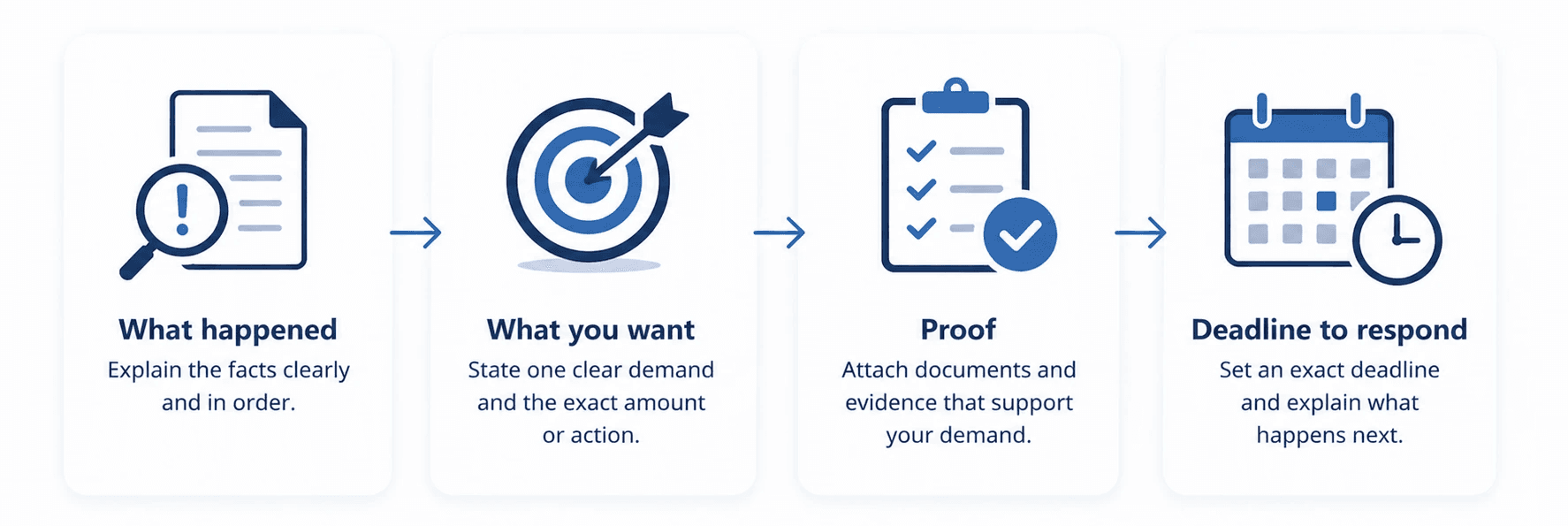
A demand letter brings that mess into one clear document. It gives the other side a formal chance to resolve the issue before you spend more time on follow-ups, small claims, attorney review, or another escalation step.
This guide is for practical use: choose a template, customize it to your dispute, send it correctly, and know what to do if the recipient does not respond.
You Might Also Like:
TL;DR
A demand letter is a formal written request that tells the recipient what happened, what you want, and when they need to respond.
Use it when informal reminders have not worked and you need a documented step before negotiation, small claims court, attorney review, or another escalation.
The letter should include a short timeline, one clear demand, an exact deadline, and proof such as invoices, contracts, photos, receipts, estimates, messages, or pay records.
For simple disputes, you can start with a demand letter template and customize it to your facts. If the dispute involves a large amount, injuries, insurance coverage, strict deadlines, or a represented opponent, get legal review before sending.
Who This Article Is For
This guide is for people who need to make a clear written demand before taking the next step in a dispute.
It is most useful if you are dealing with:
unpaid invoices, late payments, refunds, or money owed;
breach of contract or a broken agreement;
landlord-tenant issues, such as repairs or security deposits;
property damage or return of property;
unpaid wages, commissions, or final pay;
a situation where small claims court may be the next step.
If you can explain what happened, what you want, and what proof you have, a demand letter template can help you turn the issue into a structured request with a deadline.
What Is a Demand Letter
A demand letter is a formal written request that explains a dispute and tells the recipient what you want them to do. It can ask for payment, a refund, repairs, return of property, claim reconsideration, or another specific action.
The purpose of a demand letter is to make the issue clear and documented. Instead of scattered emails, calls, texts, and reminders, you create one organized record of your position.
A demand letter usually includes the key facts, the demand, the deadline, and the proof that supports your request. It is often used before negotiation, small claims court, attorney review, agency complaints, or another escalation step.
A demand letter is not a lawsuit or a court order. It does not force the recipient to comply. Its value comes from clarity: the other side can see what you are asking for, why you are asking for it, and what may happen if they ignore the deadline.
When Should You Send a Demand Letter
Send a demand letter when informal reminders are not working and you need a documented next step.
It is usually worth sending when one clear action could resolve the dispute. For example, the recipient could pay an overdue invoice, return property, complete repairs, refund money, respond to an insurance claim, or fix a broken contract obligation.
A demand letter is especially useful when you want to:
set a clear deadline;
show that you tried to resolve the issue before escalating;
organize your proof in one place;
create a record for small claims, mediation, an agency complaint, or attorney review;
move the conversation from vague promises to a specific decision.
Do not use a demand letter as a substitute for a required legal notice, insurance process, warranty claim, chargeback, or contract notice step. If your contract, lease, policy, or state rules require a specific process, follow that process first.
You may want legal guidance before sending a demand letter if the dispute involves a large amount of money, injuries, insurance coverage, a tight deadline, a represented opponent, possible counterclaims, or a strict notice requirement.
Choose the Right Demand Letter Template
Pick the template by the problem you need to solve, not by the title alone. Most demand letters follow the same basic structure, but the proof and wording change depending on the dispute.
Situation | Use this template | What to demand |
|---|---|---|
Someone owes you money | Payment of a specific amount by a specific date | |
A client has not paid an invoice | Immediate payment of the unpaid invoice | |
The payment is late but not really disputed | Payment of the overdue balance, plus any supported late fees | |
A contract was broken | Cure the breach, pay damages, refund money, or perform the promised obligation | |
You want to give one last chance before escalation | Final opportunity to resolve before small claims, attorney review, or another step | |
You may file in small claims court | Payment or action that resolves the dispute before filing | |
You need a refund | Refund of a specific amount by a deadline | |
Property was damaged | Payment for repair, replacement, or documented loss | |
Someone is holding your property | Return of specific items by a deadline | |
You are dealing with a landlord or tenant issue | Security deposit return, repairs, rent payment, or another lease-based action |
How to choose quickly
If the dispute is about a fixed amount, start with a payment or unpaid invoice template. If the dispute is about a broken promise, use a breach of contract template. If the next step could be court, use a small claims or final demand template. If the issue depends on a lease, policy, wage record, or accident claim, use a more specific template so the proof matches the situation.
For example, if a client owes $1,800 for completed work, do not use a general “legal demand letter” just because it sounds stronger. Use an unpaid invoice demand letter, attach the invoice and proof of delivery, set a payment deadline, and explain how to pay. The more specific the template, the harder it is for the recipient to delay by asking what the letter is about.
How to Write and Prepare a Demand Letter
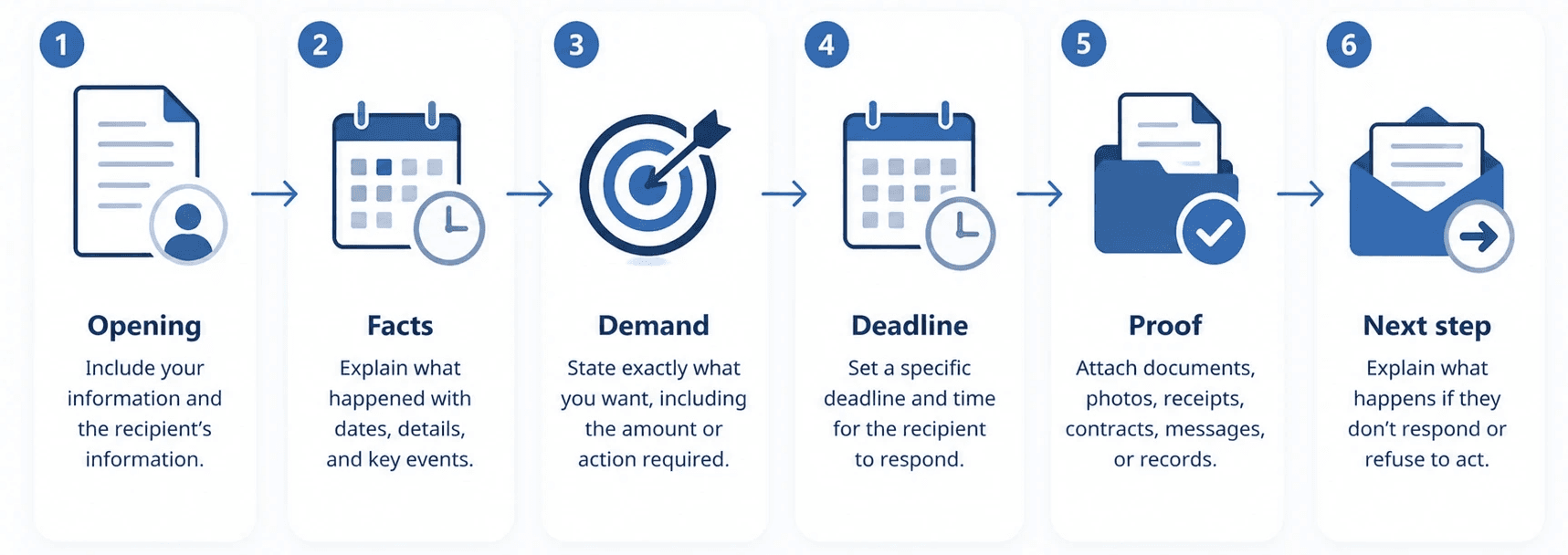
A strong demand letter is not long or dramatic. It is clear, specific, and easy to verify. The recipient should be able to understand your position in less than a minute: what happened, what you want, why you are asking for it, and what proof supports your demand.
Use this structure:
Opening: Say what the letter is about and what you are requesting.
Facts: Give a short timeline with dates, amounts, names, and key events.
Demand: State the exact payment, action, refund, repair, return, or response you want.
Deadline: Use a specific calendar date, not “ASAP” or “soon.”
Proof: List or attach the documents that support your claim.
Next step: Explain what you may do if there is no response, without making threats.
1. Start with facts, not frustration
The letter should read like a clean record, not a complaint. Avoid long background stories and focus on what can be checked.
Weak version:
You have ignored me for weeks and made this situation impossible.
Stronger version:
Invoice #1048 for $1,850 was sent on March 3, 2026, with payment due by March 18, 2026. The work was delivered on March 1, and you confirmed receipt by email on March 2.
The second version works better because it gives the recipient less room to argue about the basic timeline.
2. Make one clear demand
Do not make the reader guess what would resolve the dispute. State the result you want in one sentence.
Examples:
“Please pay the outstanding balance of $1,850 by May 15, 2026.”
“Please return the listed equipment to the address below by May 15, 2026.”
“Please provide a written repair plan and completion date by May 15, 2026.”
“Please reconsider the claim denial and respond in writing by May 15, 2026.”
If you are demanding money, show a simple calculation. Include the original amount, payments already made, credits, fees you can support, and the final balance.
3. Set a real deadline
A demand letter needs a deadline because the deadline creates the decision point. For simple payment disputes, 7–14 days is often enough. For more complex issues, such as insurance, repairs, or multi-document disputes, 14–30 days may be more reasonable.
Use an exact date:
Please respond no later than May 15, 2026.
Avoid vague wording:
Please respond immediately.
A clear date makes follow-up easier and creates a cleaner record if the dispute later goes to small claims, mediation, an agency, or a lawyer.
4. Attach the right proof
Your proof should match the type of demand. Do not attach everything you have. Attach what proves the core facts and the amount or action requested.
Dispute type | Useful proof |
|---|---|
Unpaid invoice or money owed | Invoice, contract, payment terms, proof of delivery, prior reminders |
Breach of contract | Signed agreement, key clause, timeline, emails/messages, proof of non-performance |
Property damage | Photos, repair estimates, receipts, incident details |
Landlord-tenant issue | Lease, photos, repair requests, move-in/move-out records, rent ledger |
Wages owed | Pay stubs, time records, schedules, commission terms, pay-period details |
Insurance or accident claim | Claim number, estimates, bills, denial letter, photos, medical records if relevant |
Return of property | Receipts, serial numbers, photos, messages confirming possession |
If you are sending the letter by email, attach the proof as one organized PDF when possible. If you are sending by mail, include copies, not originals.
5. Keep the tone firm and usable
The best tone is professional, direct, and calm. You can be serious without sounding aggressive.
Avoid:
insults;
threats you are not prepared to follow through on;
exaggerated damages;
unsupported late fees or penalties;
emotional language;
claims you cannot prove.
Use neutral language instead:
If I do not receive a response by the deadline above, I will consider available next steps, including small claims court, mediation, agency options, or attorney review.
That wording keeps pressure on the recipient without weakening your credibility.
Quick checklist before sending
Before you send the demand letter, make sure it includes:
the correct names and contact details;
a short factual timeline;
one clear demand;
an exact deadline;
payment, return, repair, or response instructions;
a short proof list or attached exhibits;
a calm explanation of possible next steps;
your signature and date.
If the recipient can understand the demand, verify the proof, and see the deadline quickly, the letter is doing its job.
How to Send a Demand Letter and Follow Up
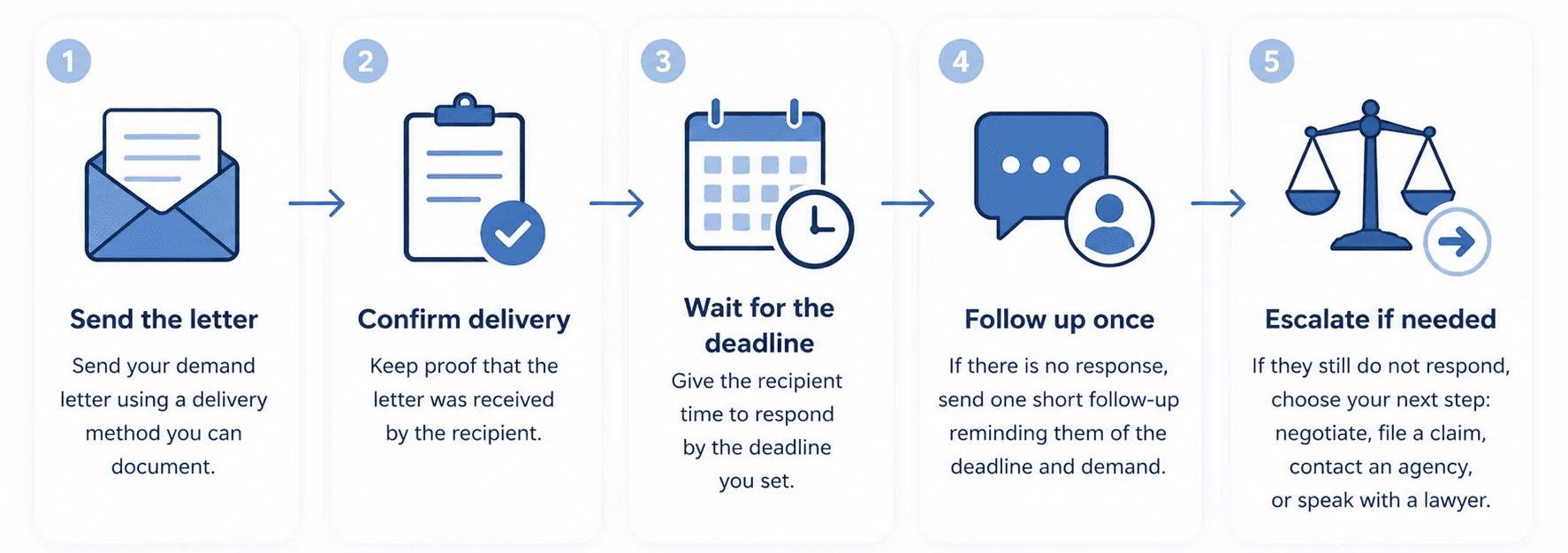
Writing the letter is only half of the job. The other half is sending it in a way you can prove and following a clear timeline after it goes out.
Before you send anything, check whether your dispute has a required notice process. Some contracts, leases, insurance policies, refund procedures, or landlord-tenant rules may require a specific address, delivery method, cure period, or form of notice. If a rule applies, follow it. A strong letter can lose value if it is sent the wrong way.
1. Choose a delivery method you can document
Use a method that creates a record. Email is often useful because it gives you a timestamp and lets you attach documents. Tracked mail or certified mail can be better when you expect the recipient to deny receiving the letter or ignore it.
For higher-stakes disputes, you can use both: send the letter by email for speed and by tracked mail for proof.
Save:
the final signed letter;
the attached exhibits or proof package;
the sent email with timestamp;
mail receipt or tracking confirmation;
any delivery confirmation;
all replies from the recipient.
Do not rely on “I sent it.” If the dispute escalates, you want to show what was sent, when it was sent, and where it was sent.
2. Start the deadline from delivery
Your deadline should run from when the recipient receives the letter or when the delivery method shows it was sent, depending on your situation and wording.
For example, instead of writing:
Please respond within 10 days.
Use:
Please respond no later than May 15, 2026.
An exact date avoids confusion. It also makes your follow-up easier because you are not arguing about when the clock started.
3. Do one short follow-up if the deadline passes
If the recipient ignores the letter, do not restart the whole argument. Send one short follow-up that references the original demand, the deadline, and the missing response.
Example:
I am following up on my demand letter sent on May 1, 2026, regarding the outstanding balance of $1,850. The response deadline was May 15, 2026, and I have not received payment or a written response. Please respond by May 20, 2026, so we can resolve this without further escalation.
This works because it keeps the pressure on without sounding emotional. It also creates a cleaner record if you later file in small claims, contact an agency, or speak with a lawyer.
4. Put any negotiation in writing
If the recipient responds with a counteroffer, payment plan, or settlement proposal, treat it as progress — but do not leave the terms vague.
Confirm the details in writing:
amount to be paid;
payment deadline;
payment method;
whether the payment resolves the full dispute;
what happens if they miss the deadline;
who is responsible for any return, repair, or delivery costs.
For example:
To confirm, you agreed to pay $1,200 by May 22, 2026, by bank transfer. Once the payment clears, I will consider invoice #1048 resolved in full.
A short written confirmation prevents a new dispute about what was agreed.
5. Escalate only after the record is clean
If there is no response after the demand letter and follow-up, choose the next step based on the type of dispute.
Situation | Possible next step |
|---|---|
Straightforward money owed | Small claims court or attorney review |
Both sides may compromise | Mediation |
Unpaid wages | Wage agency or employment lawyer |
Consumer fraud or scam pattern | Consumer protection complaint |
Insurance delay, denial, or underpayment | Claim appeal, state insurance department, or attorney review |
High-dollar or complex contract dispute | Lawyer review before filing |
Safety, harassment, or threats | Legal help sooner, not repeated letters |
A final demand letter can be useful, but only if you are actually ready to escalate. Do not call a letter “final” if you plan to keep sending more reminders. That weakens your deadlines.
6. Know when not to wait
Do not spend weeks sending follow-ups if the dispute has a legal deadline, a large amount of money, injuries, insurance coverage issues, a threat of counterclaims, or a represented opponent.
In those situations, the safer move is usually to get legal guidance before the deadline passes or before you accidentally weaken your position with extra messages.
The goal is simple: send the letter, prove delivery, wait for the deadline, follow up once, and then choose the next step. A demand letter works best when your timeline is organized and you do not keep moving the deadline.
Legal Checks and Common Mistakes
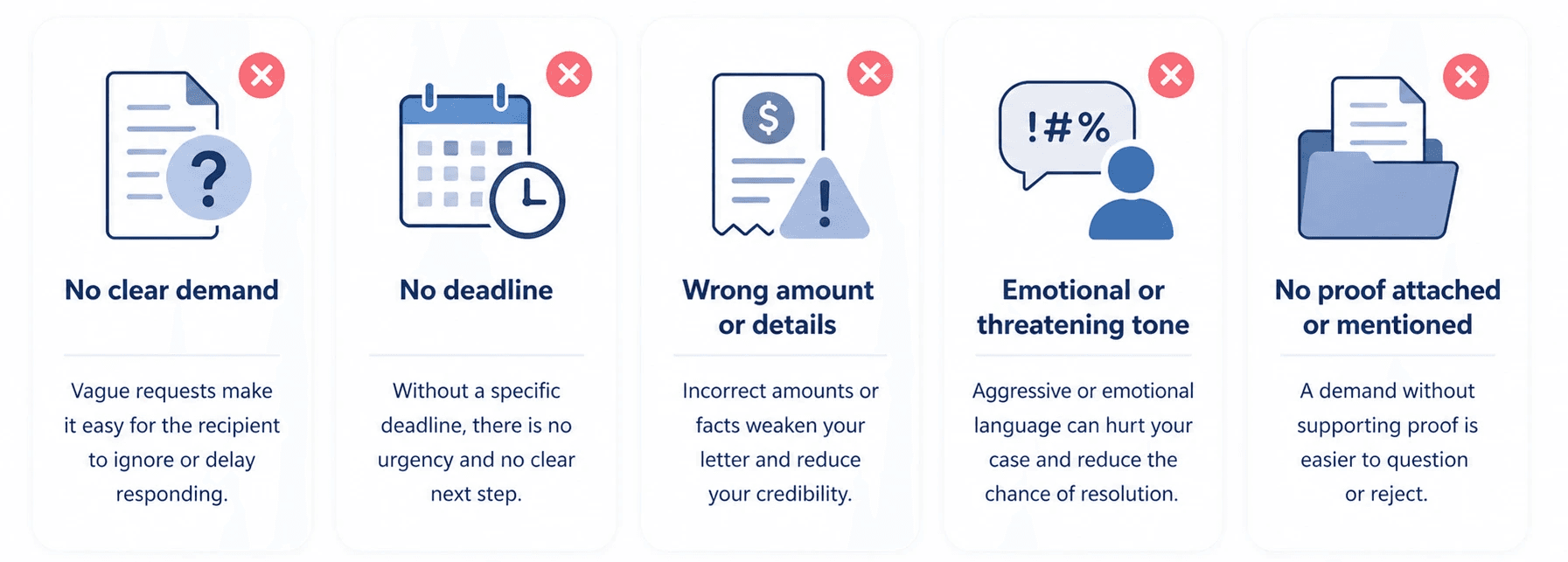
A demand letter is usually allowed and often useful, but it is not the same thing as filing a case or sending an official statutory notice. Before you send it, make sure the letter fits your contract, your state rules, and your dispute type.
The goal is not to make the letter sound more “legal.” The goal is to avoid mistakes that give the recipient an easy excuse to ignore it.
1. Check the contract, lease, or policy first
Some disputes have notice rules built into the documents. A contract, lease, insurance policy, warranty, or service agreement may tell you:
where notice must be sent;
whether email is allowed;
whether certified mail is required;
how many days the other side has to cure the issue;
whether mediation or arbitration is required before filing a claim.
Before sending, check the notice clause. It is one of the easiest details to miss.
2. Do not assume a demand letter stops legal deadlines
A demand letter does not automatically pause the statute of limitations or extend filing deadlines. If your claim is close to a deadline, do not rely on the letter as your safety net.
This matters most in disputes involving:
injury or accident claims;
insurance coverage;
wage deadlines;
landlord-tenant notice periods;
high-value contract claims;
state-specific small claims or agency deadlines.
A practical rule: if missing the deadline would seriously hurt your case, get legal guidance before waiting for the recipient to respond.
3. Do not inflate the amount
Only demand amounts you can explain and support. Unsupported late fees, penalties, interest, attorney’s fees, or emotional damages can make the whole letter look unreliable.
For example, if the unpaid invoice is $1,850, do not turn it into a $4,000 demand unless you can show the exact basis for the extra amount. A cleaner version is:
The outstanding balance is $1,850. I am not including additional fees in this demand, but I reserve the right to pursue any available remedies if this remains unresolved.
That keeps your position firm without making the number look exaggerated.
4. Do not threaten things you are not prepared to do
A demand letter can mention possible next steps, but it should not sound like a personal attack. Avoid threats about reputation, public reviews, social media, immigration status, employment, or anything unrelated to the dispute.
Use calm escalation language:
If I do not receive a response by the deadline, I will consider available next steps, including small claims court, mediation, agency options, or attorney review.
This is stronger than aggressive language because it sounds credible and controlled.
5. Send it to the right person
A strong letter loses power if it goes to the wrong recipient. Use the legal name of the person or business when possible, and check the correct address.
For a business dispute, that may mean:
the client’s billing contact;
the company’s registered address;
the notice address in the contract;
the claims department for an insurer;
the property manager or landlord named in the lease.
Do not guess when the document gives you a notice address.
6. Keep proof of what you sent
Delivery proof matters, but content proof matters too. You want to be able to show not only that something was sent, but exactly what was sent.
Save:
the final signed letter;
the PDF or DOCX version you sent;
all exhibits or attachments;
email headers or sent email confirmation;
certified/tracked mail receipt;
delivery confirmation;
recipient replies.
This becomes useful if you later need to show a court, agency, mediator, or lawyer that you made a clear demand and gave the recipient a fair chance to respond.
Quick mistake checklist
Before sending, check that you are not making one of these common mistakes:
the demand is vague;
the deadline has no exact date;
the amount is inflated or unsupported;
the letter includes emotional accusations;
the proof is missing or disorganized;
the letter goes to the wrong person or address;
the delivery method does not match the contract or lease;
the letter threatens consequences you are not ready or allowed to pursue;
you are waiting on a demand letter while a legal deadline is close.
A demand letter works best when it is accurate, calm, and easy to prove. The more disciplined the letter is, the harder it is for the recipient to dismiss it as a complaint instead of a real demand.
FAQ About Demand Letters in the U.S.
Q: What is a demand letter?
A: A demand letter is a formal written request that explains a dispute, states what you want, and gives the recipient a deadline to respond before further action.
Q: Can I use a demand letter template?
A: Yes. A template is a useful starting point, but you should customize the names, dates, amount, deadline, proof, and next steps to fit your situation.
Q: What should a demand letter include?
A: Include a short timeline, one clear demand, an exact deadline, instructions for how to comply, and supporting proof. If money is involved, show how you calculated the amount.
Q: How do I write a demand letter for payment?
A: State the exact amount owed, what it is for, when it was due, and how the recipient can pay. Refer to the invoice, contract, payment terms, or proof of delivery.
Q: How long should I give someone to respond?
A: For simple payment disputes, 7–14 days is often reasonable. For more complex disputes, 14–30 days may make more sense. Use a specific calendar date.
Q: Should I send a demand letter by email or certified mail?
A: Email creates a quick timestamp and makes it easy to attach documents. Certified or tracked mail helps prove delivery. For higher-stakes disputes, using both is often best.
Q: What happens if someone ignores a demand letter?
A: If the deadline passes, send one short follow-up. If there is still no response, consider the next step, such as small claims court, mediation, an agency complaint, or attorney review.
Conclusion
A demand letter is not powerful because it sounds “legal.” It is powerful because it removes confusion.
When a dispute stays in messages, calls, reminders, and unfinished promises, both sides can keep avoiding the real decision. A demand letter changes that. It puts the facts, the request, the deadline, and the proof in one place. The recipient no longer has to guess what you want — and can no longer easily pretend the issue is unclear.
If your goal is to resolve the dispute, write the letter so the other side can act on it. If your goal is to prepare for escalation, write it so a court, mediator, agency, or lawyer can understand the timeline quickly. In both cases, the same rule applies: make the demand clear, make the proof easy to review, and make the next step obvious.