Business
Car Lease Agreement Guide: Terms, Payments & Compliance 2026
Learn everything about car lease agreements. Download our free template or customize yours with AI for a smooth, legally sound leasing experience.
Leasing a car means you use the vehicle for a set time without owning it. A car lease agreement puts that deal in writing, including payment terms, mileage limits, responsibilities, and end-of-lease rules.
Here is what to know before you sign a car lease agreement in 2026.
You Might Also Like:
Car Rental Agreement Template: The Complete Guide for Owners and Freelancers in 2026
Studio Rental Agreement Template: Your 2026 Guide to Legal Clarity & Creative Freedom
What Is a Car Lease Agreement?
A car lease agreement is a contract between you and the company that owns the car. It gives you the right to use the vehicle under the terms written in the agreement.
Unlike a car loan, a lease does not make you the owner. The vehicle still belongs to the lessor unless your agreement includes a buyout option.
How Does Leasing a Car Work?
Leasing usually follows a simple process: you choose a vehicle, agree on the lease terms, sign the agreement, make payments, and return or buy the car when the lease ends.
The contract should explain the lease length, payment schedule, mileage allowance, maintenance duties, insurance requirements, and return conditions. The details are covered in the sections below.
Car Lease Terms Explained
Car lease terms can look confusing at first. But most agreements use the same basic language.
Term | What It Means | Why It Matters |
|---|---|---|
Lease term | How long you use the car | Most leases last 24 to 48 months |
Monthly payment | What you pay each month | It is one part of the lease cost |
Mileage limit | How many miles you can drive | Many leases allow around 10,000 to 15,000 miles per year |
Residual value | The car’s expected value at lease end | It affects your payment and buyout price |
Money factor | The finance charge on the lease | It works like interest on a loan |
Due at signing | What you pay before driving away | This can include fees, taxes, and the first payment |
Disposition fee | A return-processing fee charged by some lessors | It can add to your final lease cost |
Early termination | Ending the lease before the agreed date | This can be expensive |
Use this table as a quick glossary while reading the agreement. If a term affects money, mileage, vehicle condition, or return rules, it should be clear before you sign.
Free Car Lease Agreement Template
A template helps you put the lease terms in one clear document. This makes it easier to compare the offer with what you actually agreed to.
Create your Car Lease Agreement with AI Lawyer. Use it to prepare a clear agreement before signing.
State-Specific Car Lease Agreements:
California | New York | Texas | Florida | Illinois | Washington
How Car Lease Payments Work
Your lease payment is mostly tied to depreciation. This means the drop in the car’s value while you use it.
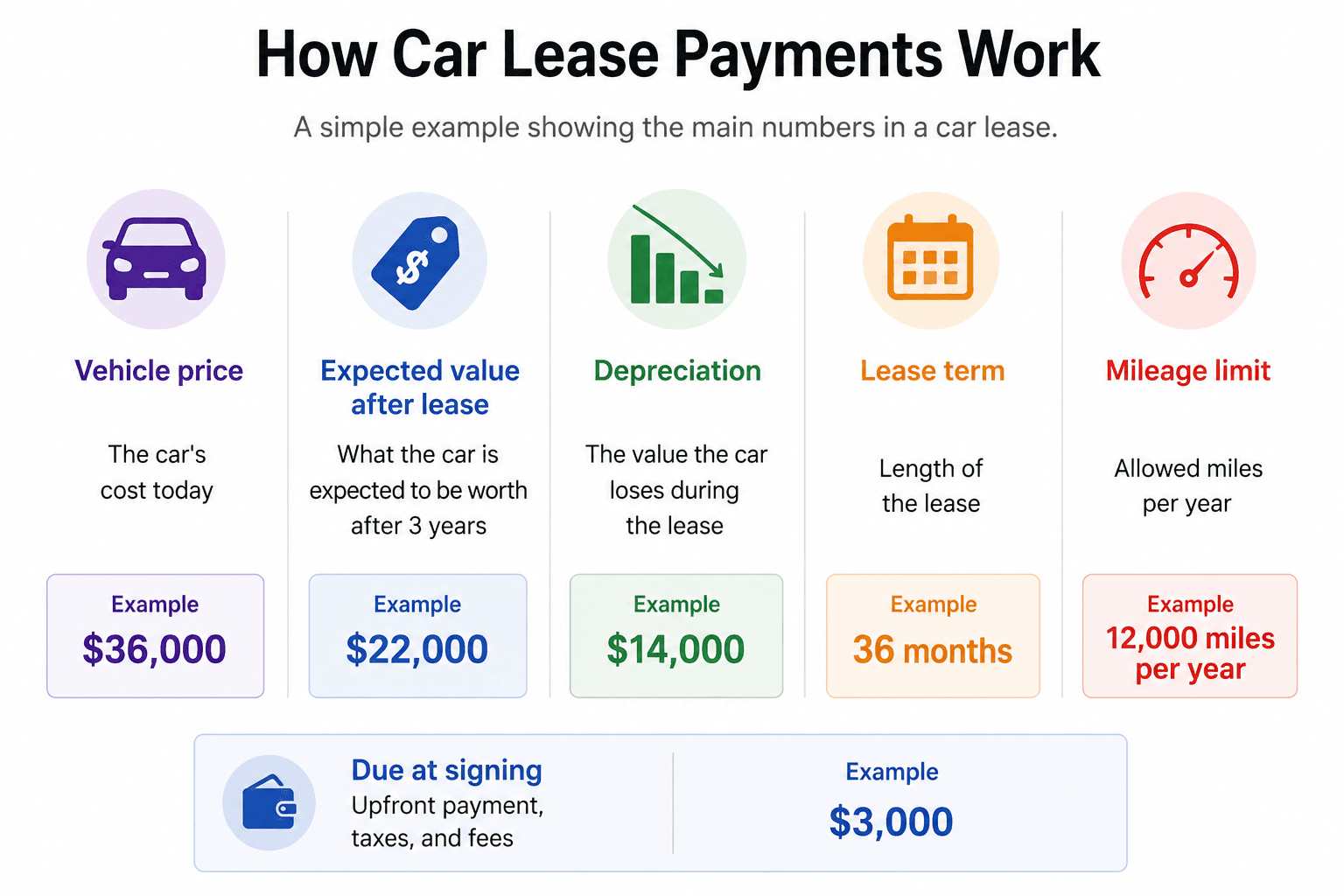
For example, a car may cost $36,000 today. If it is expected to be worth $22,000 after three years, the lease mainly covers the $14,000 difference. You also pay taxes, fees, and finance charges.
Here is a simple example:
Cost Item | Example |
|---|---|
Vehicle price | $36,000 |
Expected value after lease | $22,000 |
Depreciation | $14,000 |
Lease term | 36 months |
Mileage limit | 12,000 miles per year |
Due at signing | $3,000 |
A lease can look simple in the ad. The agreement shows the real numbers.
Ask what you will pay at the start, each month, and when the lease ends.
How Long Is a Car Lease Agreement?
Most car lease agreements last 24, 36, or 48 months. A 36-month lease is one of the most common options because it gives drivers enough time with the car without making the contract too long.
A shorter lease can work if you like changing cars often. It may also help if you do not want to stay tied to one vehicle for several years.
A longer lease gives you more time with the same car. But it also means more time for mileage buildup, tire wear, maintenance needs, and possible changes in your driving habits.
Before choosing a lease term, think about how long you want to keep the car and how many miles you drive each year. The right lease length should match your real use, not just the offer that looks easiest today.
What Should a Car Lease Agreement Include?
Before signing, check:
Vehicle details: make, model, year, VIN, and starting mileage.
Lease term: start date, end date, and lease length.
Payment terms: amount, due date, late fees, and payment method.
Due at signing: first payment, taxes, fees, and any down payment.
Mileage limit: allowed miles per year and extra-mile charges.
Maintenance: service, repairs, tires, and inspection duties.
Insurance: required coverage and proof of policy.
Wear and tear: what counts as normal use and what costs extra.
Early termination: fees or rules if you end the lease early.
Purchase option: whether you can buy the car at the end.
For consumer leases, Regulation M from the Consumer Financial Protection Bureau requires clear disclosures for key lease costs and terms.
The signed agreement controls the deal. If a cost is not clear, ask before you sign.
How to Lease a Car for the First Time
Leasing a car for the first time is easier when you compare offers in the same format.
Start by estimating how many miles you drive each year. Then compare cars using the same lease length and mileage allowance. This helps you avoid comparing offers that only look similar.
Next, ask each dealer for the same numbers: amount due at signing, monthly payment, lease term, and total lease cost. Put the offers side by side before choosing.
After that, review the agreement itself. Check that the numbers match the offer and that any promised changes are written into the contract.
Before you drive away, keep a copy of the signed agreement, payment schedule, insurance proof, and any inspection notes. This gives you a record if there is a dispute later.
What Happens at the End of a Car Lease?

When the lease ends, the car is usually inspected. The lessor checks mileage, damage, and overall condition.
You may have three options:
Return the car and pay any final charges.
Lease another vehicle if you want a new car.
Buy the car if your agreement includes a purchase option.
Extra costs may apply if the car is returned with excess mileage or damage beyond normal wear. In New York, the Attorney General’s lease guidance explains that a driver may request a second inspection at their own expense if they dispute excess wear or damage charges.
Before your final appointment, compare your buyout price with the car’s market value. This helps you decide whether it is better to return the car or keep it.
Common Car Lease Fees to Watch For
The fees most likely to surprise lessees are excess mileage, excess wear, disposition, early termination, and late payment charges.
Check the agreement for the amount or calculation method for each one. A few cents per extra mile can become expensive if you drive thousands of miles over the limit. Small dents, tire wear, or missing maintenance records can also lead to extra charges.
Ask the dealer to show each possible fee in the agreement.
Car Lease Agreement Compliance in 2026
In the U.S., consumer vehicle leases must follow disclosure rules under Regulation M.
For 2026, Regulation M generally applies to consumer leases of $73,400 or less. It covers leases used mainly for personal, family, or household purposes, with a term longer than four months.
The rule requires key lease costs and terms to be disclosed clearly. This includes the payment schedule, total cost, liability, and purchase option.
If required terms are missing, ask for a corrected copy.
State-Specific Car Lease Rules
A generic lease template is only a starting point. State rules can affect registration, title wording, taxes, inspections, and consumer rights.
This section focuses on California, New York, Florida, and Texas. California, New York, and Florida appear among high-leasing states in Experian/CULA data. Texas is included for a different reason: its tax treatment can affect how lease payments and lease structure are handled.
In California, leased vehicles must be registered in the names of both the lessor and the lessee. The lessor is marked as LSR, and the lessee is marked as LSE, according to the California DMV leased vehicle rules.
In New York, drivers may have extra protection if they dispute lease-end charges. The New York Attorney General says a driver may request a second inspection at their own expense by a licensed appraiser agreed to by the lessor.
In Florida, registration can depend on how the leased vehicle is titled. The FLHSMV title and registration procedure says that when a leased vehicle is titled for the first time in Florida, registration may be issued in the lessee or registrant’s name when the vehicle class allows it. This makes it important to identify the lessor, lessee, and registrant correctly in the agreement.
In Texas, tax treatment can affect the lease structure. The Texas Comptroller states that, under an operating lease, the lessor remains the title owner and the lessee does not owe tax on lease payments. Experian also notes that Texas lease payments can be higher because of trucks and how sales tax is handled on leased vehicles.
These examples show why the agreement should match the state where the vehicle will be leased, registered, and used.
FAQs
Q: Can I negotiate a car lease agreement?
A: Yes. You may be able to negotiate the vehicle price, mileage limit, due-at-signing amount, and some fees. Ask what can be adjusted before you agree to the deal.
Q: Is insurance included in a car lease?
A: Usually, no. Most lease agreements require you to carry your own insurance. The contract should show the minimum coverage you need.
Q: What is the difference between a car lease and a car rental?
A: A car lease is usually a long-term agreement. It often lasts 24 to 48 months and may include mileage limits, insurance rules, maintenance duties, and a buyout option. A car rental is usually short-term. People use rentals for trips, repairs, or temporary transportation.
Q: Can I modify a leased car?
A: Usually, only with written approval. Changes like tinted windows, new wheels, or aftermarket parts may need to be removed before return.
Q: What documents should I keep after signing?
A: Keep the signed lease agreement, payment records, inspection reports, insurance proof, and any written changes to the deal.