Business
Business Sale Agreement: Free Template to Secure 2026 Deals
Download a free Business Sale Agreement template and customize it with AI to secure safe business deals in 2026 for buyers, sellers, and freelancers.
Transferring a business without a formal agreement can lead to costly legal battles and broken deals. Misunderstandings over assets, debts, or transition responsibilities are common and avoidable. A Business Sale Agreement protects both parties by detailing every critical aspect of the sale.
You Might Also Like:
Business Requirements Document (BRD): The Legal & Strategic Must-Have for 2026 Projects
Corporate Bylaws Template: Protect Your Business with a Free Custom Template
What is a Business Sale Agreement?
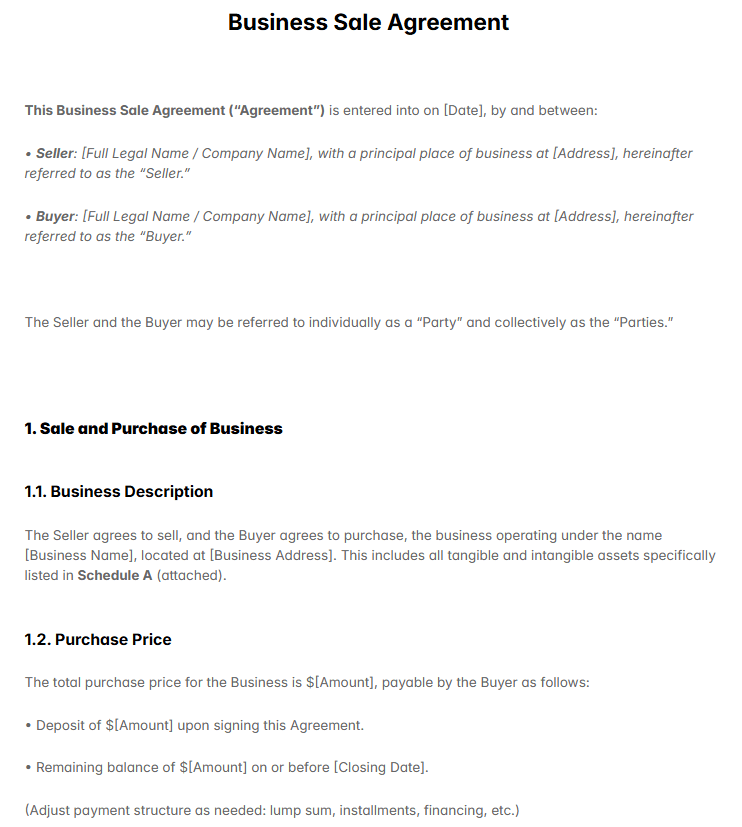
Transferring a business without a formal agreement can lead to costly disputes, tax complications, and unenforceable verbal promises. To protect both the buyer and seller, you can download the Business Sale Agreement template or create a customized version with our AI Generator — then have a local attorney review it before signing.
Because business sale laws vary across the U.S., choose a state-specific template for stronger compliance with local regulations:
California | New York | Texas | Florida | Illinois | Washington
This guide is part of our Business Documents Templates Series, where you’ll find ready-to-use legal templates for safe and professional business operations.
Who Benefits Most from a Business Sale Agreement?
Solo entrepreneurs and freelancers selling service-based businesses: Whether you’re handing off a web design agency, coaching brand, or Etsy store, a Business Sale Agreement ensures clarity around client handovers, digital assets, and ongoing responsibilities.
Family-owned businesses transitioning to the next generation: These agreements formalize transfers between relatives, covering valuation, goodwill, consulting roles, and non-compete terms — minimizing tension and preventing legal or tax issues.
Brick-and-mortar small business owners: Local cafés, salons, gyms, or boutiques changing hands benefit from a formal record of what’s sold — fixtures, leases, licenses — and clear payment schedules that prevent confusion during the transition.
Investors or partners exiting a company: Selling your stake in a growing venture? A sale agreement documents share price, voting rights, buyer liabilities, and future involvement, ensuring clean separation and protecting seller interests.
Digital business sellers: From Shopify stores to SaaS tools, sellers of online businesses must transfer domain names, user databases, content rights, and earnings history — all handled transparently with a Business Sale Agreement.
Buyers of assets-only deals: Purchasing select assets (not the entire business)? These agreements clarify what’s excluded — like debts or legal claims — while defining inventory, licenses, or customer lists that are transferred.
Why You Need This in 2026
The landscape of small business ownership is shifting fast. BizBuySell reports 9,546 closed small business transactions in 2024, and its latest Insight Report says the business-for-sale market stabilized in 2025 with transactions flat — with some delayed 2025 closings rolling into 2026 as more professionals monetize their businesses.
Key statistics
Roughly 40% of small business sales fall apart due to lack of clear legal agreements or financial transparency.
Legal Importance and Context of a Business Sale Agreement
Ensures Legal Clarity: Clearly outlines what’s included in the sale such as assets, intellectual property, or customer lists preventing misunderstandings.
Protects Freelancers and Small Business Owners: Formalizes transitions of digital businesses, design studios, or consultancy practices helping solo professionals avoid costly legal pitfalls.
Prevents Disputes: Acts as legally binding evidence if disagreements occur over ownership, payment terms, or post-sale responsibilities.
Complies with U.S. Business Law: Many business transfers must comply with the Uniform Commercial Code (UCC) and state-specific disclosure laws.
Essential for Tax & Licensing Compliance: Helps both parties properly report the transaction to tax authorities and update licenses or registrations.
Builds Buyer Confidence: Having a signed agreement reassures buyers that the transaction is professional, transparent, and enforceable especially important for online or service-based businesses.
Recognized in Court: Unlike verbal agreements, a written Business Sale Agreement is enforceable in legal disputes under contract law and the Statute of Frauds.
So we offer A tool to generate customized agreements using AI, tailored to your specific business type, size, and location.
Real-World Examples
In 2022, a Sydney man was forced to pay damages after reclaiming a charcoal chicken shop he had agreed to sell for AUD 100,000. Though only a preliminary “head of agreement” was signed, the court ruled it legally binding and upheld the sale. The buyer had already paid, and the seller’s reversal caused business losses.
In Burns v. Burns (2019), a family-run business sale turned into a legal dispute because there was no written agreement clarifying the terms. The absence of documentation led to court costs and a broken relationship.
When Should You Use a Business Sale Agreement?
You should always use a Business Sale Agreement when:
You're selling or buying a business (partial or full)
You're transferring ownership to a family member, investor, or partner
You're purchasing only business assets, not the full entity
Use Case 1: A freelance designer sells their client list and tools to another creative.
Use Case 2: A small retail shop owner hands over the business to a new buyer, including the lease and equipment.
Key Sections of a Business Sale Agreement and How to Fill Them Out
When using our template, here are the essential sections to complete:
Buyer & Seller Info Legal names, addresses, contact details
Business Details Name, registration number, and description
Assets Included Equipment, inventory, IP, and contracts
Sale Price & Payment Terms Total price, instalment details, payment method
Liabilities Specify who is responsible post-sale
Closing Date & Signatures Final date, conditions, and digital or wet signatures
Authorization and Signature: Always confirm identities, add date, and notarize if required.
Practical Tips for Using a Business Sale Agreement Effectively
Keep a digital and physical copy of the signed agreement
Verify all business details, including financials and liabilities
Clearly communicate terms with the other party to avoid misinterpretation
⚖️ Legal Tip: The Critical Clauses That Protect Parties in Business Sales
According to the American Bar Association's Business Law Section, three essential protective clauses are frequently omitted from business sale agreements that later lead to costly disputes:
Representations and Warranties with Survival Periods: Most agreements fail to properly structure seller warranties. The ABA recommends specific language like: "Seller represents and warrants that: (1) all financial statements provided are complete and accurate as of their respective dates; (2) all assets are in good working condition; (3) there are no undisclosed liabilities; (4) all tax returns are filed and taxes paid; and (5) there are no pending or threatened legal actions. These representations and warranties shall survive closing for a period of 24 months, except for tax and environmental representations which shall survive for the applicable statute of limitations plus six months." This language provides specific post-closing protection for the buyer.
Indemnification with Baskets and Caps: Industry data shows that 64% of business sale disputes involve indemnification claims. Your agreement should clearly state: "Seller shall indemnify and hold Buyer harmless from any losses resulting from: (1) breach of representations and warranties; (2) undisclosed liabilities; (3) pre-closing operations; and (4) specifically excluded liabilities. Buyer shall not be entitled to indemnification until aggregate losses exceed $[X] (the 'Basket'), after which Buyer may claim the entire amount. Seller's total indemnification liability shall not exceed $[Y] (the 'Cap'), except for claims involving fraud, intentional misrepresentation, or tax liabilities, which shall not be subject to the Cap." This structure provides certainty for both parties about potential post-closing liability.
Non-Competition and Customer Protection: The International Association of Business Brokers reports that 71% of business sale disputes involve customer or competitive issues. Include specific language about: "For a period of [X] years after closing, Seller shall not, directly or indirectly: (1) engage in any business that competes with the Business within a [Y]-mile radius of the Business's current locations; (2) solicit or service any customer or supplier of the Business; (3) employ or solicit any employee of the Business; or (4) disparage the Business or Buyer. These restrictions are separate and severable, and the unenforceability of any restriction shall not affect the enforceability of the others." This language protects the value of what the buyer purchased.
The Harvard Business Review reports that disputes involving these missing clauses account for approximately 78% of all business sale litigation.
📌 Real‑World Case: $1.8 Million Damages Awarded for Asset Misrepresentation
In 2023, a U.S.-based small business transaction led to litigation after the buyer discovered that key financial representations were false or misleading. The Business Sale Agreement lacked clear representations and warranties, particularly around inventory, financial statements, and customer contracts. Post-acquisition, the buyer sued for fraudulent misrepresentation, claiming the seller knowingly misrepresented critical business facts. Courts assessed damages based on out-of-pocket losses plus lost value under the "benefit of the bargain" rule, resulting in a judgment of approximately $1.8 million, which included both compensatory and consequential damages. Litigation spanned over 9 months, and attorneys’ fees added substantial costs.
Key Takeaway: This case shows how the absence of explicit representations and warranties in a Business Sale Agreement can open the seller to major liability. Without clear clauses defining asset ownership, inventory, and contract integrity, the buyer justified a fraud claim. Including detailed representations clauses and warranty survival periods, plus inventory verification procedures, would mitigate exposure and enforce clearer accountability — shielding both parties from costly disputes.
🔑 Additional Insight: Industry-Specific Business Sale Considerations
Modern business sale agreements should include industry-specific sections that address unique operational and regulatory concerns:
Industry | Key Agreement Elements | Special Considerations | Risk Factors |
|---|---|---|---|
Technology | IP ownership verification | Open source compliance | Customer data transfer |
Healthcare | Regulatory compliance | Patient record transfer | Insurance tail coverage |
E-commerce | Platform account transfers | Inventory valuation | Return liability |
Professional Services | Client consent requirements | Work-in-progress | Reputation protection |
Manufacturing | Equipment warranties | Supply chain contracts | Environmental liability |
According to the International Business Brokers Association's 2024 Transaction Report, 82% of successful business sales now use industry-specific agreement formats rather than generic templates. Your business sale agreement should reflect your specific industry with tailored provisions addressing sector-standard risks.
Expert Insights
“Protecting your interests in a business sale starts and ends with a thorough purchase agreement.”
— Leading M&A Attorney
“A business sale agreement isn’t just a handshake — it’s a protective shield for both buyer and seller.”
— BusinessBrokerNews expert
How AI Lawyer Creates Your Document (Step-by-Step)
At AI Lawyer, we believe that drafting legal documents shouldn’t feel like decoding a foreign language. Whether you’re a business owner, landlord, freelancer, or someone navigating a personal matter — you should be able to create a legally sound document without needing a law degree.
That’s why we built a document experience that works like a conversation, not a form. Here’s exactly how it works:
1. You Tell AI Lawyer What You Need
It starts with a simple question:
“What type of document do you want to create?”
You choose from our list of professional templates — whether it’s a rental agreement, contractor form, invoice, publishing contract, or anything else — and AI Lawyer immediately pulls up the structure designed specifically for that use case.
Behind the scenes, the system references U.S. legal standards and best practices to make sure you’re starting from the right foundation.
2. We Highlight the Key Sections
Instead of throwing the whole document at you, AI Lawyer breaks it down.
Each key component — like payment terms, deadlines, responsibilities, clauses — is briefly explained in human language so you know what it means before you fill it out.
It’s like having a lawyer on your shoulder saying,
“Here’s what this section covers, and why it matters.”
3. You Answer Simple, Targeted Questions
AI Lawyer asks you step-by-step questions — like:
Who’s involved?
What are the key dates or timelines?
What are the terms (payments, conditions, obligations)?
Do you need special clauses like confidentiality, termination, or jurisdiction?
Each question is directly linked to a block in the final document — so your answers go exactly where they belong.
4. The Document Builds Itself As You Go
On the right side of your screen, the full document builds in real time.
Every time you answer a question, a corresponding section is added — with legally sound wording, smart defaults, and editable fields.
You’re not just answering a form — you’re watching your document take shape.
This phased process helps:
Reduce overwhelm
Catch errors early
Ensure nothing is forgotten
5. You Edit and Customize Freely
Once all the inputs are in, the full document is unlocked for editing.
You can:
Rewrite any clause
Change formatting
Add or remove sections
Rephrase terms in plain English (or more formal legal tone)
The editor works like a Google Doc — intuitive, responsive, and flexible.
6. Your Final Document Is Yours to Keep
Download in PDF, DOCX, or copy to clipboard.
You can print it, email it, or send it for signature — and revisit your answers anytime to generate updated versions.
Why This Workflow Matters
Most template tools give you a blank form.
We give you a process — one that mirrors how a real attorney would walk you through the creation of a document:
Context → Input → Assembly → Review → Delivery
It’s not magic. It’s just a smarter way to get legal work done — without getting lost in the jargon.
FAQs
Q: Can I sell my business without an agreement?
A: Technically, yes — but it leaves you exposed to disputes over hidden debts, assets, or responsibilities. A formal agreement offers essential protection and enforceability.
Q: Is this agreement valid internationally?
A: It can be, but must reference and comply with local laws in each jurisdiction — like UCC in the U.S. or contract law abroad — to ensure enforceability.
Q: What if the buyer refuses to sign?
A: You should not proceed. Without a signed agreement, the sale lacks legal standing. Consult a lawyer to protect your interests.
Q: What should be included in representations and warranties?
A: Include financial accuracy, asset condition, tax compliance, absence of legal actions, and a survival period (e.g., 24 months post-close) to protect against post-sale issues.
Q: How does indemnification work in a sale agreement?
A: The agreement typically includes a "basket" (claim threshold) and cap on the seller’s liability — ensuring buyers are covered for pre-closing issues like undisclosed liabilities or breaches of warranty.
Q: Why include a non-compete clause?
A: To protect the buyer’s investment, the seller is generally restricted from competing within a defined radius and period (e.g., 2 years, 50 miles), preventing customer poaching and preserving business value.
Final thoughts
Selling a business is a major financial and legal step — and a well-drafted agreement is essential to protect your interests, prevent disputes, and ensure a clean transfer of ownership. Download the free Business Sale Agreement template, select a state-specific version if needed, or generate a tailored agreement using our AI Generator — then have an attorney review local requirements before signing.
State-Specific Business Sale Agreement Templates:
California | New York | Texas | Florida | Illinois | Washington
Explore more resources in our Business Documents Templates Series to secure your business transactions with clarity, professionalism, and legal compliance.
Sources and References
Market and transaction data in this guide draw on the BizBuySell Insight Report on closed small-business sales and related coverage of 9,093 completed U.S. business transactions in 2023, alongside industry research from the Bureau of Labor Statistics — Business Employment Dynamics on deal volume, valuations, and common causes of failed sales.
Legal and regulatory context is based on the Census Bureau — Business Dynamics / Ownership Changes, IRS rules on the sale of a business and Publication 544 on sales and other dispositions of assets, and the Uniform Commercial Code Article 2 on sales of goods as summarized by the Uniform Law Commission.
Discussion of disputes, misrepresentation risk, and damages in business transfers is informed by publicly reported litigation and commentary, including analyses of fraudulent-misrepresentation claims and “benefit-of-the-bargain” damages in business sale contexts from reputable legal sources such as Easler Law’s overview of misrepresentations in business sales and recent case notes on fraud defenses in sale-of-business disputes.
You Might Also Like: