Business
Business Requirements Document (BRD): Free Template for 2026
Download a free AI-generated Business Requirements Document (BRD) template for 2026. Customize it fast and stay compliant, efficient, and client-ready for every project.
Every project starts with an idea but without a clear Business Requirements Document (BRD), that idea can quickly become a costly mess. Missed deadlines, feature creep, and legal oversights can drain your budget and reputation. In 2026, when clients demand efficiency and compliance, a well-crafted BRD is your roadmap to avoid losing time, money, and trust. Here’s how to fix that and get ahead.
You Might Also Like:
Business Plan Template: Free Download + How It Can Secure Funding & Guide Growth
Business Sale Agreement: Free Template to Secure Business Deals in 2026
What Is a Business Requirements Document (BRD)?
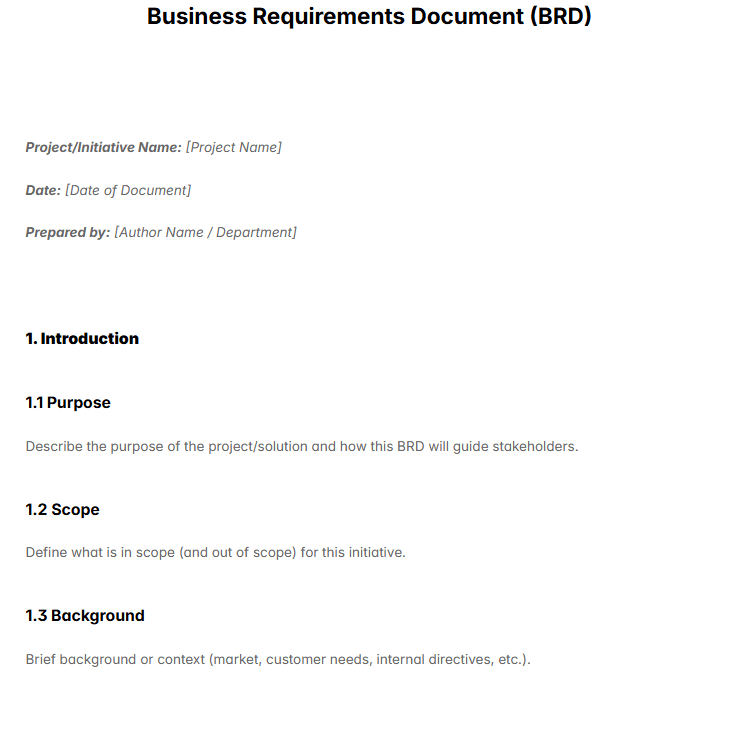
A BRD defines a project’s goals, scope, stakeholders, and success criteria. It ensures everyone from freelancers and designers to business owners is aligned before work begins.
Free Business Requirements Document Template by AI Lawyer.
Key Statistics on BRD Impact
47 % of failed projects are due to inaccurate or poorly managed requirements.
51 % of project and program dollars are wasted because of poor requirements management often due to lack of formal BRDs.
A study analysing over 1,200 use case-based requirements (2020–2024) found strong correlation between high-quality BRD components and smoother development.
Business Requirements Document (BRD) represents one of the many templates available within the Business Document category featured on our website.
For a more comprehensive understanding of Business Document — including their legal nuances, variations across jurisdictions, and practical applications — we invite you to explore our in-depth overview article dedicated to this document category.
Who Benefits Most from a Business Requirements Document (BRD)?
Project-based professionals, development teams, and client-side stakeholders rely on a BRD to keep ambitious ideas from spiraling into chaos. Whether launching a website, integrating systems, or rolling out a new product, it ensures clarity around goals, scope, and delivery expectations.
IT and software development teams: Precise BRDs define functional and non-functional requirements, helping engineers, QA, and product management stay aligned and avoid costly rework.
Freelancers, agencies, and consultants: When onboarding new clients or projects, a BRD outlines responsibilities, deliverables, timelines, and testing criteria — minimizing misunderstandings and establishing accountability.
Stakeholder groups and procurement professionals: BRDs provide the detailed documentation needed to secure executive or vendor buy-in, establish budgets, and manage expectations upfront, ensuring everyone moves in the same direction.
Regulated industries and compliance teams: A well-crafted BRD proves due diligence, supports audit trails, and aligns project plans with regulations like ISO 9001 or Sarbanes‑Oxley.
Cross-functional or distributed teams: Serving as a shared reference point, the BRD improves coordination among remote team members, clients, and third-party vendors — reducing confusion and enhancing collaboration.
Legal Importance and Context
1. Prevents Misunderstandings
A BRD documents every agreed detail scope, roles, timelines minimizing the risk of verbal miscommunication.
If a dispute arises, it serves as a clear point of reference.
2. Strengthens Accountability
Each party’s responsibilities are clearly outlined, helping enforce accountability.
Reduces the chances of blame-shifting during project execution.
3. Supports Legal Defence
A signed BRD can support your position in case of contractual disputes.
Shows intent, agreement, and documented approvals valuable in legal reviews.
4. Aids Regulatory Compliance
In regulated industries, BRDs help show project planning aligns with compliance standards.
Relevant Laws:
Sarbanes Oxley Act (SOX) for financial transparency and documentation
ISO 9001 for quality management and process validation.
Click here to download your free, legally compliant BRD template customizable in minutes.
Strategic Benefits of BRDs (Beyond Legal)
1. Clear Vision & Project Alignment
Aligns stakeholders on project goals, scope, and expected outcomes from the very beginning.
Minimizes miscommunication between teams (design, development, management).
2. Improved Resource Planning
Helps allocate time, budget, and team roles more effectively.
Prevents resource wastage by avoiding unnecessary features or tasks.
3. Stronger Collaboration
Acts as a shared reference point for internal and external stakeholders.
Enhances cross-functional teamwork through clearly defined expectations.
4. Faster Decision-Making
Enables quick approvals and change management with documented workflows.
Reduces project delays caused by ambiguity or shifting objectives.
5 Supports Agile & Iterative Workflows
Can be adapted for Agile environments by breaking down large goals into user stories and requirements. Supports incremental delivery with traceable goals.
Case Example
A mid-sized company used a BRD to plan a custom software system.
As a result, they cut operational costs by 30% and improved productivity by 40%.
Clear requirements helped them avoid delays, reduce rework, and deliver faster to clients.
When Should You Use a Business Requirements Document (BRD)?
Use a BRD when embarking on any structured project. Common scenarios:
New product or website launches ensure branding and functionality meet business objectives
Client-based contracts outline deliverables, milestones, and responsibilities
System integrations clarify technical needs, workflows, and compliance
Use Cases:
A freelance designer building a custom e‑commerce portal for a client.
A small biz launching a CRM migration requiring stakeholder input.
An event organizer creating an online registration system with secure payment.
Key Sections of a BRD and How to Fill Them Out
A robust BRD should include:
Executive Summary One‑page overview of project purpose and objectives
Scope & Objectives SMART goals and project boundaries
Business & Functional Requirements What must the tool/system do?
Stakeholders Who’s involved? Roles & responsibilities
Constraints & Risks Budget, timelines, legal or technical limitations
Cost-Benefit Analysis ROI estimates and full business justification
Authorization & Signature Sign‑off section, dated and signed by authorized parties
Our Downloadable BRD template is easily customized via AI, making setup quick, professional, and tailored to your needs.
Practical Tips for Using a BRD Effectively
Keep digital copies for version control and auditing
Verify inputs thoroughly facts, dates, legal terms
Communicate step-by-step: ensure clients & teams understand timeline, signoffs, and change control
⚖️ Legal Tip: The Critical Clauses That Protect Parties in Business Requirements Documents
According to the Project Management Institute's Legal Standards Committee, three essential protective clauses are frequently omitted from BRDs that later lead to costly disputes:
Change Control Procedure with Pricing Impact: Most BRDs fail to adequately address scope changes. The PMI recommends specific language like: "Any change to the requirements outlined in this document must follow the Change Control Process: (1) Changes must be submitted in writing using the Change Request Form; (2) All changes will be evaluated for impact on schedule, cost, and quality; (3) No work on changes shall commence without written approval; (4) Changes requiring additional resources or extending timeline will be billed at $X/hour or may require contract amendment. Verbal requests or approvals for changes are not binding." This language prevents scope creep and establishes a clear process for handling inevitable changes.
Intellectual Property Rights and Deliverable Ownership: Industry data shows that 63% of project disputes involve IP ownership confusion. Your BRD should clearly state: "Upon full payment of all fees due under this agreement, Client shall own all deliverables specifically created for Client under this BRD, except for: (1) Pre-existing intellectual property owned by Service Provider; (2) Third-party materials licensed to Client; (3) General knowledge, processes, and techniques developed by Service Provider during the project. Service Provider retains the right to use general knowledge and experience gained during the project for future work, provided no Client confidential information is disclosed." This language clarifies ownership expectations from the outset.
Acceptance Criteria and Testing Procedures: The International Association of Business Analysts reports that 72% of project disputes involve disagreements about whether requirements were met. Include specific language about: "Deliverables will be considered accepted when they meet the following criteria: (1) Functionality performs as specified in Section X of this BRD; (2) Performance meets the metrics defined in Section Y; (3) Client has completed acceptance testing within 10 business days of delivery; (4) If Client does not provide written notice of deficiencies within the testing period, the deliverable will be deemed accepted. If deficiencies are identified during testing, Service Provider shall have 15 business days to remedy such deficiencies, after which the acceptance testing process will restart." This language establishes clear standards for project completion.
The Harvard Business Review reports that disputes involving these missing clauses account for approximately 68% of all project-related litigation.
📌 Real‑World Case: VA Scheduling Project Stalled by Poor Requirements Planning
In 2025, the U.S. Government Accountability Office (GAO) released a report (GAO‑25‑106851) on the Department of Veterans Affairs’ long‑running attempt to modernize its appointment scheduling systems. The report found that VA’s project planning and requirements management failed to meet established best practices. Specifically, VA did not implement a formal requirements management plan, leading to fragmented systems, user confusion, and persistent scheduling delays across dozens of hospitals and clinics.
Even after investing over $1.3 billion, the system failed to deliver promised improvements. GAO issued recommendations calling for a full requirements development and management plan, consistent with Project Management Institute standards.
Key Takeaway: This case illustrates how missing or inadequate requirements planning and documentation can result in massive budget overruns and operational paralysis. Without a robust BRD–style framework — including a standards-based requirements management plan, stakeholder alignment, and clear success criteria — the VA’s modernization efforts stalled despite enormous financial investment. A well-structured BRD could have enforced clarity, consistency, and accountability, steering the project to success instead of costly failure.
🔑 Additional Insight: Industry-Specific BRD Considerations
Modern Business Requirements Documents should include industry-specific sections that address unique operational and compliance concerns:
Industry | Key BRD Elements | Special Considerations | Risk Factors |
|---|---|---|---|
Healthcare | HIPAA compliance requirements | Patient data handling | Regulatory reporting |
Financial Services | Security standards | Transaction processing | Audit trail requirements |
E-commerce | Payment processing | Inventory management | Return processing |
Manufacturing | Quality control specifications | Supply chain integration | Material requirements |
SaaS | User permission structures | Data migration | API documentation |
According to the Business Analysis Body of Knowledge (BABOK) 2024 Guide, 81% of successful projects now use industry-specific BRD formats rather than generic templates. Your Business Requirements Document should reflect your specific industry with tailored requirements addressing sector-standard compliance and operational needs.
Expert Insights
“A business requirements document is like a blueprint for a new project or partnership — you can see the plan and imagine the final results at a glance. Indeed, a BRD communicates all of the most crucial elements of a project quickly… This comes in handy for planning projects, purchases or process changes — when it’s crucial that everyone involved understands the context, needs and ideal outcomes.”
— Responsive.io
“Working with a Business Requirements Document is essential for the successful execution of any project. It ensures clear communication, comprehensive documentation, effective scope management, risk mitigation, efficient project planning and execution, quality assurance, and enhanced collaboration. By investing time and effort into creating a detailed BRD, organizations can significantly increase their chances of project success.”
— Maxwell Chukwuemeka, LinkedIn
How AI Lawyer Creates Your Document (Step-by-Step)
At AI Lawyer, we believe that drafting legal documents shouldn’t feel like decoding a foreign language. Whether you’re a business owner, landlord, freelancer, or someone navigating a personal matter — you should be able to create a legally sound document without needing a law degree.
That’s why we built a document experience that works like a conversation, not a form. Here’s exactly how it works:
1. You Tell AI Lawyer What You Need
It starts with a simple question:
“What type of document do you want to create?”
You choose from our list of professional templates — whether it’s a rental agreement, contractor form, invoice, publishing contract, or anything else — and AI Lawyer immediately pulls up the structure designed specifically for that use case.
Behind the scenes, the system references U.S. legal standards and best practices to make sure you’re starting from the right foundation.
2. We Highlight the Key Sections
Instead of throwing the whole document at you, AI Lawyer breaks it down.
Each key component — like payment terms, deadlines, responsibilities, clauses — is briefly explained in human language so you know what it means before you fill it out.
It’s like having a lawyer on your shoulder saying,
“Here’s what this section covers, and why it matters.”
3. You Answer Simple, Targeted Questions
AI Lawyer asks you step-by-step questions — like:
Who’s involved?
What are the key dates or timelines?
What are the terms (payments, conditions, obligations)?
Do you need special clauses like confidentiality, termination, or jurisdiction?
Each question is directly linked to a block in the final document — so your answers go exactly where they belong.
4. The Document Builds Itself As You Go
On the right side of your screen, the full document builds in real time.
Every time you answer a question, a corresponding section is added — with legally sound wording, smart defaults, and editable fields.
You’re not just answering a form — you’re watching your document take shape.
This phased process helps:
Reduce overwhelm
Catch errors early
Ensure nothing is forgotten
5. You Edit and Customize Freely
Once all the inputs are in, the full document is unlocked for editing.
You can:
Rewrite any clause
Change formatting
Add or remove sections
Rephrase terms in plain English (or more formal legal tone)
The editor works like a Google Doc — intuitive, responsive, and flexible.
6. Your Final Document Is Yours to Keep
Download in PDF, DOCX, or copy to clipboard.
You can print it, email it, or send it for signature — and revisit your answers anytime to generate updated versions.
Why This Workflow Matters
Most template tools give you a blank form.
We give you a process — one that mirrors how a real attorney would walk you through the creation of a document:
Context → Input → Assembly → Review → Delivery
It’s not magic. It’s just a smarter way to get legal work done — without getting lost in the jargon.
FAQs
Q: Is a BRD necessary for small projects?
A: Yes. Even small-scale initiatives benefit from a BRD, as it defines scope and prevents scope creep, miscommunication, and unclear expectations.
Q: Can I update a BRD mid-project?
A: Absolutely. Changes should be tracked in a change control log, with stakeholder sign-off to keep everyone aligned and documented.
Q: Does a BRD have legal weight in disputes?
A: While not a formal contract, a signed BRD is strong documentary evidence that can support claims during legal disputes or misaligned expectations.
Q: What essential clauses should a BRD include?
A: Critical clauses cover change control procedures, deliverable ownership/IP rights, and clear acceptance criteria — preventing feature creep and scope disputes.
Q: Who should review and approve the BRD?
A: Stakeholders across roles — project sponsors, business analysts, technical leads, finance, compliance, and end-users — should review and sign off to ensure alignment.
Q: How formal should a BRD be?
A: As formal as the project's scale and context require. It can range from structured internal documents with version control to formal appendices to contracts for high-value or regulated projects.
Q: Is a BRD necessary for small projects?
A: Yes, clarity at the outset prevents scope creep and legal misunderstandings down the line.
Q: Can I update a BRD mid-project?
A: Absolutely use change logs so all stakeholders agree to revisions.
Q: How legal is a BRD?
A: While not a formal contract, a signed BRD is a strong defence in disputes or misaligned expectations.
Final thoughts
Great projects begin with great clarity. A Business Requirements Document (BRD) turns vague ideas into structured, actionable plans saving you from costly missteps.
Don’t just start, start strong. With our free AI-powered Business Requirements Document template, you can build faster, smarter, and safer.
Sources and References
Data and insights on the impact of poor requirements management are drawn from Project Management Institute research, including the Pulse of the Profession requirements management report, along with findings summarized in project management statistics on requirements-related failure and wasted spend and supporting analyses of how poor requirements drive unmet project goals and overruns.
Definitions and best practices for Business Requirements Documents are informed by professional business analysis resources, including International Institute of Business Analysis guidance on documenting requirements, detailed BRD structure and content overviews, and practitioner materials explaining how BRDs align stakeholders and support successful delivery. The legal and compliance context for using BRDs as part of audit trails and governance is supported by documentation and internal control obligations under the Sarbanes-Oxley Act of 2002 and by the planning and process-clarity principles embedded in ISO 9001 quality management systems standards, both of which stress traceable requirements, documented procedures, and continuous improvement.
You Might Also Like: