Business
Business Plan Template: Free Download to Get Funding Faster
Free Business Plan Template (2026): download and customize fast to secure funding, attract investors, reduce risk, and grow with confidence.
Thousands of businesses shut down each year not because the idea was bad, but because there was no clear plan to make it work. No pitch, No roadmap. If you're trying to attract investors, secure a loan, or even align a small team around your vision, walking in without a solid business plan is the fastest way to lose trust and funding.
In 2026, expectations are higher. Lenders want risk-proof models. Investors expect data backed projections. Even clients are choosing providers who show strategy, not guesswork.
That’s why we created a free, customizable Business Plan Template, a tool designed not just to look good on paper, but to help you get funded, stay focused, and grow smarter.
You Might Also Like:
Legally Sound Board Resolution Template - Free & AI-Powered Template
Business Requirements Document (BRD): The Legal & Strategic Must-Have for 2026 Projects
What is a Business Plan Template?
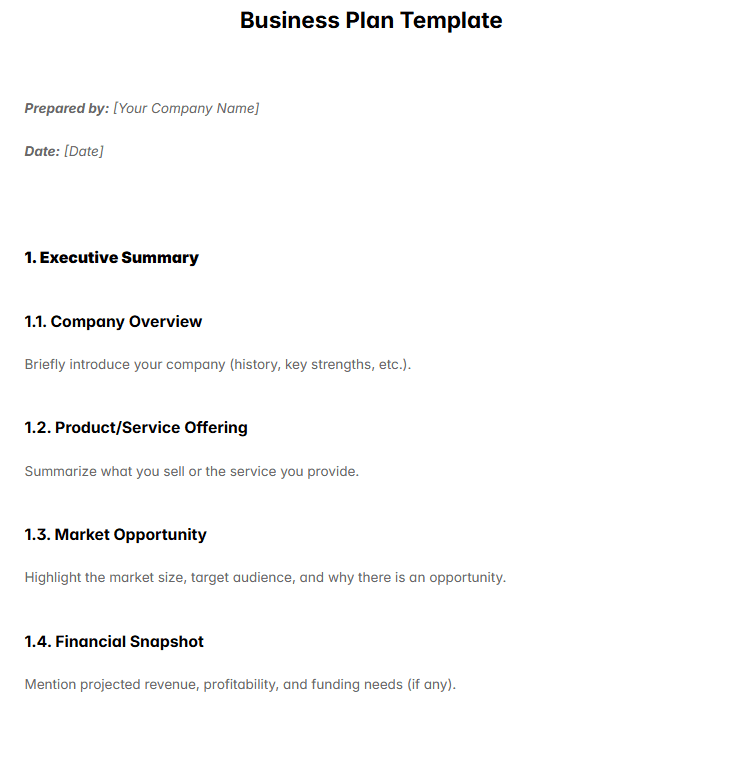
A Business Plan Template is a ready-to-use document that outlines your business strategy, goals, operations, financials, and market research. It gives your ideas structure and helps you communicate clearly with investors, partners, or even your team.
Business Plan Template represents one of the many templates available within the Business Document category featured on our website.
For a more comprehensive understanding of Business Document — including their legal nuances, variations across jurisdictions, and practical applications — we invite you to explore our in-depth overview article dedicated to this document category.
Who Benefits Most from a Business Plan Template?
Aspiring entrepreneurs, scaling freelancers, and startup founders gain clarity and credibility with a structured Business Plan Template. It helps them turn ambitious ideas into actionable strategies — critical for securing funding, loans, or team alignment.
Small business owners seeking growth: Whether you're expanding into new markets or applying for financing, a formal plan demonstrates financial forecasting and operational readiness — impressing banks and investors.
Consultants, agencies, and investors: Clear business plans outline vision, model, and metrics — making it easier to attract clients, partners, or external capital.
Nonprofits and community ventures: With grant applications or funding proposals, nonprofits benefit from strategic storytelling, cost estimates, and compliance checklists — a formal plan positions them as trustworthy and mission-driven.
Teams needing internal alignment: For businesses going through pivots or strategic shifts, a business plan ensures everyone — from marketing to finance — is working from the same playbook.
Regulated and compliance-driven sectors: Industries like health, fintech, or education benefit from structured plans documenting regulatory awareness, business operations, and risk mitigation.
Why business plan is gaining Importance, with some Key statics
Better Funding Outcomes Entrepreneurs with a formal business plan are 2.5x more likely to get funded. Investors and banks want proof that your business is viable. A structured plan shows them how you’ll generate revenue and manage costs.
Growth & Business Success Businesses with plans grow 30% faster than those without. Emphasize how a plan aligns business goals and supports long-term strategy.
Brings Clarity to Your Vision, it forces you to think through your goals, audience, pricing, and strategy turning abstract ideas into a practical, step-by-step plan.
Risk Reduction 70% of small businesses fail within 10 years, often due to lack of clear direction. By forecasting expenses, timelines, and challenges, you can identify issues early and avoid costly missteps.
Legal Significance and Context
From a legal perspective, a business plan may not be a binding contract, but it holds substantial legal relevance in several ways:
Due Diligence Requirement: Lenders and investors often request a business plan to comply with financial and legal due diligence protocols.
Proof of Intent: It may serve as evidence of intent in legal disputes or audits.
Compliance with Funding Requirements: Many public funding programs (like SBA loans) legally require the submission of a structured business plan.
Risk Disclosures: Business plans include market risk disclosures, which can help protect you legally.
When Should You Use a Business Plan Template?
Use a business plan template when:
You're launching a new business or startup.
You're a freelancer or designer scaling into a firm.
You're seeking investment, loans, or grants.
You're revamping your existing business strategy.
Download and edit a legally sound business plan instantly
Real world example Dropbox’s co-founder Drew Houston created a simple yet clear business plan to explain his cloud storage vision. Combined with a viral demo, it attracted attention from top-tier investors including Sequoia Capital, who later led a $250M round.
Key Sections of a Business Plan Template and How to Fill Them Out
Here are the core parts of your business plan template and tips for filling them effectively:
Executive Summary: Overview of your business and its goals.
Company Description: What your business does and whom it serves.
Market Research: Competitive analysis and target audience insights.
Organization & Management: Structure and team roles.
Products/Services: What you sell and how it solves problems.
Marketing Strategy: How you plan to attract and retain customers.
Financial Projections: Income statements, cash flow, and funding needs.
Authorization & Signature: To validate the document.
Use AI to personalize and auto-generate sections
Practical Tips for Using a Business Plan Template Effectively
Keep Digital Copies: Save backups in cloud storage for easy updates.
Verify Data Thoroughly: Ensure all projections and market data are accurate.
Communicate Clearly: Share your plan with co-founders, advisors, or teams regularly.
⚖️ Legal Tip: The Critical Clauses That Protect Entrepreneurs in Business Plans
According to the American Bar Association's Business Law Section, three essential protective elements are frequently omitted from business plans that later lead to funding complications or legal exposure:
Proper Risk Disclosure Statements: Most business plans fail to adequately address potential risks. The ABA recommends specific language like: "This business plan contains forward-looking statements and projections that involve risks and uncertainties. Actual results may differ materially from those projected due to factors including but not limited to: market conditions, competitive pressures, regulatory changes, economic downturns, supply chain disruptions, and other factors beyond our control. These projections should not be considered guarantees of future performance." This language helps protect entrepreneurs from potential claims of misrepresentation when seeking funding.
Intellectual Property Protection Notices: Industry data shows that 58% of business plans inadvertently disclose proprietary information without protection. Your business plan should clearly state: "This document contains confidential and proprietary information belonging exclusively to [Company Name]. By receiving this plan, the recipient acknowledges its confidential nature and agrees not to copy, distribute, or disclose its contents to third parties without express written permission. Nothing in this document should be construed as granting any license or right to use any trademark, patent, copyright, or trade secret contained herein." This language helps preserve your intellectual property rights when sharing your plan.
Regulatory Compliance Acknowledgment: The Small Business Administration reports that 71% of business plans fail to address industry-specific regulatory requirements. Include specific language about: "This business will comply with all applicable federal, state, and local regulations including but not limited to: [list specific regulations relevant to your industry such as FDA, HIPAA, GDPR, etc.]. We have allocated resources for ongoing compliance monitoring and implementation of required changes as regulations evolve. Regulatory changes may impact timelines and financial projections contained in this plan." This language demonstrates regulatory awareness to investors and lenders.
The Harvard Business Review reports that business plans lacking these protective elements are 3.2 times more likely to face funding delays or rejections during due diligence.
📌 Real‑World Case: Fortrea Holdings Faces Investor Lawsuit Over Misleading Forecasts
In June 2025, biotech-focused contract research firm Fortrea Holdings Inc. was hit with a class-action securities lawsuit. Investors allege that the company's public projections — post-spin-off from Labcorp — were materially inflated, especially regarding revenue and cost-savings forecasts. Those projections were presented without sufficient disclosure of risks or supporting assumptions, misleading investors between July 2023 and February 2025.
The legal action seeks damages for alleged overvaluation and investor losses due to the discrepancy between optimistic projections and actual performance.
Key Takeaway: This case highlights the risks of sharing unsubstantiated financial projections without transparent risk disclaimers, assumption clarity, or formal validation. Overly optimistic forecasts in materials resembling a business plan can expose companies to allegations of misrepresentation and investor lawsuits. Including legally sound projection disclosures, supporting assumptions, and forward-looking statement safe harbor language in your plan can mitigate liability and preserve credibility.
🔑 Additional Insight: Industry-Specific Business Plan Considerations
Modern business plans should include industry-specific sections that address unique operational and regulatory concerns:
Industry | Key Plan Elements | Special Considerations | Risk Factors |
|---|---|---|---|
Technology | IP protection strategy | Development timelines | Technical feasibility |
Healthcare | Regulatory pathway | Reimbursement model | Clinical validation |
E-commerce | Customer acquisition costs | Logistics infrastructure | Return rate projections |
Professional Services | Capacity planning | Client retention strategy | Key person dependencies |
Manufacturing | Supply chain analysis | Quality control systems | Material cost volatility |
According to the National Venture Capital Association's 2024 Due Diligence Report, 76% of successfully funded startups now use industry-specific business plan formats rather than generic templates. Your business plan should reflect your specific industry with tailored sections addressing sector-standard metrics and compliance requirements.
Expert Insights
“A business plan is a roadmap for every aspect of your business. It introduces your company, staff, and product. It also analyzes your market research and explains the company’s financial situation.”
— Architectural Digest guide on business planning
“A one-page business plan template compiles the essential information you need to explain your business and present it in the best light to investors, partners, suppliers, vendors, and employees… Using a business plan template frees up and saves valuable time and effort by providing guidance on what to include and highlight while ensuring you don’t overlook any necessary details.”
— Wrike on one-page business plans
How AI Lawyer Creates Your Document (Step-by-Step)
At AI Lawyer, we believe that drafting legal documents shouldn’t feel like decoding a foreign language. Whether you’re a business owner, landlord, freelancer, or someone navigating a personal matter — you should be able to create a legally sound document without needing a law degree.
That’s why we built a document experience that works like a conversation, not a form. Here’s exactly how it works:
1. You Tell AI Lawyer What You Need
It starts with a simple question:
“What type of document do you want to create?”
You choose from our list of professional templates — whether it’s a rental agreement, contractor form, invoice, publishing contract, or anything else — and AI Lawyer immediately pulls up the structure designed specifically for that use case.
Behind the scenes, the system references U.S. legal standards and best practices to make sure you’re starting from the right foundation.
2. We Highlight the Key Sections
Instead of throwing the whole document at you, AI Lawyer breaks it down.
Each key component — like payment terms, deadlines, responsibilities, clauses — is briefly explained in human language so you know what it means before you fill it out.
It’s like having a lawyer on your shoulder saying,
“Here’s what this section covers, and why it matters.”
3. You Answer Simple, Targeted Questions
AI Lawyer asks you step-by-step questions — like:
Who’s involved?
What are the key dates or timelines?
What are the terms (payments, conditions, obligations)?
Do you need special clauses like confidentiality, termination, or jurisdiction?
Each question is directly linked to a block in the final document — so your answers go exactly where they belong.
4. The Document Builds Itself As You Go
On the right side of your screen, the full document builds in real time.
Every time you answer a question, a corresponding section is added — with legally sound wording, smart defaults, and editable fields.
You’re not just answering a form — you’re watching your document take shape.
This phased process helps:
Reduce overwhelm
Catch errors early
Ensure nothing is forgotten
5. You Edit and Customize Freely
Once all the inputs are in, the full document is unlocked for editing.
You can:
Rewrite any clause
Change formatting
Add or remove sections
Rephrase terms in plain English (or more formal legal tone)
The editor works like a Google Doc — intuitive, responsive, and flexible.
6. Your Final Document Is Yours to Keep
Download in PDF, DOCX, or copy to clipboard.
You can print it, email it, or send it for signature — and revisit your answers anytime to generate updated versions.
Why This Workflow Matters
Most template tools give you a blank form.
We give you a process — one that mirrors how a real attorney would walk you through the creation of a document:
Context → Input → Assembly → Review → Delivery
It’s not magic. It’s just a smarter way to get legal work done — without getting lost in the jargon.
FAQs
Q: Can I use the same template for different business types?
A: Yes — templates are versatile, but you must tailor each section (like market research or financials) to your specific industry and goals.
Q: Is a business plan legally required?
A: No — but it's strongly recommended by lenders, investors, and grant providers. It also serves as evidence of intent and planning if questioned by regulators or financial institutions.
Q: Can AI really customize a business plan?
A: Yes. AI tools can pre-fill sections, format professional layouts, and ensure consistency — though you'll need to verify data accuracy and personalize key narrative elements.
Q: How detailed should my financial projections be?
A: Include a three-to-five-year forecast — covering profit and loss, cash flow, and balance sheet. Support projections with realistic assumptions and sensitivity analysis.
Q: Should I include risk disclosures and confidentiality clauses?
A: Absolutely. Risk disclosures protect you from liability, and confidentiality statements (like non‑disclosure) keep your ideas and IP safe when sharing your plan.
Q: How often should I update my business plan?
A: Regularly — at least annually or whenever there's a major change (e.g., funding round, pivot, hiring key staff). Use it as a living document to track progress and adapt to market shifts.
Final Thoughts:
Success doesn’t come from having a great idea alone, it comes from knowing how to execute it. A business plan brings structure to your vision, helping you prepare for challenges and prove your potential to investors, lenders, and partners. Our free and AI-powered Business Plan Template gives you the structure and insight you need without the stress.
Sources and References
Data and research on the impact of planning and business plans on funding and growth draw on the U.S. Small Business Administration’s guidance on writing and using business plans, its resources on planning and funding your business and preparing to approach lenders, as well as summarized statistics showing that startups with complete business plans are more likely to secure funding and that companies with formal plans grow faster than those without.
Business failure and risk figures are informed by survival-rate data from the U.S. Bureau of Labor Statistics and recent analyses of closure rates over the first decade of operations, while lender expectations and due-diligence practices regarding business plans are supported by SBA loan-preparation materials and third-party SBA lending guidance.
Illustrative examples of how a clear vision and plan support fundraising reference the early Dropbox pitch and investor materials and retrospective analyses of the Dropbox pitch deck used to raise its initial Sequoia funding, which highlight how a simple but well-structured plan and story helped turn a concept into a funded, scalable business.
You Might Also Like: