Business
Bill of Sale: Free Template (DOCX) for Cars, Boats, Trailers & Equipment
Download a free Bill of Sale template in DOCX or create one with AI. Includes DMV-ready fields for cars, boats, trailers, and equipment, plus key terms and tips for U.S. private sales.
Private sales look simple until something goes wrong.
You sell a car, boat, trailer, tools, or equipment. The buyer pays, takes the item, and everyone assumes the deal is done. Then a DMV issue, toll notice, payment dispute, or disagreement about the item’s condition appears later.
A Bill of Sale helps prevent that. It creates a written record of who sold the item, who bought it, what changed hands, how much was paid, and when possession transferred.
For private-party sales, that record matters. Without it, you may be left with text messages, payment screenshots, and two different versions of the deal.

You Might Also Like:
Why a Bill of Sale Matters
A private sale can feel finished once the buyer pays and takes the item. But the risky part often starts after the handoff.
A Bill of Sale gives both sides a written record of the deal. It connects the payment to a specific item, records the transfer date, and shows the terms the buyer and seller agreed to.
Proof of payment alone is usually not enough. A bank transfer or cash receipt may show that money moved, but not what was sold, what condition it was in, or whether the sale was final.
Say you sell a used trailer and include the spare tire, hitch, and ramps. Two weeks later, the buyer says something was missing. If those details are listed in the Bill of Sale, both sides can check the signed record instead of arguing from memory.
The main value is simple: a Bill of Sale turns a private deal into a transaction you can prove.
What Is a Bill of Sale?
A Bill of Sale is a signed document that confirms the transfer of personal property from seller to buyer. It shows who participated in the sale, what was sold, how much was paid, and when the item passed to another owner.
Simply put, it answers questions that will be important later:
Who sold the thing?
Who bought it?
What exactly was transferred?
What was the price?
Was it sold as-is or with any written promises?
When did the change of ownership occur?
A Bill of Sale is often used for automobiles, motorcycles, boats, trailers, equipment, tools, furniture, electronics, and other personal property. Cornell Law School's Legal Information Institute also defines it as a written document that records a purchase or transfer.
For vehicles and other titled or registered property, a Bill of Sale records the terms of the transaction, but it usually does not replace the certificate of title, registration paperwork, or any state-required transfer forms.
Free Bill of Sale Template
Once you understand what a Bill of Sale does, the next step is to put the deal in writing.
Use this free Bill of Sale template to record the buyer, seller, item description, price, transfer date, payment terms, and as-is or warranty terms.
Choose the format that suits your situation:
DOCX Bill of Sale Template — best if you want to edit the form before signing.
Bill of Sale PDF — best for saving, sending, or keeping a final copy.
Printable Bill of Sale — useful for in-person sales, DMV visits, or paper records.
You can use a ready-made template or create a custom version with AI Lawyer if your sale includes additional details such as vehicle VIN, included accessories, payment schedule, gift transfer, or as-is terms.
If the item may require title documents or registration, check your state's requirements in the USA.gov State Motor Vehicle Services Directory before signing.
Create Bill of Sale with AI Lawyer
Don’t Confuse a Bill of Sale With Other Documents
A Bill of Sale is often used in conjunction with other documents, but it does not replace every document in a private sale. Use this quick guide to understand what each document is responsible for.
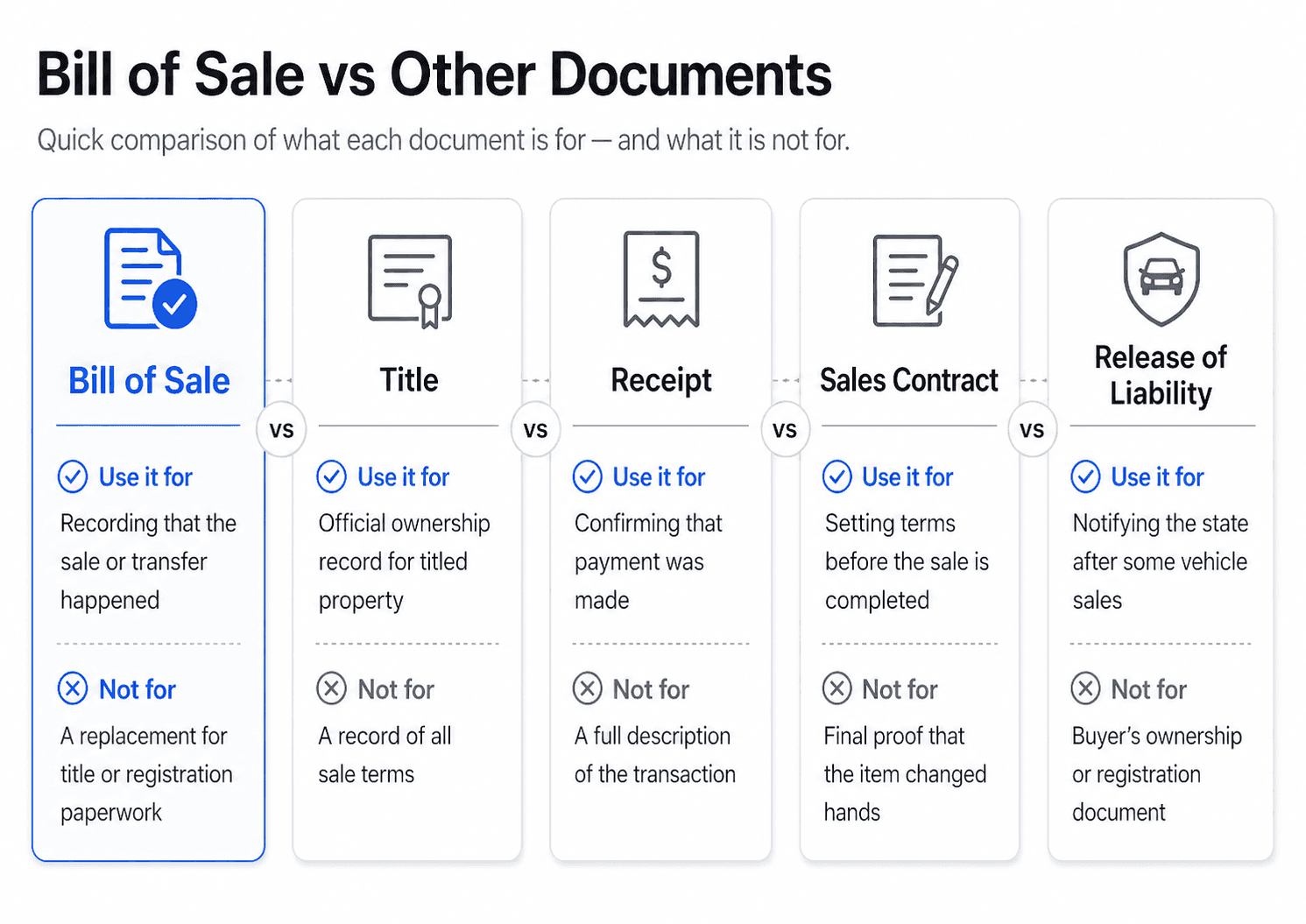
Document | Use it for | Do not use it as |
|---|---|---|
Bill of Sale | Recording that the sale or transfer happened | A replacement for title or registration paperwork |
Certificate of Title | Official ownership record for titled property | A record of all sale terms |
Receipt | Confirming that payment was made | A full description of the transaction |
Sales Contract / Purchase Agreement | Setting terms before the sale is completed | Final proof that the item changed hands |
Release of Liability | Notifying the state after some vehicle sales | Buyer’s ownership or registration document |
For titled property, the title process is separate from the Bill of Sale. Cornell Law School’s certificate of title overview explains that titles are commonly used for vehicles, boats, and similar property.
Some states also use seller-side notices after a vehicle sale. For example, California uses a Notice of Transfer and Release of Liability, which helps report that ownership or possession changed after a vehicle sale. California DMV instructions require the notice to be submitted within five calendar days of the transfer.
Bottom line: a Bill of Sale records the transaction. Other documents may still be needed to prove ownership, confirm payment, or complete state registration.
When Is a Bill of Sale Needed?
You typically need a Bill of Sale when the sale may need to be proven later — to the DMV, insurance company, tax office, accountant, or other party.
Use it when:
the item is a car, motorcycle, boat, trailer, mobile home, tractor, or equipment;
the item has a VIN, HIN, serial number, or model number;
the buyer needs documents for title, registration, insurance, taxes, or business records;
the item is so valuable that a dispute would be expensive;
the sale is private, for cash, or without dealer paperwork;
the item is being sold as-is;
payment involves a deposit, installments, or delayed pickup;
the transfer is a gift, or the price is significantly below market value.
For vehicles, boats, trailers, and other property that requires registration, check your state’s official requirements in the USA.gov State Motor Vehicle Services Directory before signing.
Rule: If the item is valuable, registered, titled, being sold as-is, or easy to dispute later, use a Bill of Sale.
What Should a Bill of Sale Include?
A Bill of Sale should make the deal clear without extra explanation. At minimum, include:
Buyer and seller details — full names, addresses, and contact information;
Item description — make, model, year, color, condition, or other identifying details;
Unique identifier — VIN, HIN, serial number, or model number;
Sale price — the amount paid, or a note that the transfer is a gift;
Payment terms — cash, bank transfer, deposit, installments, or paid in full;
Date and location — when and where the sale happened;
Condition terms — whether the item is sold as-is or with a warranty;
Included items — keys, spare parts, accessories, manuals, attachments, or tools;
Signatures — both parties should sign and keep a copy.
For vehicles, copy the VIN carefully and check it with the NHTSA VIN Decoder
if needed.
For boats, trailers, mobile homes, or other property, check the required fields for your state in the USA.gov State Motor Vehicle Services Directory.
As-Is vs. Warranty in a Bill of Sale
As-is means the buyer accepts the item in its current condition. This is common for used cars, boats, trailers, tools, equipment, and personal property.
A simple clause can say:
Buyer accepts the item in its current condition, with no warranties except those written in this Bill of Sale.
If the seller makes a promise, keep it specific. “Battery charger works at the time of sale” is clearer than “equipment is in good condition.”
“As-is” language does not protect the seller from fraud or hidden known defects. For general background, UCC § 2-316 explains how warranties may be excluded or modified, including requirements for conspicuous language in certain disclaimers.
Tip: Write down known defects, included accessories, and any promises before both sides sign.
How to Write a Bill of Sale
A Bill of Sale does not need complex legal language. It just needs accurate details.
Step 1: Choose the right form
Use a template that matches the item.
Step 2: Add the parties and item details
Fill in the buyer, seller, item description, and any key identifier.
Step 3: Record the price and terms
Add the sale price, payment method, transfer date, and whether the item is sold as-is or with a warranty.
Step 4: Check state requirements
Check whether your state requires a specific form, notary, or witness through the USA.gov State Motor Vehicle Services Directory.
Step 5: Sign and keep copies
Both parties should sign the document and keep a copy. Save a PDF version as well in case you need it later.
Common Bill of Sale Mistakes to Avoid
Most Bill of Sale problems come from small details that were missed before signing.
Avoid these common mistakes:
Wrong VIN, HIN, or serial number
Vague item description
No payment details
No as-is or warranty language
Missing signatures
Using only a generic form for registered property
Tip: Do not fix signed documents with white-out or silent edits. If something important is wrong, prepare a corrected version and have both parties sign it again.
Bill of Sale Templates by Type
Choose the template based on what you are selling:
Vehicle Bill of Sale — for cars, motorcycles, trucks, RVs, and other vehicle sales.
Boat Bill of Sale — for boats, personal watercraft, motors, and boat-related transfers.
Trailer Bill of Sale — for utility trailers, camper trailers, travel trailers, and similar property.
Equipment Bill of Sale — for tools, machinery, tractors, heavy equipment, and business assets.
General Bill of Sale — for furniture, electronics, collectibles, household items, and other personal property.
As-Is Bill of Sale — for sales where the buyer accepts the item in its current condition.
Gift Bill of Sale — for transfers where the item is given for free or for a symbolic price.
If the sale does not fit one category, start with a General Bill of Sale or create a tailored version with AI Lawyer.
FAQ
Q: What should I do if a buyer refuses to sign a Bill of Sale?
A: Take it as a warning sign. A Bill of Sale protects both parties, so a refusal could mean that the buyer doesn't want a clear record of the transaction. If the item is valuable, titled, registered, or being sold for cash, it's safer not to complete the sale without a signed document.
Q: Should I list any issues with the item if it's already sold as is?
A: Yes. "As is" helps, but a written record of defects makes the deal clearer. If the boat has a cracked seat, the trailer needs headlights, or the laptop battery is low, write it down. It’s harder for the buyer to later claim that the problem was hidden.
Q: What if the buyer pays now but picks up the item later?
A: Add a receipt date and state when ownership passes. Until the buyer actually picks up the item, there can be confusion about damage, storage, theft, or liability. A short line, such as “ownership passes [date/time],” can help prevent this.
Q: Can a Bill of Sale contract cover multiple items?
A: Yes, if the items are part of a single transaction. Clearly list each item, especially if they have serial numbers or accessories. For a large package, add an appendix or description to keep the main form from becoming cluttered.
Q: What if there are two sellers or two buyers?
A: Include everyone involved in the transaction. If the item is owned by two people, both must be listed, and both must sign. If two buyers are purchasing together, list both buyers so that the record reflects the actual transaction.