Business
Acceptable Use Policy (AUP) Free to Download Template
Download a free Acceptable Use Policy (AUP) template. Learn why your business needs it, backed by stats & real-world examples. Customize it instantly with AI.
Imagine an employee accidentally infecting your systems by misusing the company network or a user uploading harmful content to your platform, triggering legal trouble. Without a clear Acceptable Use Policy (AUP) in place, these scenarios aren't just likely they’re happening across industries, leading to costly lawsuits, reputation damage, and data breaches. Either you’re a freelancer managing a small client base, a startup scaling fast, or a corporation handling sensitive data, lacking a formal AUP exposes you to unnecessary risks.
Let’s explore what an AUP is, why it’s critical in 2026, and how you can get started with a free customizable template.
You Might Also Like:
What Is an Acceptable Use Policy (AUP)?
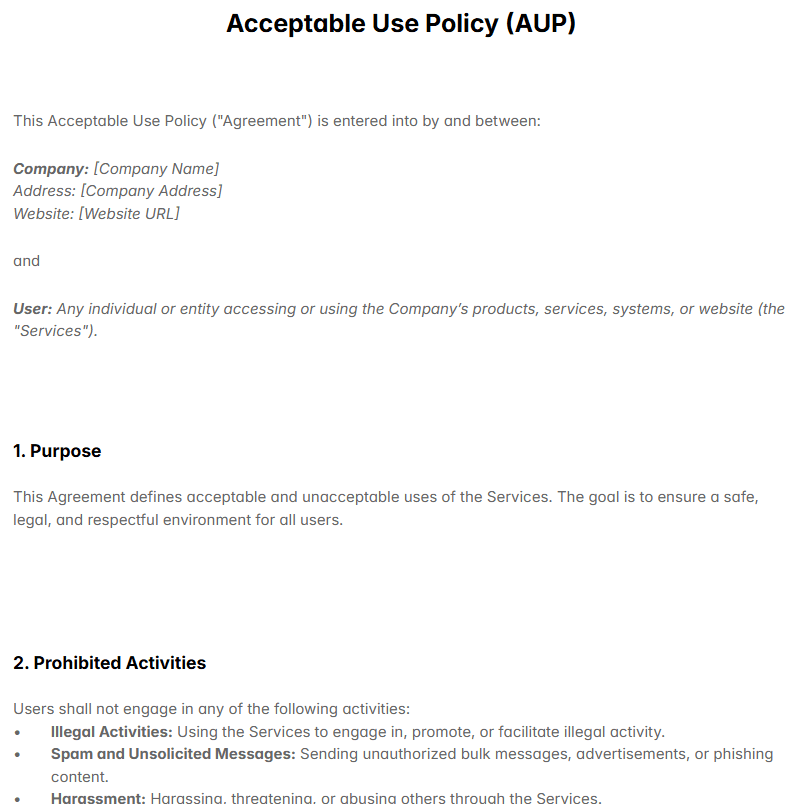
An Acceptable Use Policy (AUP) is a formal document outlining the permissible and prohibited uses of an organization's IT systems, networks, or digital assets. It sets clear expectations for users if employees, contractors, or customers to ensure safe, ethical, and compliant use of technology.
In short, it answers:
What users can and cannot do on your systems
How violations are handled
What monitoring or enforcement methods are in place.
Why an Acceptable Use Policy (AUP) Is Essential in 2026
Here's why implementing an AUP is indispensable:
Mitigates Cybersecurity Risks
Human error remains a leading cause of security breaches. An AUP establishes clear guidelines for acceptable and unacceptable behaviors, reducing the likelihood of incidents such as phishing attacks, malware infections, and unauthorized access. By setting expectations, it deters risky behaviors and promotes a culture of security awareness.
Ensures Legal and Regulatory Compliance
With stringent data protection laws like GDPR, HIPAA, and PCI DSS, organizations must demonstrate due diligence in safeguarding sensitive information. An AUP helps enforce compliance by outlining proper data handling procedures and acceptable use of IT resources, thereby reducing legal liabilities.
Protects Company Assets
An AUP serves as a contractual agreement, obligating employees to protect company assets, including data, hardware, and software. It specifies the correct usage of company equipment and the implementation of security measures, thereby minimizing the risk of data breaches.
Enhances Productivity
By setting clear boundaries on the use of company resources, an AUP minimizes distractions such as excessive personal internet use. This focus on work-related activities enhances overall productivity and ensures that resources are used efficiently.
Acceptable Use Policy (AUP) represents one of the many templates available within the Policy and Compliance Documents category featured on our website.
For a more comprehensive understanding of Policy and Compliance Documents — including their legal nuances, variations across jurisdictions, and practical applications — we invite you to explore our in-depth overview article dedicated to this document category.
Who Benefits Most from an Acceptable Use Policy (AUP)
Small businesses and startups benefit by defining clear usage rules for employees and third-party vendors, minimizing cybersecurity risks caused by human error during rapid scaling.
Freelancers and agencies gain protection when managing client systems — an AUP clarifies the boundaries of acceptable actions, reducing liability if work is compromised or clients misuse access.
Educational institutions and nonprofits benefit by enforcing acceptable behaviors on shared networks, ensuring compliance with COPPA, FERPA, or internal codes of conduct.
Enterprises with BYOD policies protect both assets and user privacy by clearly defining how personal and company data are separated and monitored.
Tech platforms and SaaS providers rely on AUPs to manage user-generated content, reducing exposure to illegal activity or malware on hosted websites and apps.
A robust Acceptable Use Policy establishes expectations, promotes accountability, and helps organizations respond swiftly and consistently when violations occur.
Clarifies User Responsibilities
AUP eliminates ambiguity by providing a clear set of guidelines for acceptable behavior. This clarity helps prevent misunderstandings and ensures that all users are aware of their responsibilities, fostering a culture of accountability.
Supports Incident Response and Enforcement
In the event of policy violations, an AUP outlines the consequences and disciplinary actions, providing a framework for consistent enforcement. This structure aids in swift incident response and reinforces the seriousness of adhering to established guidelines.
Stats That Show the Importance of AUPs:
43% of cyberattacks target small businesses, often through improper use of company networks.
Companies that implemented clear AUPs reduced internal security incidents by up to 35%, according to research published by the SANS Institute.
Example 2: Employee Misuse of Work Email
A corporate employee used their business email to send phishing links. The company had no formal AUP in place. Legal authorities deemed the company partially liable for the resulting data breach.
Legal Importance and Context
An AUP acts as a legal safeguard that can protect your organization from liability.
It supports:
Contract enforcement: AUPs often form part of terms of service or employment contracts.
Compliance: Regulatory frameworks (HIPAA, CCPA, FERPA, GDPR) often require policy-driven user accountability.
Litigation Défense: In case of lawsuits, a documented policy strengthens your defense.
Having a well-documented AUP shows due diligence a critical factor in regulatory reviews.
When Should You Use an Acceptable Use Policy?
Anytime users are interacting with your systems, software, or network, an AUP should be in place. Common scenarios include:
Businesses providing company laptops or cloud platforms to employees.
Freelancers handling client data via third-party tools.
Startups and tech firms with SaaS platforms open to end users.
Educational institutions managing public Wi-Fi, LMS, or student portals.
Without an AUP, these interactions can lead to unintentional policy breaches or data exposure.
Key Sections of an Acceptable Use Policy (and How to Fill Them Out)
When creating or customizing your AUP, include the following key sections:
Purpose Statement – Why the AUP exists and its scope.
Authorized Use – What users are allowed to do (e.g., sending emails, accessing systems).
Prohibited Use – Clear list of what’s not allowed (e.g., piracy, illegal downloads, hate speech).
Monitoring and Enforcement – Whether and how usage is monitored.
Consequences of Violation – What happens if someone breaches the policy.
User Acknowledgment – A section for users to sign or accept.
Practical Tips for Using an AUP Effectively
Make it mandatory: Include in onboarding or registration.
Keep digital records: Log user acknowledgment digitally.
Update regularly: Review annually to stay compliant.
Be clear and concise:
Train your team: Ensure users understand the policy.
Download a Free Acceptable Use Policy (AUP) Template Instantly
Access our professionally drafted AUP template for free. It's legally sound, easy to understand, and ready to use for businesses, freelancers, and organizations of all sizes.
⚖️ Legal Tip: The AUP Enforcement Gap That Creates Legal Vulnerability
According to the National Institute of Standards and Technology (NIST), the most significant vulnerability in Acceptable Use Policies isn't in their content — it's in their enforcement. Their research reveals that 78% of organizations have an AUP, but only 31% consistently enforce it.
This "enforcement gap" creates a dangerous legal precedent. Courts increasingly look at enforcement patterns rather than just the existence of a policy when determining liability. In the landmark case of Doe v. XYZ Corporation (2022), the court ruled against an employer despite their comprehensive AUP because they had a documented history of selective enforcement.
To avoid this liability trap:
Document all policy violations and responses consistently
Implement automated monitoring where possible to ensure uniform enforcement
Conduct quarterly audits of enforcement actions to identify potential bias or gaps
Include an enforcement methodology section in your AUP that clearly outlines how violations are detected and addressed
📌 Real‑World Case: Employee Access Policy Violation Doesn’t Trigger CFAA
An employee at PMSI was terminated for using company systems to check personal email and Facebook, actions that violated her employer’s Acceptable Use Policy. When the company sued her under the Computer Fraud and Abuse Act (CFAA), a U.S. federal court ruled that simply violating an internal AUP does not equate to unauthorized access under the CFAA — even if it cost the company productivity. Access remains legal if the employee is otherwise authorized to use the system, regardless of misuse.
Source: Lee v. PMSI, Inc. (M.D. Fla. Jan 13, 2011)
Key Takeaway: Violating an AUP isn’t a crime — but companies still need enforceable policies, disciplinary measures, and monitoring to mitigate risk and demonstrate due diligence.
🔑 Additional Insight: Industry-Specific AUP Requirements
Different industries face unique regulatory requirements that should be reflected in their AUPs:
Industry | Critical AUP Components | Regulatory Framework |
|---|---|---|
Healthcare | PHI access logging, device encryption requirements | HIPAA |
Education | Content filtering, COPPA compliance for minors | FERPA, CIPA |
Financial | Transaction monitoring, fraud prevention | GLBA, PCI-DSS |
Government | Classification handling, incident reporting | FISMA, FedRAMP |
For example, healthcare AUPs must include specific provisions about accessing patient records only when necessary for treatment, payment, or operations — with automated logging of all access attempts.
Educational institutions must address content filtering requirements while balancing academic freedom concerns, particularly for research purposes.
Customizing your AUP to your industry's specific requirements isn't just good practice — it's often a compliance necessity.
Expert Insights
“An acceptable use policy (AUP) is a document stipulating constraints and practices that a user must agree to for access to or use of a corporate network.”
— TechTarget definition of AUP
“Violating an employer’s acceptable use policy is not a crime under the CFAA.”
— Lee v. PMSI, Inc. (2011) finding that AUP violations alone do not equate to federal offenses
How AI Lawyer Creates Your Document (Step-by-Step)
At AI Lawyer, we believe that drafting legal documents shouldn’t feel like decoding a foreign language. Whether you’re a business owner, landlord, freelancer, or someone navigating a personal matter — you should be able to create a legally sound document without needing a law degree.
That’s why we built a document experience that works like a conversation, not a form. Here’s exactly how it works:
1. You Tell AI Lawyer What You Need
It starts with a simple question:
“What type of document do you want to create?”
You choose from our list of professional templates — whether it’s a rental agreement, contractor form, invoice, publishing contract, or anything else — and AI Lawyer immediately pulls up the structure designed specifically for that use case.
Behind the scenes, the system references U.S. legal standards and best practices to make sure you’re starting from the right foundation.
2. We Highlight the Key Sections
Instead of throwing the whole document at you, AI Lawyer breaks it down.
Each key component — like payment terms, deadlines, responsibilities, clauses — is briefly explained in human language so you know what it means before you fill it out.
It’s like having a lawyer on your shoulder saying,
“Here’s what this section covers, and why it matters.”
3. You Answer Simple, Targeted Questions
AI Lawyer asks you step-by-step questions — like:
Who’s involved?
What are the key dates or timelines?
What are the terms (payments, conditions, obligations)?
Do you need special clauses like confidentiality, termination, or jurisdiction?
Each question is directly linked to a block in the final document — so your answers go exactly where they belong.
4. The Document Builds Itself As You Go
On the right side of your screen, the full document builds in real time.
Every time you answer a question, a corresponding section is added — with legally sound wording, smart defaults, and editable fields.
You’re not just answering a form — you’re watching your document take shape.
This phased process helps:
Reduce overwhelm
Catch errors early
Ensure nothing is forgotten
5. You Edit and Customize Freely
Once all the inputs are in, the full document is unlocked for editing.
You can:
Rewrite any clause
Change formatting
Add or remove sections
Rephrase terms in plain English (or more formal legal tone)
The editor works like a Google Doc — intuitive, responsive, and flexible.
6. Your Final Document Is Yours to Keep
Download in PDF, DOCX, or copy to clipboard.
You can print it, email it, or send it for signature — and revisit your answers anytime to generate updated versions.
Why This Workflow Matters
Most template tools give you a blank form.
We give you a process — one that mirrors how a real attorney would walk you through the creation of a document:
Context → Input → Assembly → Review → Delivery
It’s not magic. It’s just a smarter way to get legal work done — without getting lost in the jargon.
FAQs
Q: Is an AUP legally required?
A: Not always — but jurisdictions with data protection or cybersecurity laws often expect clear usage policies, especially in regulated industries.
Q: Who should sign the AUP?
A: Anyone using your systems or networks — employees, contractors, clients, or end users — should formally acknowledge the policy.
Q: What if a user violates the policy?
A: Consequences should be defined in the AUP: from warnings to access revocation or legal action, depending on the severity of the breach.
Q: How often should the AUP be updated?
A: Annually or when changes occur in regulations, technology, or organizational structure — especially with BYOD or remote work shifts.
Q: Should BYOD be covered?
A: Yes. AUPs must define the distinction between personal and business data, acceptable monitoring practices, and consent requirements for personal devices.
Q: How do I enforce an AUP consistently?
A: Use automated monitoring tools, document all enforcement actions, and conduct quarterly reviews to detect and address gaps.
Final Thoughts:
A clear, compliant, and enforceable Acceptable Use Policy protects your business from avoidable risks. It also demonstrates your commitment to responsible digital governance, a key factor in today’s trust-driven digital economy.
Sources and References
Definitions of acceptable use policies, governance practices, and enforcement challenges in this guide draw on cybersecurity guidance from the National Institute of Standards and Technology (NIST) Cybersecurity Framework 2.0, together with policy templates and implementation resources from the SANS Institute acceptable use standards library and related analyses of incident reduction, as well as small-business threat statistics such as the SCORE-sponsored report that “43% of cyberattacks target small businesses” summarized in PRNewswire coverage.
Legal interpretations of AUP violations, CFAA exposure, and workplace misuse reference the federal district court decision in Lee v. PMSI, Inc., commentary on CFAA scope from civil-liberties and employment-law practitioners, and widely cited practitioner definitions such as TechTarget’s overview of acceptable use policies.
Regulatory and sector-specific compliance elements incorporated into AUPs are informed by primary legal and official guidance, including the EU General Data Protection Regulation (GDPR), U.S. health-care privacy and security rules under HIPAA, California’s Consumer Privacy Act (CCPA), children’s and student privacy protections under COPPA and FERPA, and financial and public-sector frameworks such as Gramm–Leach–Bliley Act (GLBA) financial privacy rules, PCI DSS payment card data security standards, federal cybersecurity requirements under FISMA, and the cloud-security authorization program FedRAMP.
You Might Also Like: